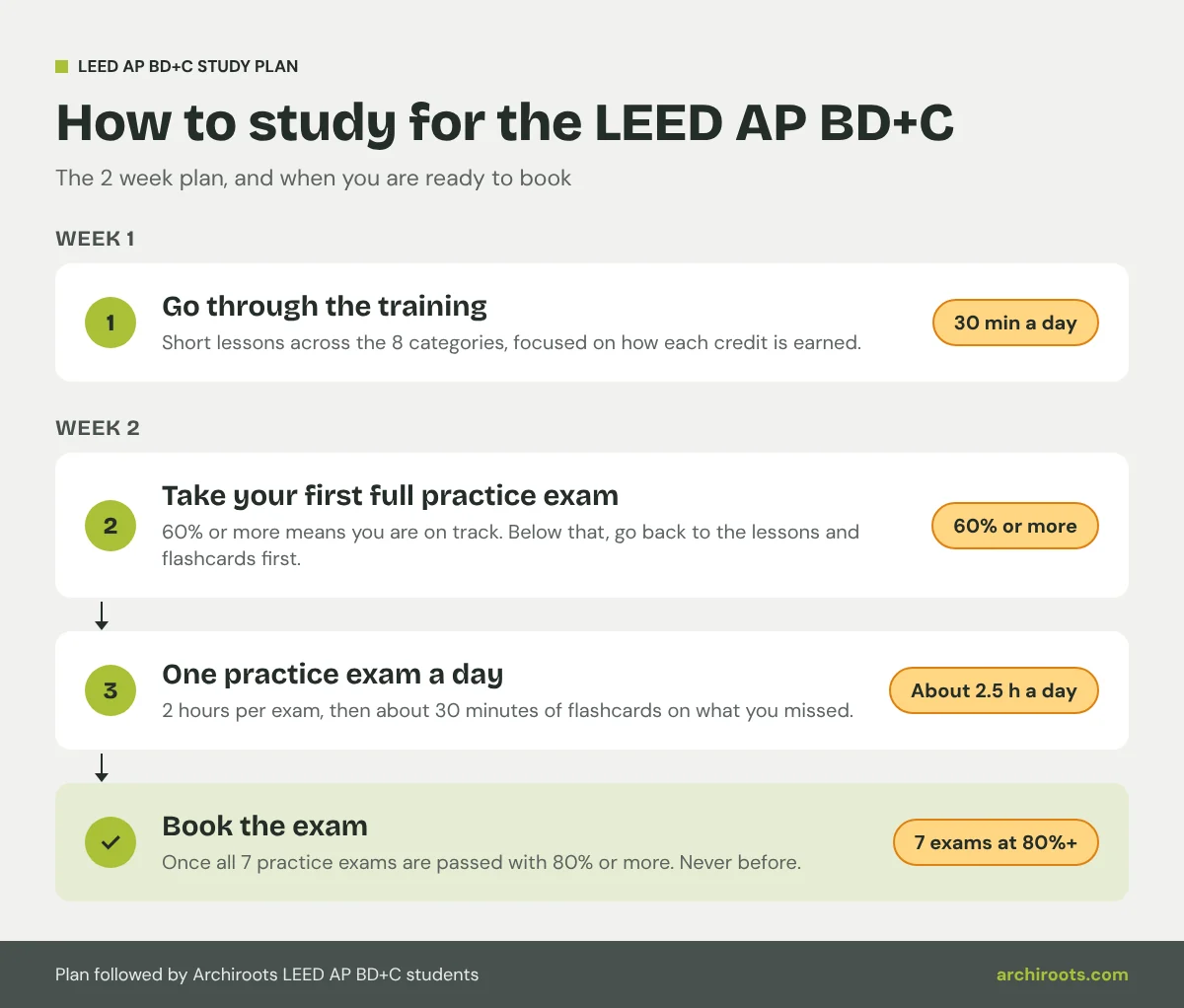
Most people pass the LEED AP BD+C v5 exam after about 2 weeks of study with archiroots, and this LEED AP BD+C study guide follows that plan. A first week of LEED AP BD+C training at about 30 minutes a day, then a second week with one of the 7 LEED AP practice exams a day and 30 minutes of LEED AP BD+C flashcards. You are ready to book when you have passed all 7 with 80% or more on each. Put most of your time into Energy and Atmosphere, Materials and Resources and Indoor Environmental Quality, which together make up 44 of the 85 scored questions. The 15 other questions are pretest, and don’t contribute to your score.
This guide is for architects, engineers, contractors, consultants and students preparing for the BD+C specialty on LEED v5. It covers the study plan, where the points are, why people fail, the numbers you have to memorize and what changed from v4.
| Detail | LEED AP BD+C exam |
|---|---|
| Version | LEED v5 |
| Questions | 100 multiple choice, 85 of them scored |
| Time | 2 hours, about 72 seconds per question |
| Passing score | 170 on a scale of 125 to 200 |
| Before you can sit it | An active LEED Green Associate credential |
| LEED project experience | Recommended, not required |
Start with the free LEED AP BD+C practice exam: 100 questions on LEED v5, an instant score and an explanation for every answer. Your score shows how far you are from ready.
How long does it take to study for the LEED AP BD+C?
Anywhere from 1 week to 3 months, depending on your pace. Any pace works as long as you finish the training material and all 7 practice exams, with flashcard review along the way. Two weeks is very doable:
| Week | What you do | Time per day |
|---|---|---|
| Week 1 | Go through the training material | About 30 minutes |
| Week 2 | One full practice exam a day, then review the flashcards | About 2.5 hours |
The second week is the heavier one, because a full practice exam takes 2 hours. People who study only on weekdays sometimes try to fit two practice exams into one day. That is about 4 hours, it is hard to keep up and much of it does not stick, so they usually end up taking 3 weeks anyway.
Where to spend your study time
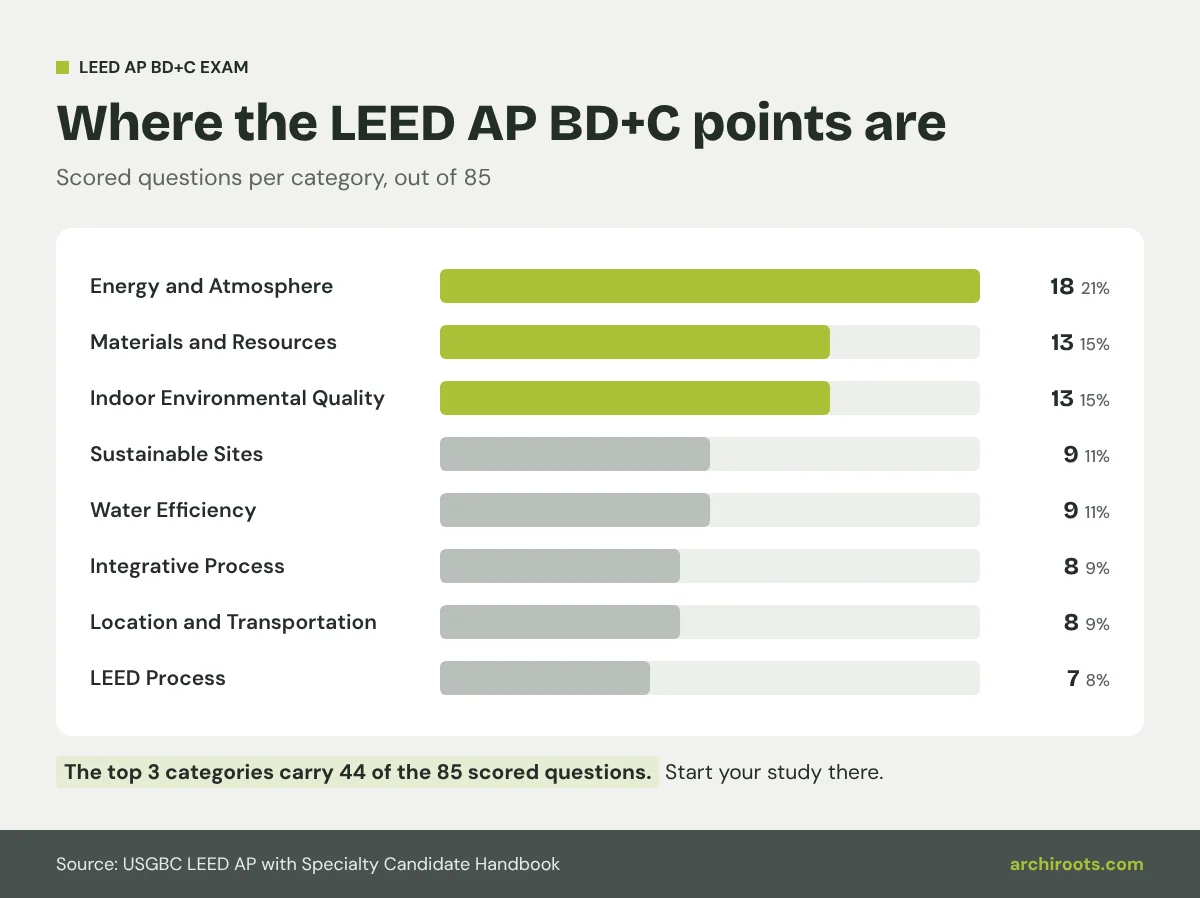
The candidate handbook lists how many scored questions come from each category. Energy and Atmosphere alone is 18 questions, about 21% of your score, and the top three categories together are just over half. Start there.
| Category | Scored questions | Share of the score |
|---|---|---|
| Energy and Atmosphere | 18 | 21% |
| Materials and Resources | 13 | 15% |
| Indoor Environmental Quality | 13 | 15% |
| Sustainable Sites | 9 | 11% |
| Water Efficiency | 9 | 11% |
| Integrative Process, Planning and Assessments | 8 | 9% |
| Location and Transportation | 8 | 9% |
| LEED Process | 7 | 8% |
Why people fail the LEED AP BD+C exam
The content is still LEED, the same as the Green Associate, only in more depth. The Green Associate checks that you understand a credit. The BD+C checks that you know how a project earns it: the formulas, the thresholds, the distances and how many points each level is worth, across every credit.
Most questions are written as real project scenarios with extra detail you do not need, like a healthcare project whose owner cannot decide which compliance path to take. Many candidates feel overwhelmed by the extra information. The most common reason people fail is too little practice, because the skill you need is spotting the key facts in a long question and ignoring the rest, and only full practice exams build it.
Missing project experience is rarely the problem. Most people sit the BD+C without having worked on a LEED project, and some have no work experience at all. Someone who has worked on one has usually handled a few credits, so those calculations feel familiar, and that is the only head start it gives. With proper training you will not be at a disadvantage. More on experience and eligibility is in what is a LEED AP.
What a BD+C question looks like
A mall is being built in New York City. The combined density within a quarter mile of the project boundary is 30,000 square feet per acre of buildable land. How many points can it earn under Surrounding Density?
The answer is 1 point. In LEED v5, the combined density table gives 1 point from 22,000 square feet per acre and 2 points from 35,000. The trap is that 30,000 is also the minimum for previously developed rural healthcare campuses, a separate path in the same credit that does not apply to a mall.
Change the question to separate densities: 8 dwelling units per acre and a nonresidential floor area ratio of 0.6. That is also 1 point. Both values clear the 1 point minimums of 7 and 0.5, and neither reaches the 2 point values of 12 and 0.8.
The numbers you have to memorize
To answer a question like that, you need two things for each credit: whether the project qualifies at all, and how many points it earns at each level. A few examples from LEED v5 BD+C:
| Credit | What to know |
|---|---|
| Surrounding Density | Measured within 0.25 miles (400 meters). Combined: 22,000 square feet per acre for 1 point, 35,000 for 2. Separate: 7 dwelling units per acre and a floor area ratio of 0.5 for 1 point, 12 and 0.8 for 2 |
| Access to Transit | Stops within 0.25 miles walking distance for buses and streetcars, 0.5 miles for bus rapid transit, rail and ferries. Weekday and weekend trips from 72 and 30 for 1 point up to 360 and 216 for 4 points |
| Enhanced Water Efficiency | Whole project path: a 30% reduction for 1 point, then 1 more point for every extra 5%, so 50% earns 5 points and 65% earns 8 |
| Fundamental Refrigerant Management | No HCFC refrigerants in new equipment. In v4 the prerequisite only banned CFCs, and avoiding HCFCs earned a credit |
The Green Associate never asked for numbers like these. The LEED AP BD+C flashcards cover the full set for daily review.
When are you ready to book the exam?
Take your first full practice exam after the training. Around 60% or more means you are on track, so carry on with one exam a day; below that, go back to the lessons and flashcards first. You are ready when you have passed all 7 full practice exams with 80% or more, with flashcard review of your mistakes between them. Do not book before you get there.
Can you still study from LEED v4 material?
No. The BD+C exam is now based on LEED v5, and much of it changed: credit names, categories, merged credits, new prerequisites and new credits. The total stays at 110 points, spread differently.
| LEED BD+C New Construction | v4 | v5 |
|---|---|---|
| Prerequisites | 12 | 16 |
| Credits | 43 | 33 |
| Total points | 110 | 110 |
The biggest shift for the exam is the focus on impact areas. Integrative Process is much larger, with new prerequisites for climate resilience, human impact and carbon assessments. Carbon and electrification are new topics too: Energy and Atmosphere now has Electrification and Reduce Peak Thermal Loads credits, and Materials and Resources covers embodied carbon. Names changed as well (Green Vehicles is now Electric Vehicles), and some requirements got stricter, like the refrigerant prerequisite above. The full credit by credit comparison is in the LEED v5 guide.
LEED AP BD+C study materials
| Material | Free or paid | What it is good for |
|---|---|---|
| Free LEED AP BD+C practice exam | Free | A first diagnostic: 100 questions on LEED v5 with explanations |
| Candidate Handbook | Free | The exam rules and the questions per category |
| Free LEED AP BD+C ebook | Free | The exam facts and the 2 week plan in one PDF |
| LEED v5 reference guide | Paid | Looking up a credit, not studying for the exam |
| LEED AP practice exams | Paid | 7 full v5 exams, 700 questions with explanations |
| LEED AP BD+C flashcards | Paid | 500 v5 cards for the numbers and thresholds |
| LEED AP BD+C exam prep | Paid | The training, the 7 practice exams and the flashcards, following the plan above |
Get the free LEED AP BD+C ebook
The free Archiroots LEED AP BD+C ebook is a short PDF with the exam facts, how BD+C compares with ID+C, the 2 week plan and links to the free resources.
Why BD+C is the specialty most people choose
Most LEED projects are BD+C projects, so BD+C is the specialty employers ask for most, and demand has grown with LEED v5. The USGBC people directory shows the gap: 25,446 people listed hold the LEED AP BD+C, against 2,480 for O+M and 2,134 for ID+C.
The credential makes your resume more credible. It tells employers and clients you can design and build to LEED principles and help a project through certification. It will rarely be the only reason for a promotion, but it often helps you land a more senior role or a raise, and your company can say its team includes a LEED AP.
LEED v5 also gives a project 1 point for having a LEED AP on the team. That point is rarely why someone gets hired, since most projects already have a sustainability consultant who brings it. Firms hire LEED APs to run the process and build to the standard. Whether the credential is worth it for you is covered in what is a LEED AP.
Frequently asked questions
How do you pass the LEED AP BD+C exam?
Finish the training, then take full practice exams until you pass all 7 with 80% or more, reviewing your mistakes with flashcards between them. Spend the most time on Energy and Atmosphere, Materials and Resources and Indoor Environmental Quality, which carry 44 of the 85 scored questions.
How many practice exams should I take before the LEED AP BD+C?
All 7 full practice exams, passing each one with 80% or more. One a day during your second week of study is a good pace.
Which LEED AP BD+C topics have the most questions?
Energy and Atmosphere has 18 scored questions, about 21% of the score. Materials and Resources and Indoor Environmental Quality follow with 13 each.
Is the LEED AP BD+C exam hard?
Yes, mainly because of the volume of material and the scenario style of the questions. The concepts are the same LEED concepts as the Green Associate. Most people who fail did too little practice.
Is there a free LEED AP BD+C study guide PDF?
Yes. Archiroots offers a free LEED AP BD+C ebook in PDF with the exam facts and the 2 week plan, and the USGBC candidate handbook is free. Avoid free PDFs of v4 study guides, since the exam is now on LEED v5.
How many people hold the LEED AP BD+C?
The USGBC people directory lists 25,446 LEED AP BD+C holders, about ten times as many as O+M or ID+C.