There is no single LEED exam. There are six, one for each LEED professional credential, and the move to LEED v5 changed most of them, something much of the study material online has not caught up with. This guide covers all of them from the GBCI candidate handbooks and USGBC’s exam information pages: which exam fits which career, the format and scoring, what each exam actually tests by knowledge domain, fees and discounts, how registration and scheduling work, what the move to v5 means for candidates, retake and rescheduling rules, and how the credential ladder and maintenance work afterwards.
| The short answer: A LEED exam is a 100 question, two hour, computer based test administered by Green Business Certification Inc. (GBCI) and delivered by Prometric at a test centre or online. A scaled score of 170 out of 200 passes. The LEED Green Associate exam has no prerequisites and costs $250 ($200 for employees of USGBC member organizations). Each LEED AP with specialty exam requires an active Green Associate and costs $350 ($250 for member employees). There are no fixed exam dates: candidates register at usgbc.org and book any available slot at prometric. The Green Associate, AP BD+C, AP O+M and AP ID+C exams are based on LEED v5, and each candidate handbook names the rating system version its exam tests. |
Which LEED exam do you need?
The exam follows the credential, and the credential follows the work. Passing any of the six exams makes the person LEED accredited; buildings are the ones that get certified, under the LEED certification requirements and levels covered separately, and the exams test that distinction.
| Exam | Credential earned | Prerequisite | Best fit | Holders, Sept 2026 |
| LEED Green Associate | LEED Green Associate | None | Anyone entering green building; required first step for every AP | 23,388 |
| LEED AP BD+C | LEED AP Building Design and Construction | Active Green Associate | Architects, engineers, contractors, consultants on new construction and major renovation | 25,591 |
| LEED AP O+M | LEED AP Operations and Maintenance | Active Green Associate | Facility and asset managers, existing building owners | 2,498 |
| LEED AP ID+C | LEED AP Interior Design and Construction | Active Green Associate | Interior designers, tenant fit out teams | 2,140 |
| LEED AP ND | LEED AP Neighborhood Development | Active Green Associate | Urban planners, master planners, developers | 780 |
| LEED AP Homes | LEED AP Homes | Active Green Associate | Home builders, residential designers | 574 |
GBCI has also offered a combined exam that covers the Green Associate and an AP specialty in one four hour session. USGBC’s exam information page shows whether it is currently available; when it is not, the Green Associate comes first as its own exam. BD+C holds more credentials than the other four specialties combined, which is why it is the default for anyone in design or construction; the LEED AP BD+C page covers that exam and the LEED AP O+M page covers the operations specialty, and the LEED AP ID+C page covers interior fit-outs. For a role by role decision, see LEED GA vs LEED AP vs WELL AP.
The LEED certification test
Many people search for a “LEED certification test” when they mean the LEED Green Associate exam, or one of the LEED AP exams. There is no test for LEED certification itself. Buildings are certified after GBCI reviews their documentation, and people become accredited by passing an exam, so a professional who says they are LEED certified has passed one of the six exams above.
All six use the same test. It is computer based and closed book, with 100 multiple choice questions in two hours, taken at a Prometric test center or online. Only 85 of the questions count toward the score, which is scaled from 125 to 200, and a 170 passes. The format section below gives the details for each exam.
Most people take the LEED Green Associate first because it has no prerequisites and every AP specialty requires it. Before paying the exam fee, the free LEED Green Associate practice exam runs 100 questions in the same format and shows how close a candidate is to the pass mark.
How to get LEED certified as a professional
The path is the same for every credential:
- Choose the credential that fits the work. Everyone needs the LEED Green Associate, either first or in a combined sitting with an AP exam. After that, people who work on new buildings usually add the LEED AP BD+C, facility managers the LEED AP O+M, and interior designers the LEED AP ID+C.
- Prepare for the exam. Self study from the official references typically takes 8 to 12 weeks. A structured exam prep course with practice exams cuts that to about two weeks at 30 minutes a day.
- Create an account at usgbc.org, apply for the exam under Credentials and pay the fee. The eligibility ID sent after payment stays valid for twelve months.
- Book a Prometric test center or an online session at prometric.com/gbci, then sit the exam.
- Keep the credential active with continuing education: 15 hours every two years for the Green Associate and 30 for a LEED AP. Several ways to earn free LEED CE hours count toward that total.
The registration section below covers the details that cost people their exam fee, such as the name on the USGBC account not matching the ID shown on exam day.
Who runs the LEED exam
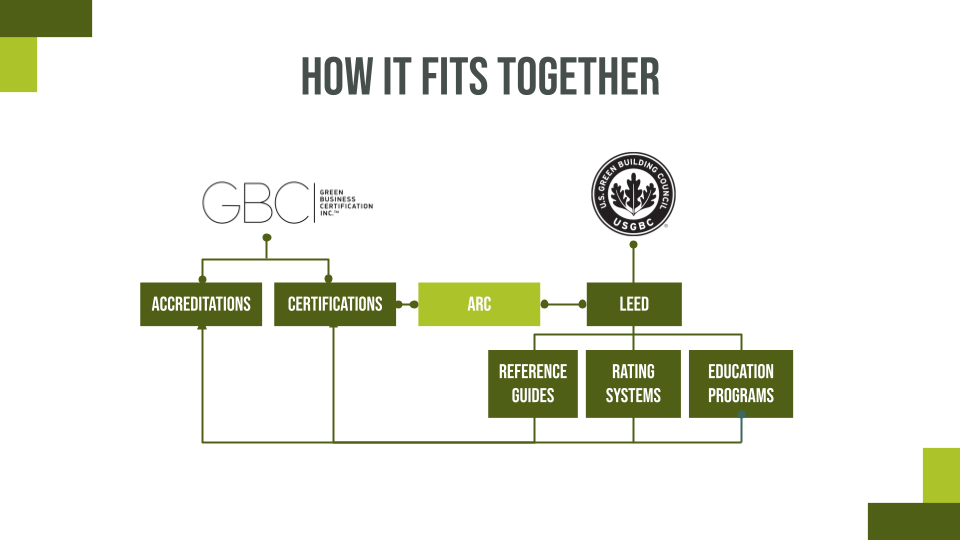
Two organizations share one login, which is where most confusion starts. The U.S. Green Building Council (USGBC) writes LEED: the rating systems, reference guides and education. GBCI verifies against LEED: it certifies projects and it writes, delivers and grades the professional exams. The exams are developed from a job task analysis after each rating system version is ratified, written by a global network of subject matter experts, and accredited under ISO 17024. Registration happens inside a free usgbc.org account, the exam is booked with Prometric, and the credential is issued by GBCI. USGBC’s own overview is on its LEED professional credentials page.
LEED exam format and scoring
Every LEED exam has the same shape: 100 multiple choice questions, 85 of them scored, two hours, and a scaled passing score of 170 out of 200. What changes between exams is the depth of the questions and how the 85 scored questions are spread across knowledge domains.
| Green Associate | AP with specialty (all five) | |
| Questions | 100 multiple choice, one correct answer each | 100 multiple choice, one correct answer each |
| Scored versus unscored | 85 scored, 15 unscored pretest items placed at random | 85 scored, 15 unscored pretest items placed at random |
| Time | 2 hours (plan for 2 hours 20 minutes with tutorial and survey) | 2 hours (plan for 2 hours 10 minutes) |
| Score scale | 125 to 200, scaled | 125 to 200, scaled |
| Passing score | 170 | 170 |
| Question types | Recall, application and analysis | Recall, application and analysis |
| Format | Closed book, computer based, questions can be flagged and revisited | Closed book, computer based, questions can be flagged and revisited |
| Delivery | Prometric test centre or ProProctor online | Prometric test centre or ProProctor online |
| Age | Under 18 allowed with parental consent form | 18 or older |
| Result | On screen at the end of the exam, except during a beta phase for a new exam version | On screen at the end of the exam, except during a beta phase for a new exam version |
Two things about scoring that candidates get wrong. First, 170 is a scaled score, not 85 correct answers; the scale adjusts for the difficulty of the specific question set, so the raw number of correct answers needed varies slightly from exam to exam. Second, GBCI does not modify scores under any circumstances. A successful challenge to a faulty question earns a free retest, not a corrected score, and the challenge must be lodged through the comment button during the exam and confirmed by email to GBCI within ten business days.
What each LEED exam tests: knowledge domains by exam
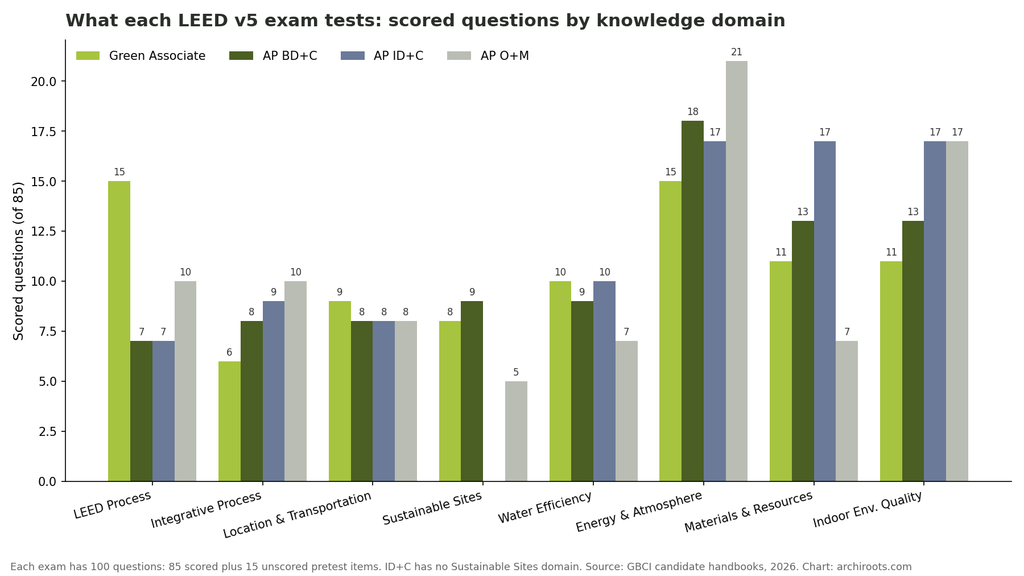
The candidate handbooks publish the number of scored questions per domain. Read across the row and the pattern is clear: Energy and Atmosphere is the heaviest domain on every v5 exam, the Green Associate is the only exam where LEED Process carries as much weight as energy, and the AP exams shift the weight toward the credit categories a practitioner has to document.
| Knowledge domain | Green Associate v5 | AP BD+C v5 | AP ID+C v5 | AP O+M v5 |
| LEED Process (and Project Priorities for ID+C) | 15 | 7 | 7 | 10 |
| Integrative Process, Planning and Assessments | 6 | 8 | 9 | 10 |
| Location and Transportation | 9 | 8 | 8 | 8 |
| Sustainable Sites | 8 | 9 | not tested | 5 |
| Water Efficiency | 10 | 9 | 10 | 7 |
| Energy and Atmosphere | 15 | 18 | 17 | 21 |
| Materials and Resources | 11 | 13 | 17 | 7 |
| Indoor Environmental Quality | 11 | 13 | 17 | 17 |
| Scored questions | 85 | 85 | 85 | 85 |
The weighting also predicts where candidates struggle. In Archiroots cohorts, Green Associate candidates lose the most practice exam points in LEED Process, the domain that looks easiest and is tested hardest, with 15 scored questions on organizational roles, certification steps, interpretations and rating system selection. AP BD+C candidates lose them in Energy and Atmosphere and Materials and Resources, the two heaviest domains on that exam. AP O+M candidates lose them in Energy and Atmosphere and Indoor Environmental Quality, which together carry 38 of the 85 scored questions.
AP Homes and AP ND follow the category structure of their own rating systems, which differs from the v5 exams above. The full outlines are in the AP with specialty candidate handbook and the Green Associate candidate handbook. Any prep material that does not map its lessons to these domains is not built for the current exam.
LEED exam cost
The LEED Green Associate exam costs $250 and each LEED AP with specialty exam costs $350, with $50 and $100 off respectively for employees of USGBC member organizations. A retake costs the full fee again.
| Exam | Standard fee | USGBC member employee | Student |
| LEED Green Associate | $250 | $200 | $100 |
| LEED AP with specialty | $350 | $250 | not offered |
| Combined Green Associate + AP | $550 | $400 | not offered |
Member pricing applies to employees of organizations holding a Silver, Gold or Platinum USGBC membership, and the membership has to be linked to the usgbc.org account before registering; it cannot be applied afterwards. USGBC’s individual membership states explicitly that it does not include exam discounts. Organizations registering five or more candidates at once contact GBCI directly, which is the route firms use with group training.
The fee buys one attempt. A retake is a new registration at the full fee, and after three unsuccessful attempts inside twelve months GBCI imposes a 90 day wait before the next registration. Rescheduling and cancellation follow a sliding scale:
| Days before the exam | Cancel | Reschedule |
| 46 days or more | Free | Free |
| 30 to 45 days | $30 fee | $30 fee |
| 4 to 29 days | $60 fee | $60 fee |
| 0 to 3 days | Not permitted, fee forfeited | Not permitted, fee forfeited |
LEED exam dates and registration
There are no universal LEED exam dates. The exams are on demand. A candidate registers, receives an eligibility ID that stays valid for twelve months, and books any available appointment at a Prometric test centre or an online ProProctor session. The sequence:
- Create a free account at usgbc.org. The first and last name must match the government ID that will be shown on exam day, in Roman characters, with no accents or special characters. A mismatch means being turned away and forfeiting the fee unless GBCI is told at least ten business days ahead. This is the single most common way candidates from Arabic, Persian and Turkish speaking countries lose an exam fee.
- Under Credentials, choose the exam and complete the application. Employees of member organizations link the membership first. Pay the fee.
- Use the eligibility ID at prometric.com/gbci to schedule. Choose a test centre or an online session, then the date and time. Prometric lists times in AM and PM; a 01:00 slot is one in the morning.
- For online testing, download ProProctor a week ahead using the 16 digit confirmation number, run the system readiness check, and prepare the room: one screen, an external camera for desktops, no paper, no physical calculator, windows covered, nobody else entering.
- Arrive or log in 30 minutes early. At a test centre, expect a metal detector, pockets emptied and sleeves rolled. Online, expect a 360 degree room scan by a readiness agent. Breaks stop nothing: the clock keeps running at a centre and breaks are not permitted at all online.
- Finish and read the pass or fail result on screen. During a beta phase for a new exam version, results arrive later instead. The credential appears in the usgbc.org account and the certificate downloads as a PDF once results are processed.
Exam day habits that separate a comfortable pass from a stressful one, drawn from Archiroots cohorts: answer every question because unscored items are indistinguishable and there is no penalty for guessing; flag and move on, then return with banked time, since 100 questions in 120 minutes is 72 seconds each; read scenario questions for the phase of the project before the answer options; use the optional tutorial minutes to settle rather than skip them; and treat the practice exam score, not the calendar, as the booking trigger.
Candidates unsure about the interface can pay for a GBCI Test Drive through Prometric, a short session that reproduces the check in and testing platform without exam content. Testing accommodations for documented disabilities are free but must be requested at registration with two forms, and scheduling is blocked until GBCI approves them, which can take ten business days.
LEED v5 and the LEED exams
The LEED Green Associate, AP BD+C, AP O+M and AP ID+C exams are based on LEED v5. GBCI moves an exam to a new rating system version through a beta phase: the exam is offered in English, the combined format can be paused, and results are released after GBCI’s analysis instead of on screen. USGBC keeps the current dates and the version of each exam on its LEED v5 exam information page.
For anyone registering now, the exam is the version listed in its candidate handbook, and an older version cannot be chosen instead. Anyone who needs the credential by a fixed date during a beta phase should plan around the results date USGBC publishes, not the exam date. Existing credential holders retake nothing: a LEED AP earned under v4 is the same credential and continues with normal maintenance.
One consequence for study material: much of what still ranks online for these exams was written for v4 and teaches a category structure the v5 exam no longer uses. The Green Associate and AP BD+C programs on this site are built on v5; check the version before trusting anything else.
The LEED accreditation ladder
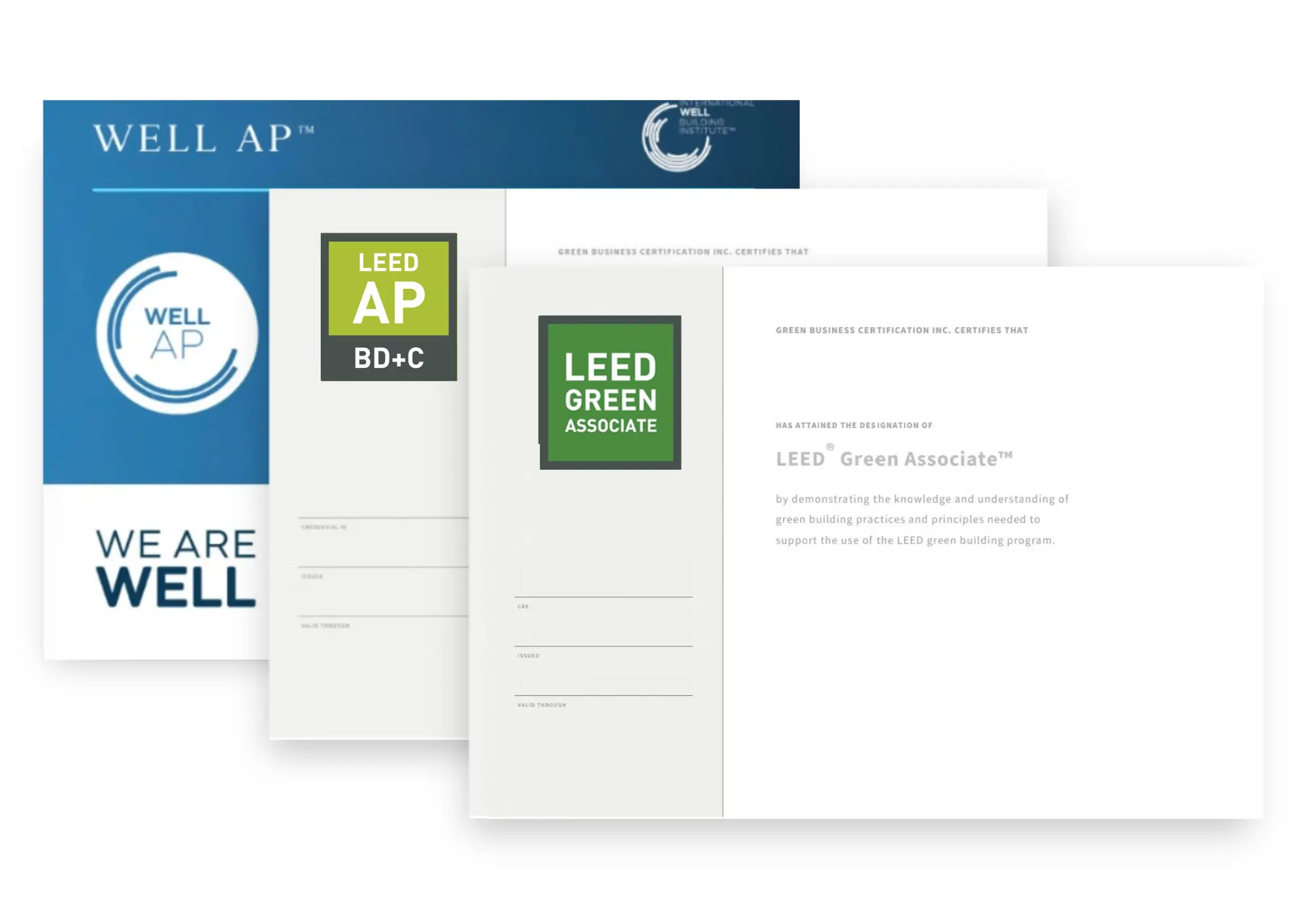
LEED accreditation has three tiers: the LEED Green Associate, earned by exam with no prerequisites; the LEED AP with specialty, earned by exam after the Green Associate; and LEED Fellow, awarded by nomination. A person is accredited, a building is certified.
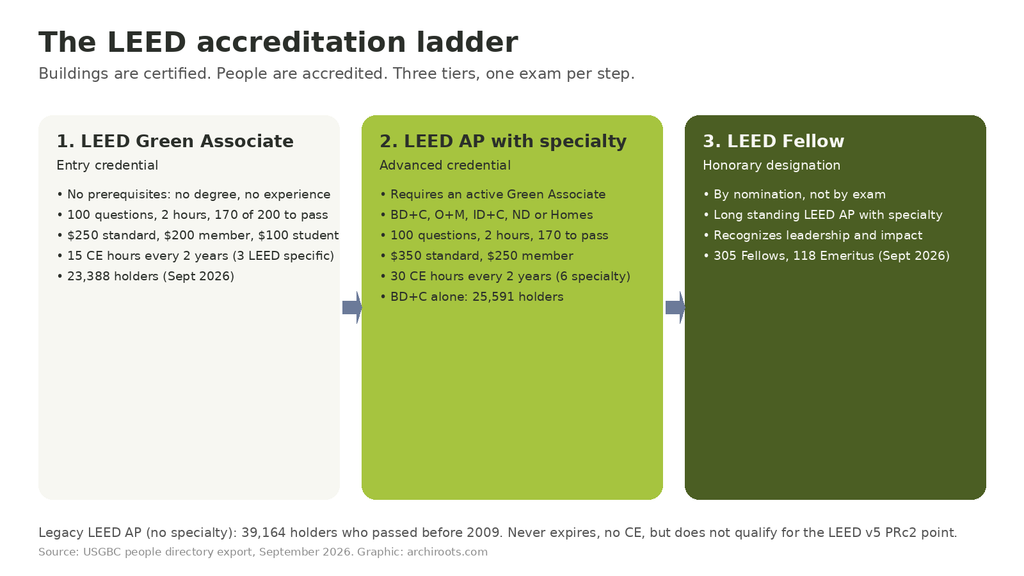
The exams sit on a three tier ladder. The LEED Green Associate is tier one and has no eligibility gate. The LEED AP with specialty is tier two, requires an active Green Associate at registration, and supersedes it: once the AP is earned the Green Associate credential expires and is replaced. LEED Fellow is tier three, awarded by nomination to long standing LEED APs rather than by exam; 305 people hold it and 118 are Fellows Emeritus.
Two naming rules from the handbooks that almost nobody follows. GBCI states that “LEED GA” is not an approved abbreviation and should not be used, and that the phrase “LEED Accredited Professional” is never to be used as a designation. The approved forms are “LEED Green Associate” and “LEED AP” followed by the specialty, for example LEED AP BD+C. Recruiters search for the abbreviations anyway, which is why both appear in this article, but the credential itself should be written the approved way on a certificate, a business card and an RFP.
The pre 2009 LEED AP and the PRc2 point
Anyone who passed the original LEED AP exam before the 2009 restructuring, described in the history of LEED, holds a LEED AP without specialty, usually called a legacy LEED AP. It predates both the Green Associate and the five specialties, never expires, carries no continuing education requirement, and is the single largest group in the USGBC directory at 39,164 people. It has one practical limit that catches project teams every year.
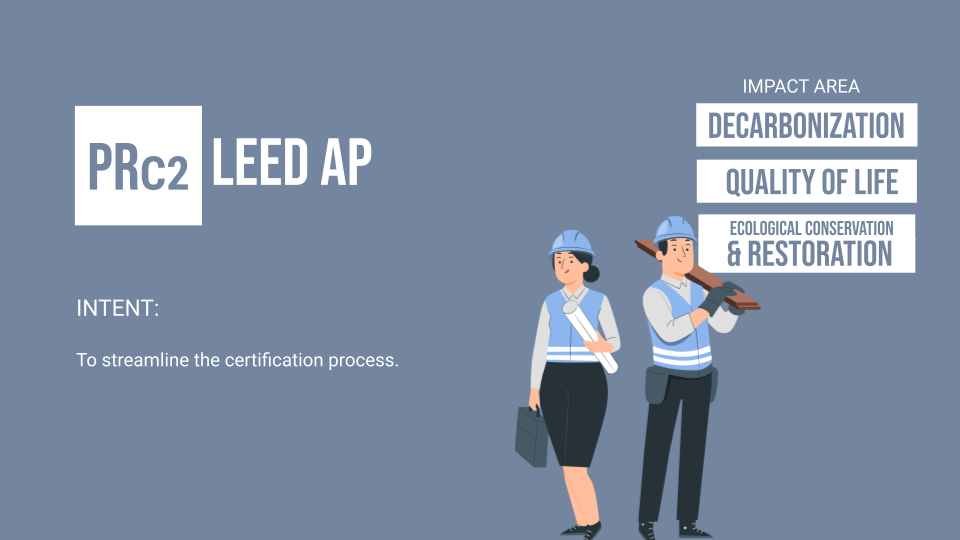
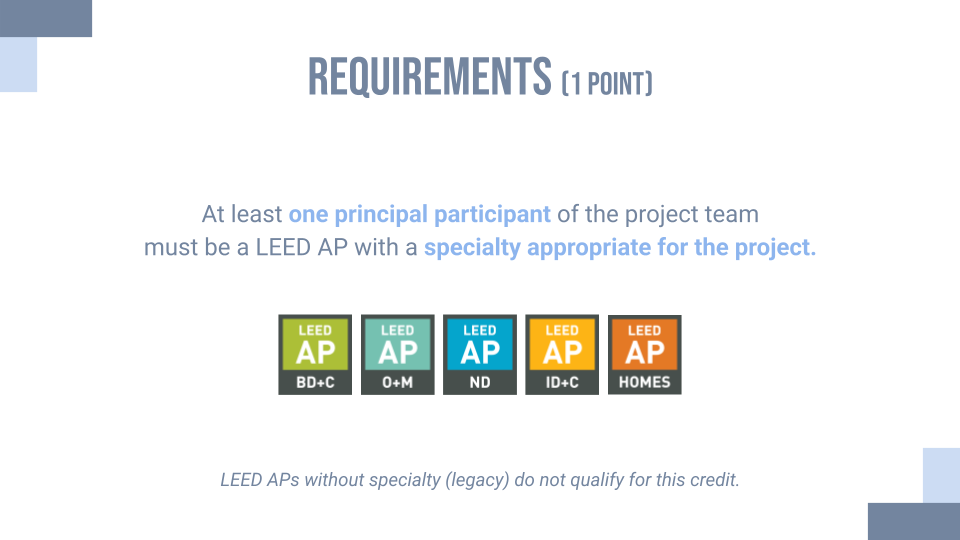
Under LEED v5, credit PRc2 awards one point when at least one principal participant on the project team is a LEED AP with a specialty appropriate to the project. A legacy LEED AP does not count. A firm with several legacy APs and no BD+C cannot claim the point on a new construction project, which is the most common reason experienced professionals sit the specialty exam.
How many people have passed a LEED exam?
As of September 2026 the USGBC people directory lists 101,676 credential holders, of whom 94,926 hold a LEED credential. Legacy LEED APs are the largest single group at 39,164, followed by LEED AP BD+C at 25,591 and LEED Green Associates at 23,388.
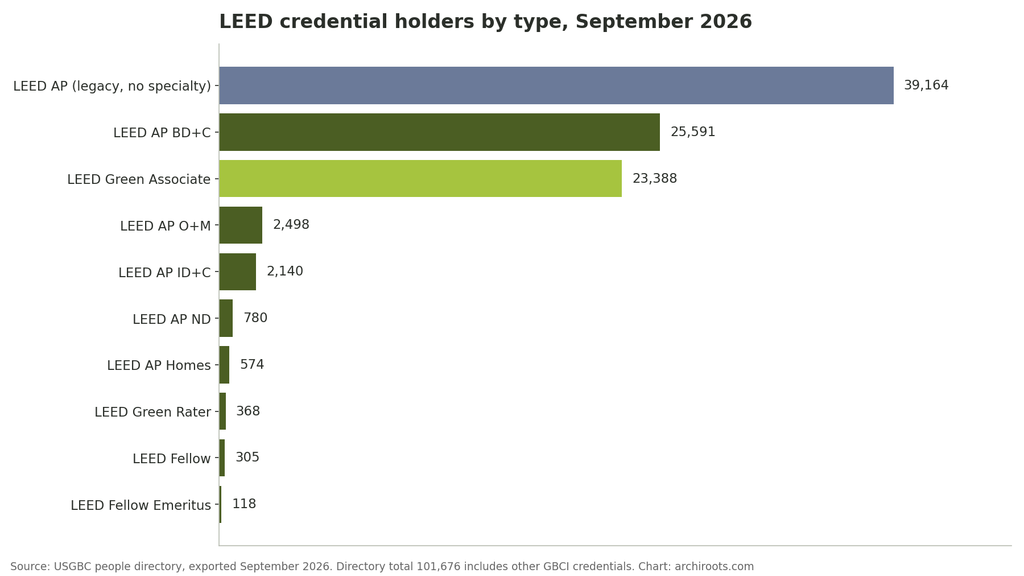
| Credential | Holders |
| LEED AP (legacy, no specialty) | 39,164 |
| LEED AP BD+C | 25,591 |
| LEED Green Associate | 23,388 |
| LEED AP O+M | 2,498 |
| LEED AP ID+C | 2,140 |
| LEED AP ND | 780 |
| LEED AP Homes | 574 |
| LEED Green Rater | 368 |
| LEED Fellow | 305 |
| LEED Fellow Emeritus | 118 |
| Directory total (includes other GBCI credentials such as WELL AP) | 101,676 |
Two numbers circulate and they measure different things. USGBC’s credentials page says more than 203,000 professionals have earned a LEED credential, a cumulative figure that USGBC reported as 185,071 in April 2013 and GBCI as 204,000 in its 2020 credentialing review, the last year it published onboarding data: 9,444 new LEED professionals that year, 3,407 of them outside the United States, across 134 countries. The directory count of 101,676 is the number listed as active today. The gap between the two is mostly Green Associates and specialty APs who stopped reporting continuing education, since a legacy AP never lapses, plus holders who opted out of the public listing. Roughly half of everyone who has ever passed a LEED exam is no longer maintaining the credential, which says more about the maintenance habit than about the exam.
The USGBC people directory was exported on September 4, 2026. Roughly 100,000 credentialed people worldwide, of whom more than a third hold a legacy AP that cannot satisfy PRc2, is a small pool against a public project directory of more than 220,000 registered LEED projects. That gap is the reason the specialty credential still appears as a named requirement in proposals and tenders, and why demand is strongest where certification volume is rising fastest, including the Gulf; the Saudi picture is broken down in LEED certification in Saudi Arabia.
Maintaining the credential after the exam
A LEED credential is maintained, not re-examined: 15 continuing education hours every two years for a Green Associate and 30 for a LEED AP, reported inside the usgbc.org account. A legacy LEED AP has no maintenance requirement.
| Credential | CE hours every two years | Of which LEED specific | Reporting period |
| LEED Green Associate | 15 | 3 | Starts on the exam date, ends two years minus one day later |
| LEED AP with specialty | 30 | 6, specific to the specialty held | Same; earning the AP starts a fresh period and retires the Green Associate |
| Legacy LEED AP | None | None | No maintenance |
Hours are reported inside the usgbc.org account, and approved providers with a GBCI course number can report them automatically. Missing the deadline moves the credential to inactive status until the hours are reported and the renewal fee paid. A running list of free LEED CE hours that count toward the LEED specific requirement is maintained on this site.
How hard is the LEED exam?
The LEED Green Associate exam is manageable with about two weeks of structured study. A LEED AP exam is somewhat harder. The question style, the categories and the concepts are the same, but there is more to memorize and you need to know how each credit is calculated.
What catches people on exam day is the wording. You eliminate two options and are left with two that look alike. Go back to the question and find the key words: best, primary, first, or a NOT that reverses the question. Sometimes both remaining answers are correct and one is better.
Take a question on when to start the integrative process. Schematic design is early, and it beats design development. The better answer is predesign, because the ideal is a charrette, a workshop with the main team members, held as early as possible.
The most common mistake in the last week is passing one or two practice exams and assuming you are ready. Review the flashcards and pass all seven practice exams before you book. The LEED Green Associate study guide lists the materials and the two week plan.
How long to prepare, and what preparation costs
Most candidates need two to six weeks with a structured course, or eight to twelve weeks from the reference guides alone. The Archiroots plan is two weeks: one week of lessons at 30 minutes a day, one week of a practice exam a day.
The exam fee is rarely the largest cost. Time is. The handbooks recommend exposure to LEED through coursework, volunteering or work before testing, and in practice preparation follows one of three routes:
| Route | Typical time | Typical cost | What it includes |
| Self study from official references | 8 to 12 weeks | $300 for a LEED v5 reference guide ($225 for member employees), plus the Core Concepts Guide and Foundations of LEED | The primary sources the exam is written from. Complete, but not organized for an exam and with no practice questions |
| Structured online course | 2 to 6 weeks | About $100 to $400 depending on provider | Lessons mapped to the exam domains, practice exams, flashcards, sometimes instructor access and a pass guarantee |
| Live or in person training | 3-5 days plus self study | $500 and up | Instructor led sessions, useful for teams and for candidates who need a fixed schedule |
The Archiroots model is the two week version of the middle row: week one is the simplified training at about 30 minutes a day, week two is one practice exam a day with flashcards, then register and schedule. The LEED Green Associate course and the LEED AP BD+C course are both built on LEED v5, include on demand instructor support, and report a 100 percent pass rate among students who complete the course and its practice exams. Before paying for any preparation, check five things: that the material is v5 and not a relabeled v4 course, that lessons map to the domain weights in the table above, that it includes full length timed practice exams, that instructor questions are answered, and what the guarantee actually requires. Free, no sign up practice exams are available for the Green Associate and for AP BD+C, with matching Green Associate flashcards and AP BD+C flashcards, and 50 cards of each are free in the free LEED Green Associate flashcards and free LEED AP BD+C flashcards. Health and wellbeing professionals usually add the WELL AP, which GBCI also administers, as a third credential.
What 7,000+ exam candidates show
Archiroots has prepared more than 7,000 professionals for these exams, and the patterns below come from that work rather than from any published statistic, because GBCI does not publish pass rates.
| Observation | What the cohorts show |
| Who fails | Archiroots does not publish a pass rate, because the pass guarantee covers every student who finishes the material and passes the practice exams. The failures come almost entirely from the 5 to 10 percent who stop partway, feel ready, and book anyway. |
| The readiness threshold | 80 percent on the practice exams is the condition for the guarantee and the line below which booking is not recommended. A scaled 170 on the real exam is not 85 percent correct, but practice exams built harder than the real thing at 80 percent have been a reliable predictor. |
| Real preparation time | Two weeks when the plan is followed: 30 minutes a day of lessons in week one, one practice exam a day in week two. Most people take three or four weeks because they skip days. The plan does not fail; the calendar does. |
| Hardest domains in practice | Green Associate: LEED Process. AP BD+C: Energy and Atmosphere, then Materials and Resources. AP O+M: Energy and Atmosphere and Indoor Environmental Quality. |
| Test center vs online | Before 2020 every candidate tested at a center. Online testing is now available and many prefer it, but most candidates still choose a center for three reasons: unstable home internet, the fact that breaks are not permitted during an online exam so a bathroom visit ends the session, and distraction at home. |
The practical reading of this table: the exam is not where candidates fail. Booking before finishing is. A candidate who completes the lessons, holds 80 percent on repeated practice exams and tests at a centre with a stable setup removes nearly every failure mode in the list.
Frequently asked questions
What is the LEED exam?
The LEED exam is the GBCI administered test that earns a LEED professional credential. There are six: the LEED Green Associate exam and five LEED AP with specialty exams (BD+C, O+M, ID+C, ND and Homes). Each has 100 multiple choice questions, a two hour limit and a passing score of 170 out of 200.
How many LEED exams are there?
Six. One for the LEED Green Associate and one for each of the five LEED AP specialties: BD+C, O+M, ID+C, ND and Homes. Every exam is 100 questions in two hours with 170 to pass; the difference is the domain weighting and the depth of the questions.
Where can you take the LEED exam?
At any Prometric test centre that delivers GBCI exams, found through the locator at prometric.com/gbci, or online from home through ProProctor.
How much does the LEED exam cost?
The LEED Green Associate exam is $250, or $200 for employees of USGBC member organizations and $100 for students. Each LEED AP with specialty exam is $350, or $250 for member employees. When GBCI offers the combined exam, it costs $550, or $400 for member employees.
When are the LEED exam dates?
There are no fixed dates. LEED exams are scheduled on demand through Prometric, at a test center or online, any time within the twelve month validity of the exam registration.
Is it better to take the LEED exam online or at a test center?
Both count equally. Online is convenient but has no breaks, requires a stable connection, a single screen and a private room, and a dropped connection three times ends the session.
Is the LEED exam based on LEED v5?
Yes for the LEED Green Associate and the AP BD+C, O+M and ID+C exams. Each candidate handbook names the rating system version its exam tests, and USGBC's LEED v5 exam information page lists the current dates and any beta phase.
What happens if you fail the LEED exam?
A new registration and full fee are required for each attempt. After three unsuccessful attempts within twelve months, GBCI requires a 90 day wait before registering again.
What is the difference between LEED certification and LEED accreditation?
Certification applies to buildings and projects after a documentation review. Accreditation applies to people after an exam. Both are issued by GBCI, and a LEED AP on the team is worth one point toward a project's certification under LEED v5 credit PRc2.
Do you need experience to take a LEED exam?
Not for the LEED Green Associate, which has no prerequisites. The AP with specialty exams require an active Green Associate credential and candidates must be 18 or older; project experience is strongly recommended by GBCI but not verified.
How many LEED accredited professionals are there?
As of September 2026 the USGBC people directory lists 101,676 credential holders, including 39,164 legacy LEED APs, 25,591 LEED AP BD+C, 23,388 LEED Green Associates and 305 LEED Fellows.
In which languages is the LEED exam available?
The LEED v5 exams launched in English, including the tutorial, non disclosure agreement and the online proctor interaction. Translated versions existed for the v4 exams, and USGBC announces additional language versions of the v5 exams as they become available.
Is LEED GA the correct name for the credential?
No. GBCI's handbook states that LEED GA is not an approved abbreviation. The credential is written LEED Green Associate. Likewise the phrase LEED Accredited Professional is not used as a designation; the correct form is LEED AP followed by the specialty.