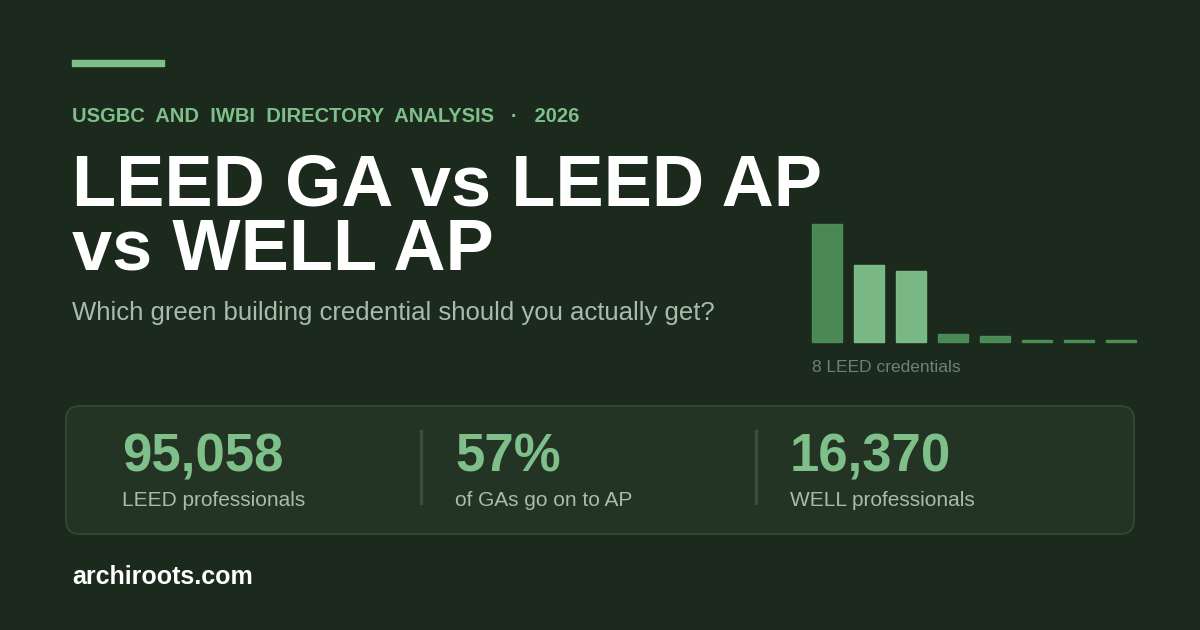
Start with the LEED Green Associate. It is the mandatory first step for every LEED AP specialty, and there is no way around it. From there, add LEED AP BD+C if you work on new construction, LEED AP O+M if you manage existing buildings, and WELL AP if your work touches occupant health, interiors or workplace strategy. LEED and WELL are not competitors, they measure different things: LEED scores a building’s environmental performance, WELL scores its effect on the people inside it. Most professionals who hold both earned the LEED Green Associate first and added WELL AP second.
The numbers back the sequence. Of the 55,252 professionals on the modern LEED credential track, 57% went on to earn a LEED AP with specialty rather than stopping at Green Associate. These figures come from the USGBC people directory and the IWBI users directory on 2 August 2026.
The three credentials at a glance
| LEED Green Associate | LEED AP with specialty | WELL AP | |
|---|---|---|---|
| What it proves | Core green building literacy | Applied expertise in one LEED rating system | Expertise in buildings and occupant health |
| Prerequisite | None, anyone can sit it | An active LEED Green Associate | None |
| Exam fee | $250, or $200 for USGBC members, $100 students | $350, or $250 for members | $299, or $245 for IWBI members |
| Exam length | 100 questions, 2 hours | 100 questions, 2 hours | 115 questions, 2 hours and 30 minutes |
| Passing score | 170 of 200 | 170 of 200 | 170 of 200 |
| Continuing education | 15 hours every 2 years | 30 hours every 2 years | 30 hours every 2 years |
| Professionals listed | 23,596 | 31,656 across five specialties | 16,370 in the IWBI directory |
| Best for | Anyone new to green building | People who deliver or document LEED projects | Interiors, workplace, health and wellbeing work |
How many people hold each credential?
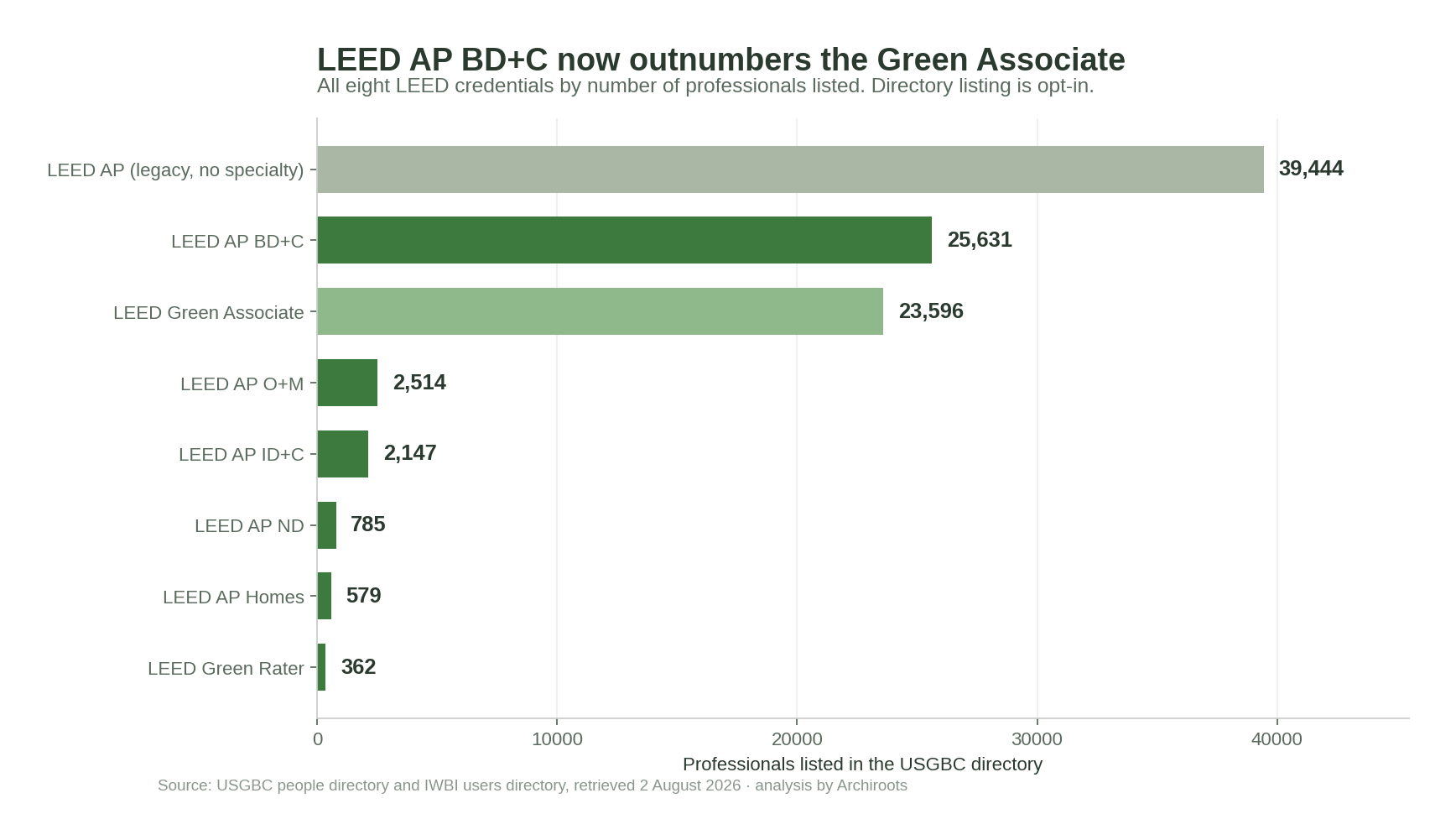
USGBC states that more than 203,000 professionals have earned a LEED credential. The public directory lists a subset of those, because listing is opt-in. Here is what the directory actually contains.
| Credential | Professionals listed | Share |
|---|---|---|
| LEED AP (legacy, no specialty) | 39,444 | 41.5% |
| LEED AP BD+C | 25,631 | 27.0% |
| LEED Green Associate | 23,596 | 24.8% |
| LEED AP O+M | 2,514 | 2.6% |
| LEED AP ID+C | 2,147 | 2.3% |
| LEED AP ND | 785 | 0.8% |
| LEED AP Homes | 579 | 0.6% |
| LEED Green Rater | 362 | 0.4% |
| Total entries | 95,058 | 100% |
The counterintuitive result is that LEED AP BD+C outnumbers the Green Associate, even though nobody can hold BD+C without passing the Green Associate exam first. The explanation is that once you earn a LEED AP with specialty, the AP credential supersedes your Green Associate. The 23,596 GA listings are people who stopped there. Everyone who went further appears under their specialty instead.
What is a legacy LEED AP, and why it matters now
The largest group in the directory, 39,444 people, holds a credential you can no longer earn.
Before 2009, there was one LEED AP credential with no specialty attached. When USGBC introduced the specialty structure, existing holders kept their credential and it became known as the legacy LEED AP. The population has been frozen since, because no new ones are issued.
Here is the part that costs projects a point, and very few articles mention it. The LEED AP credit, which sits in the Project Priorities category in LEED v5 and was in Innovation under v4, requires that at least one principal participant on the project team holds a LEED AP with a specialty appropriate for the project. Two conditions have to be met at once:
- The specialty has to match the rating system. A LEED AP BD+C does not earn the point on an O+M project, and vice versa.
- A legacy LEED AP does not qualify at all. No specialty means no point, regardless of how long the person has held the credential.
So a firm can have a twenty-year LEED AP on the team and still lose that point. If you hold a legacy LEED AP and you want your projects to earn it, you need to sit an AP with specialty exam. For most people that means BD+C, and because a legacy AP already holds an active credential you go straight to the specialty exam rather than repeating the Green Associate.
LEED Green Associate vs LEED AP: which one do you need?
The order is fixed. Every LEED AP specialty requires an active LEED Green Associate credential at registration. The only question is whether you stop at Green Associate or keep going.
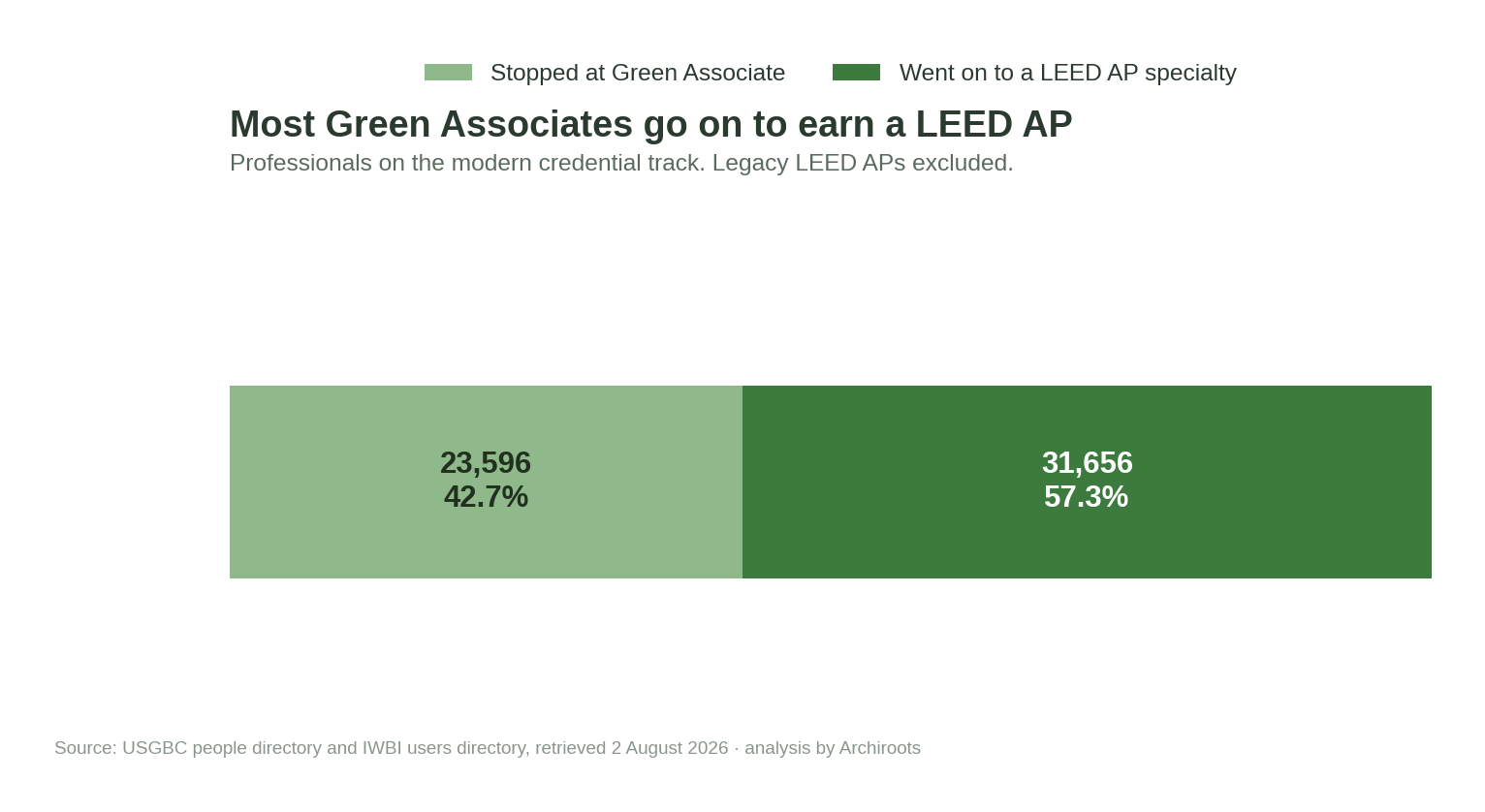
Of the 55,252 professionals on the modern track, 23,596 hold only the Green Associate and 31,656 hold an AP with specialty. The majority advance.
That figure matches what we see in our own training. Across 7,000+ professionals trained, roughly half of those who start with the Green Associate come back for an AP credential within a year or two. Our internal rate and the global directory rate land within a few points of each other, which suggests neither is a quirk of one sample.
The LEED Green Associate is the right endpoint for a large share of professionals, and treating it as a stepping stone you must move past is a mistake. Here is the honest split.
Stop at Green Associate if
- You support LEED projects without documenting them: marketing, sales, procurement, facilities coordination, product manufacturing.
- You need green building literacy for tenders, ESG reporting or client conversations rather than credit-level work.
- You are a student or early career and want the credential on your CV before you have project experience.
- You want the lower maintenance burden. 15 continuing education hours every two years instead of 30.
Go on to LEED AP if
- You lead, document or review LEED submissions.
- Your firm bids on LEED projects and needs an AP with the matching specialty on the team to earn that credit.
- You want the credential employers actually specify in job postings and prequalification documents.
- You are a consultant and need the depth to answer credit-level questions without guessing.
Which LEED AP specialty should you choose?
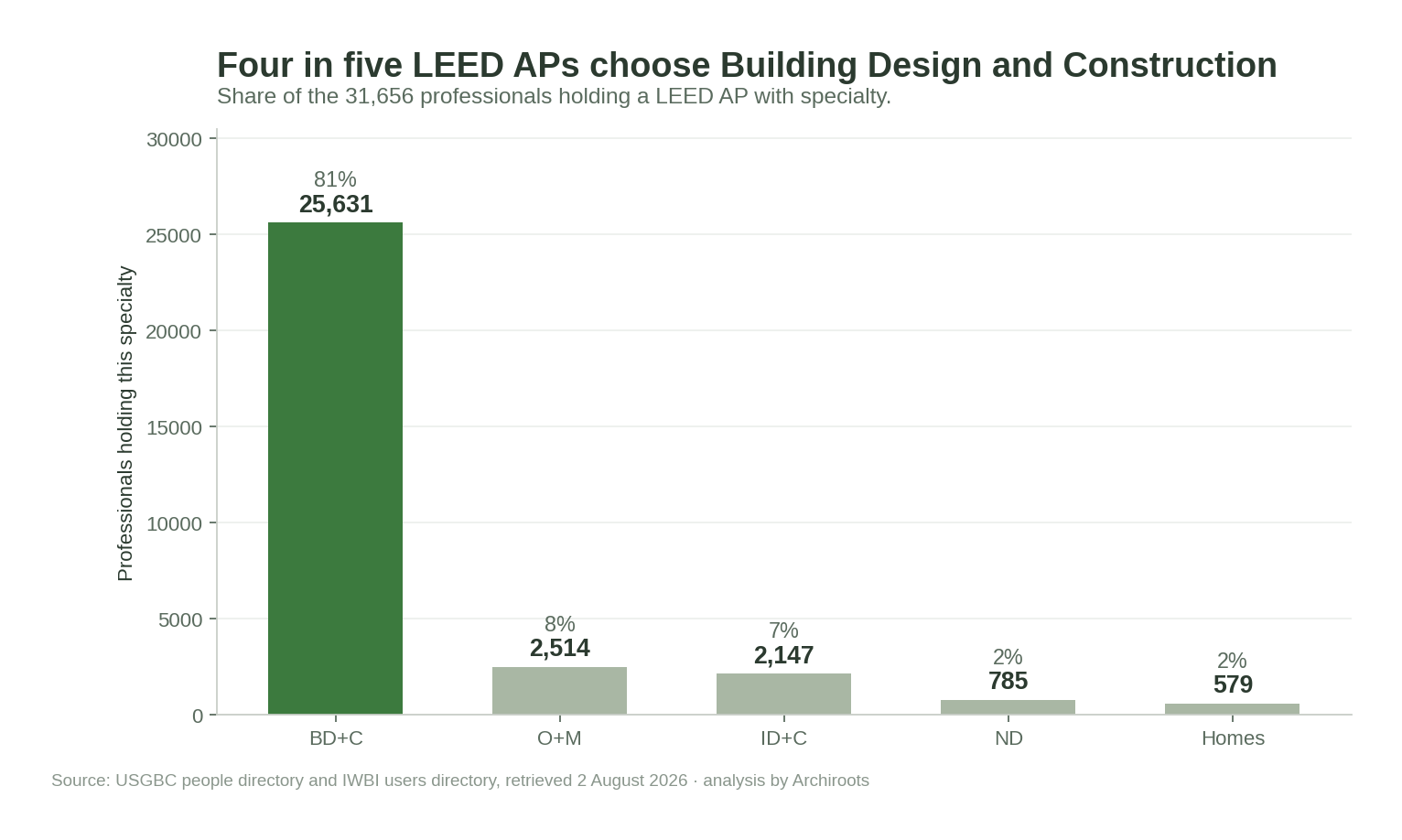
BD+C holds 81% of all specialties. That is not fashion, it follows the market: new construction and major renovation is where the largest share of certification work happens.
| Specialty | Choose it if you work on | Holders |
|---|---|---|
| BD+C | New construction, major renovation, core and shell, schools, healthcare, data centers, warehouses | 25,631 |
| O+M | Existing buildings in operation, facilities management, recertification, portfolio performance | 2,514 |
| ID+C | Interior fit-outs, tenant improvements, retail and hospitality interiors | 2,147 |
| ND | Neighbourhood and master planning, land development | 785 |
| Homes | Residential, single family and multifamily | 579 |
When in doubt, pick the rating system your projects certify under. If you split your time between new builds and existing assets, BD+C is the safer default because the pipeline is larger, and LEED AP O+M is the better choice only if operations is genuinely most of your work. Both specialties have a two-week course: LEED AP BD+C exam prep for new construction and LEED AP O+M exam prep for existing buildings.
LEED vs WELL: what each one actually measures
This is where the confusion is worst, because people assume the two systems compete. They do not. LEED certifies a building’s environmental performance. WELL certifies its effect on the people inside it. A building can hold both, and many do. The rating system itself, its 110 points and its four levels, is covered in what is LEED.
| LEED | WELL | |
|---|---|---|
| Owner | U.S. Green Building Council | International WELL Building Institute |
| Measures | Environmental impact of the building | Health and wellbeing impact on occupants |
| Typical focus | Energy, carbon, water, materials, site | Air, water, nourishment, light, movement, mind, community |
| Launched | 1998 | 2014 |
| Verification | Documentation review | Documentation plus on-site performance testing |
| Credential | LEED Green Associate, LEED AP | WELL AP |
| Professionals listed | 95,058 directory entries | 16,370 |
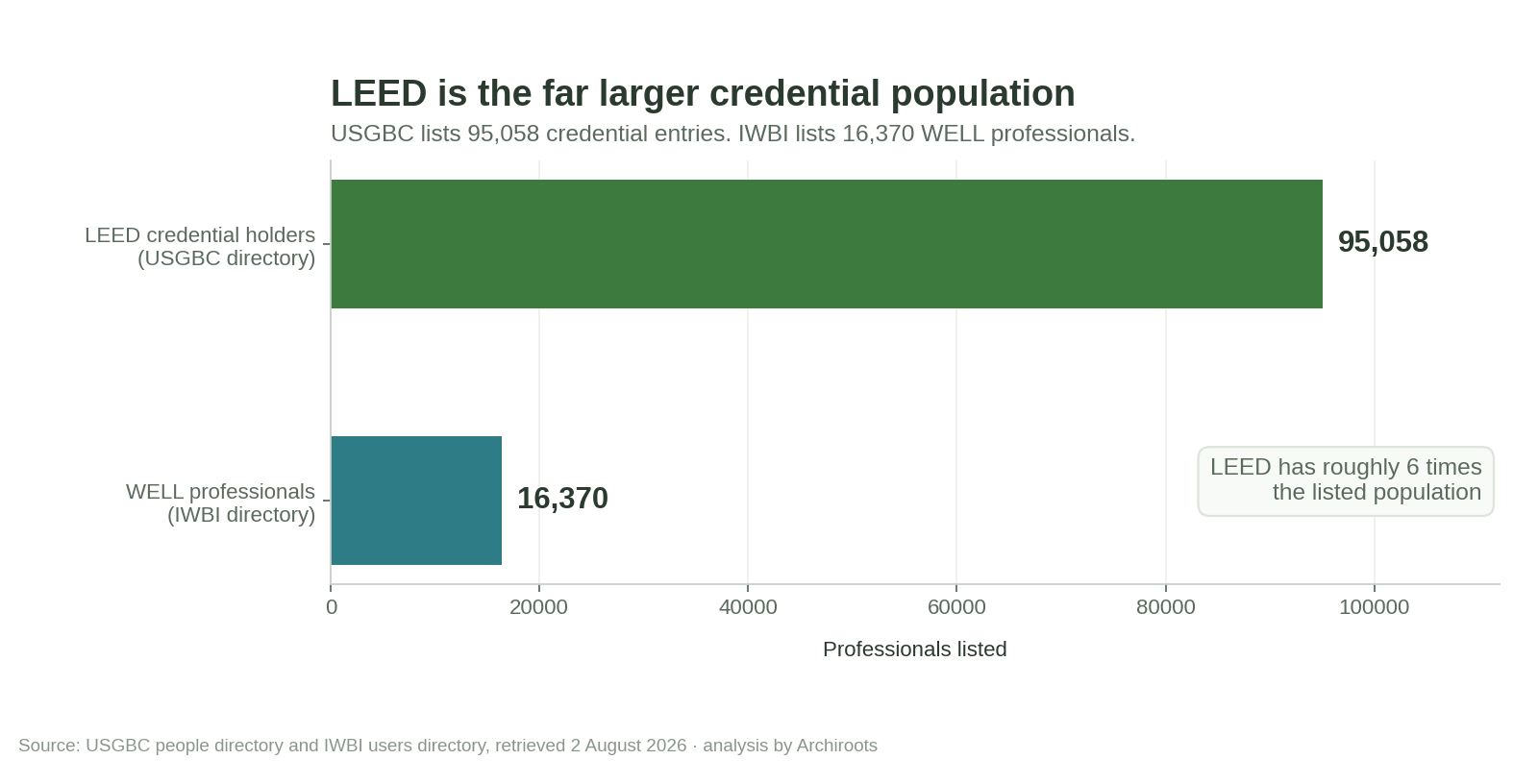
LEED is the far larger market, which is what you would expect from a system with a sixteen year head start. But WELL is growing from a smaller base, and among the professionals we train WELL AP accounts for 15% of enrolments, well above what the global ratio alone would predict. The demand is running ahead of the installed base.
What WELL actually asks of a building
The clearest way to understand the difference is to look at what WELL requires that LEED never touches. WELL concepts reach into operations, policy and management in ways that surprise people arriving from LEED:
- Nourishment. What the cafeteria serves, including requirements around fruit and vegetable availability and limits on portion sizes intended to reduce weight gain.
- Movement. Ergonomic workstations, monitor arms, adjustable chairs, and employer incentives that encourage physical activity.
- Mind. Mental health support, biophilic design, and workplace policies.
- Community. Health services, parental leave provisions and equitable workplace practices.
The full set of concepts is published in the WELL Building Standard. None of that appears in LEED. LEED sits closer to the fundamentals of the building itself: do not build on sensitive land, use less energy, reduce potable water, choose better materials. WELL is more operational and management driven, and it asks the owner to commit to things that continue after handover.
That difference is exactly why the two credentials pair well. A WELL AP who also holds a LEED credential can speak to both halves of a project, and in LEED v5 the overlap has grown, since the quality of life impact area covers ground WELL has occupied since 2014. That is why a LEED AP BD+C who adds WELL AP is a more useful hire than either credential alone.
Which is harder: LEED AP or WELL AP?
LEED exams are 100 question (2 hours), WELL AP are 115 question (2 hours and 30 minutes) but share the same format: multiple choice questions, 170 out of 200 to pass. The difficulty differences are in the content.
| Exam | Difficulty | Where people struggle |
|---|---|---|
| LEED Green Associate | Most approachable | Volume of terminology. The logic is conceptual rather than technical |
| LEED AP with specialty | Harder than GA | Calculations and credit-level detail. Candidates assume they know the answer from experience and get caught |
| WELL AP | Harder in a different way | Concepts with no LEED equivalent. There is less to reason from if your background is LEED only |
The Green Associate has the highest pass rate of the three in our experience, because it tests understanding of how LEED works rather than the arithmetic of individual credits. The AP exams are trickier precisely because experienced professionals over-trust their instincts and skip the calculation.
WELL AP is harder for a specific reason: it is newer, and much of its content has no LEED counterpart. If your entire frame of reference is LEED, concepts like nourishment policy and movement incentives feel foreign, and you cannot fall back on intuition. Nothing about it is beyond reach, but it does need studying rather than recognising.
Take the free LEED AP BD+C practice exam and the free WELL AP practice exam back to back and the difference in question style is obvious within ten questions.
How long does each exam take to prepare for?
Every source gives a different answer, and they are all right, because preparation time depends entirely on the method. Reading a reference guide cover to cover is a different commitment from working through a structured course that flags what is actually examinable.
With a focused course, two weeks is realistic for the Green Associate. Here is the approach we use, and it works because it forces you to measure your readiness rather than guess at it:
- Week one: watch 30 minutes a day, then take one practice exam.
- Score 60% or above: carry on and work through the remaining practice tests.
- Score below 60%: stop and review. Go back through the flashcards or the relevant course sections before taking another test.
- Consistently hitting 80%: you are ready to book the exam.
The 80% threshold matters. It leaves headroom for exam pressure and for questions phrased differently from anything you have practised. Booking at 70% is how people end up paying twice, since there are no discounted retakes. You can measure where you stand right now with a free LEED Green Associate practice exam, and our full LEED Green Associate practice exams and LEED AP practice exams follow the same scoring logic.
Should you take the combined GA and AP exam?
Not any more, and for the moment you cannot. Combined exams are not available during the LEED v5 beta phase, and the last day to sit one in the combined format was 26 April 2026, per the USGBC v5 exam information.
Even when it was available, we advised against it, and only a small share of our students took that route. The reasoning:
- Four hours of testing is too long. Concentration collapses in the second half and people start answering without reading properly.
- The discount is not worth the risk. Saving roughly $50 against the risk of failing a non-refundable exam is poor economics.
- Splitting them lets you learn from the first. Passing the Green Associate tells you exactly how the exam style works before you attempt the harder one.
Take the Green Associate, pass it, then prepare for the specialty. It is slower on paper and faster in practice.
Where LEED professionals are, by country

| Country | LEED professionals listed |
|---|---|
| United States | 73,781 |
| Canada | 5,580 |
| Saudi Arabia | 2,889 |
| United Arab Emirates | 2,504 |
| China | 2,258 |
| India | 1,692 |
| United Kingdom | 673 |
Two results are worth pausing on.
Saudi Arabia has more LEED professionals than China or India, despite a fraction of the population of either. That tracks with the certification pipeline: the Kingdom now has 1,354 LEED certified projects and commercial certifications have roughly doubled since 2023. We covered that market in detail in our analysis of LEED certification in Saudi Arabia. Roughly 30% of the professionals we train are based in Saudi Arabia or working on Saudi projects, and BD+C is consistently their first choice.
The United Kingdom has only 673, fewer than a quarter of Saudi Arabia’s total. That is BREEAM’s home market, and where a strong national system is entrenched, LEED adoption stays low. The same dynamic is worth watching in Saudi Arabia with Mostadam, though so far the two are running in parallel rather than displacing each other.
The recommended path
| Your situation | What to take |
|---|---|
| New to green building, any profession | LEED Green Associate. There is no alternative first step. The LEED Green Associate exam prep course covers it in two weeks. Firms putting several people through at once should look at LEED group training instead. |
| Architect, engineer or contractor on new builds | Green Associate, then LEED AP BD+C |
| Facilities or asset manager on existing buildings | Green Associate, then LEED AP O+M |
| Interior designer or workplace strategist | Green Associate, then WELL AP. Add LEED AP ID+C if you document LEED fit-outs |
| Project manager on LEED projects | Green Associate, then LEED AP BD+C. Many pair it with PMP |
| Working on occupant health, HR or ESG | WELL AP, with the Green Associate for context |
| Legacy LEED AP wanting the project point | The AP with specialty exam matching your rating system. No need to repeat the Green Associate |
| Firm staffing up for a bid | Green Associate across the team, AP with the matching specialty for the leads |
In practice most professionals stop at two credentials. Among the organizations we train, the common combinations are Green Associate plus LEED AP BD+C, or Green Associate plus WELL AP. Very few teams take all three, because three courses is a lot of time to ask of staff, and the marginal value of the third is lower than the first two. If you have to choose, pick the second credential that matches the work you actually do rather than the one that sounds most complete.
Frequently asked questions
Should I get LEED Green Associate or LEED AP first?
Green Associate, and it is not optional. Every LEED AP specialty exam requires an active LEED Green Associate credential at registration.
Is LEED AP better than LEED Green Associate?
It is more advanced rather than better, and which one is right depends on your work. The Green Associate proves broad green building literacy and suits people who support LEED projects without documenting them. The LEED AP proves you can apply a specific rating system at credit level and is what employers specify for people who lead or document certifications. Of professionals on the modern credential track, 57% hold an AP with specialty and 43% stopped at Green Associate.
Which LEED AP specialty is most popular?
BD+C by a wide margin. It accounts for 25,631 of the 31,656 LEED APs with specialty listed in the USGBC directory, or 81%. O+M follows with 2,514 and ID+C with 2,147. The dominance follows the market, since new construction and major renovation is where most certification work happens.
What is the difference between LEED and WELL?
LEED measures a building’s environmental performance: energy, carbon, water, materials and site. WELL measures its effect on the people inside it: air, water, nourishment, light, movement, thermal comfort, sound, materials, mind and community. They are complementary rather than competing, and many buildings pursue both. WELL also requires on-site performance testing, which LEED does not.
Should I get LEED AP or WELL AP?
Match the credential to your work. LEED AP if you deliver or document building certifications, particularly new construction. WELL AP if your work involves interiors, workplace strategy, occupant health or ESG reporting on wellbeing. If you do both kinds of work, most people take the LEED Green Associate first and add WELL AP second, which is the most common pairing among the organisations we train.
Is WELL AP harder than LEED AP?
Harder in a different way. Both are multiple choice with the same 170 out of 200 passing score. WELL AP is more difficult for candidates coming from a LEED background because much of its content has no LEED equivalent, such as nourishment policy, ergonomic requirements and employee movement incentives. There is less to reason from, so it needs studying rather than recognizing. The LEED AP exams are harder than the Green Associate because of the calculations and the credit-level detail.
How many LEED professionals are there?
USGBC states that more than 203,000 professionals have earned a LEED credential. The public directory, which is opt-in, lists 95,058 credential entries as of August 2026. The largest group is the legacy LEED AP at 39,444, followed by LEED AP BD+C at 25,631 and LEED Green Associate at 23,596.
How many WELL APs are there?
The IWBI users directory lists 16,370 professionals as of August 2026, which includes WELL AP, WELL Faculty and WELL Advisory designations. That is roughly one sixth of the listed LEED population, which is what you would expect given that WELL launched in 2014 and LEED in 1998.
What is a legacy LEED AP?
A LEED AP earned before 2009, when the credential had no specialty attached. There are 39,444 of them listed and no new ones are issued. The distinction matters on projects: the LEED AP credit requires a principal participant holding an AP with a specialty appropriate for the rating system, so a legacy LEED AP without a specialty does not earn the point. Legacy holders who want to qualify need to sit an AP with specialty exam.
How long does it take to prepare for the LEED Green Associate?
Two weeks is realistic with a structured course, longer if you are working through reference guides on your own. A workable method is 30 minutes of study a day for the first week, then a practice exam. Score 60% or above and continue through the remaining tests. Score below 60% and review before testing again. When you are consistently scoring 80%, book the exam.
Which country has the most LEED professionals?
The United States, with 73,781 listed in the USGBC directory, followed by Canada at 5,580. Saudi Arabia is third among the countries we checked at 2,889, ahead of the United Arab Emirates at 2,504, China at 2,258 and India at 1,692. The United Kingdom has only 673, reflecting BREEAM’s dominance in its home market.
Do I need a LEED credential to work on a LEED project?
No. Anyone can work on a LEED project without holding a credential. But the project earns a point under the LEED AP credit only if at least one principal participant holds a LEED AP with a specialty matching the rating system, which is why firms bidding on LEED work keep credentialed staff on the team.