The LEED Green Associate is the entry level LEED credential. It shows that a person understands green building and the LEED rating system well enough to work on a LEED project. GBCI awards it to anyone who passes the 2 hour exam, and there are no prerequisites.
This guide covers what the credential is, who asks for it, what it costs, how to earn it and what to do with it after you pass. The exam itself has its own page, the LEED exam guide. To prepare, see the LEED Green Associate exam prep or try the free LEED Green Associate practice exam.
The short version
- The LEED Green Associate is the entry level LEED credential, awarded by GBCI after passing the 2 hour exam with no prerequisites.
- The exam fee is $250, $200 for employees of USGBC member organizations and $100 for students.
- Job ads from firms such as Perkins&Will, HDR and Bureau Veritas ask for it, and some give new hires 6 months to earn it.
- It supports in pay raises with a new role, a new employer or a LEED project to work on.
- The approved title is LEED Green Associate. “LEED GA” should not be written after a name.
| Fact | Detail |
|---|---|
| What it is | The first of three LEED credential tiers: LEED Green Associate, LEED AP with specialty, LEED Fellow |
| Issued by | Green Business Certification Inc. (GBCI), for the U.S. Green Building Council (USGBC) |
| Requirements | None. No degree, no experience, no minimum age (under 18 needs a parent’s consent) |
| Exam | 100 multiple choice questions, 2 hours, based on LEED v5 |
| Passing score | 170 on a scale of 125 to 200 |
| Exam fee | $250, $200 for employees of USGBC member organizations, $100 for students |
| Valid for | 2 years, renewed with 15 continuing education hours |
| Official title | LEED Green Associate. “LEED GA” is not an approved abbreviation |
| People who hold it | About 23,600 hold the Green Associate alone in the USGBC directory (August 2026) |
What is the LEED Green Associate?
LEED stands for Leadership in Energy and Environmental Design. It is the green building rating system run by USGBC, and it is covered in full in what LEED is and how certification works. Buildings earn LEED certification. People earn LEED credentials, and the LEED Green Associate is the first one.
The credential says one thing about its holder: this person knows the concepts behind green building and how a LEED project runs. It does not say the person is a sustainability consultant or a senior designer. Those roles come from a profession and from project experience, and the credential sits on top of them.
Is the LEED Green Associate a certification or a license?
Strictly, it is a professional credential. Most people call it the LEED Green Associate certification, it is not a license. No law requires it to practice architecture or engineering, and it grants no legal authority. Employers and clients ask for it by choice.
What does LEED GA mean?
LEED GA is the common shorthand for LEED Green Associate, and it is what most people call it. But it is not the official title. The GBCI candidate handbook says “LEED GA” is not an approved abbreviation and should not be used under any circumstances. After your name, the credential is written out in full: LEED Green Associate.
Where it sits among the LEED credentials
Until June 30, 2009 there was a single LEED AP exam and no entry level. In 2009 the system was split into tiers, and the Green Associate became the foundation that every LEED AP specialty is built on.
| Tier | Credential | What it shows | Needs |
|---|---|---|---|
| 1 | LEED Green Associate | General knowledge of green building and LEED | Nothing |
| 2 | LEED AP with specialty (BD+C, O+M, ID+C, ND, Homes) | Technical knowledge of one rating system | An active LEED Green Associate |
| 3 | LEED Fellow | A long record of achievement in the field | Nomination |
The comparison of the LEED Green Associate, LEED AP and WELL AP goes through the differences in detail.
How many LEED Green Associates are there?
| Measure | Number |
|---|---|
| People holding the LEED Green Associate alone | 23,596 |
| People holding a LEED AP with specialty | 31,656 |
| Share of the modern credential track that went on to a LEED AP | 57% |
| LEED professionals listed in the United States | 73,781 |
| LEED professionals listed in Canada | 5,580 |
| LEED professionals listed in Saudi Arabia | 2,889 |
| LEED professionals listed in the United Arab Emirates | 2,504 |
Is the LEED Green Associate certification worth it?
For most people who work in or near the building industry, yes. How much it helps depends on three things: the job you are applying for, the country you work in and the firm you want to join.
That is why online threads on this question never settle. An engineer whose firm never bids on LEED work says it did nothing. An architect whose firm sells itself on its LEED accredited team says it got the interview. Both are describing their own market accurately.
It is not a master’s degree or a bachelor’s degree. It is a 2 hour exam that costs a few hundred dollars. Passing it tells clients and employers that you understand green building and can help a LEED project run smoothly. On a project that is not pursuing LEED, it still shows that you know how to design and build sustainably.
Firms want it for a commercial reason too. Many advertise that their team is LEED accredited, and they bid on new projects with the team’s resumes and credentials attached. LEED is the most widely recognized green building system, so it is the credential they ask for most.
What the credential does not do
It does not replace a discipline. Someone with no profession, no skills and no experience will not become a senior designer or a sustainability consultant by passing one exam. The credential adds to a career that already exists or is being built.
It also does not raise a salary by itself, as the salary section below shows.
Who benefits, by profession
Every discipline on a building project uses the credential in its own field.
| Profession | How LEED knowledge is used on a project | Usual next credential |
|---|---|---|
| Sustainability consultant | Advises which products and strategies earn points. Accreditation is expected in this role | LEED AP BD+C or O+M |
| Architect | Designs to the credits, for example sizing windows from a daylight analysis and planning space for recycling | LEED AP BD+C |
| Mechanical engineer | Selects HVAC systems with low global warming potential refrigerants and builds the energy model | LEED AP BD+C or O+M |
| Interior designer | Specifies low VOC paints and furniture with environmental product declarations or Cradle to Cradle certification | LEED AP ID+C |
| Civil engineer | Handles site work so construction does not damage the site | LEED AP BD+C |
| Owner or developer | Chooses a site near dense, mixed use areas to cut commuting, and decides which credits to target | Often stops at the Green Associate |
| Outside the building industry | Understands carbon and energy targets for a building already in operation | Depends on the role |
The last row comes from a real case. One Green Associate known to Archiroots works in quality control at a hospital. The hospital was already running and had been told to lower its carbon emissions and improve energy efficiency, and it needed someone who understood the concepts. She studied, passed and took that work on.
Who asks for the LEED Green Associate? What job ads say
LEED Green Associate jobs are rarely advertised under that name. The credential shows up inside ads for architects, engineers, interior designers and consultants, as a requirement or a preference.
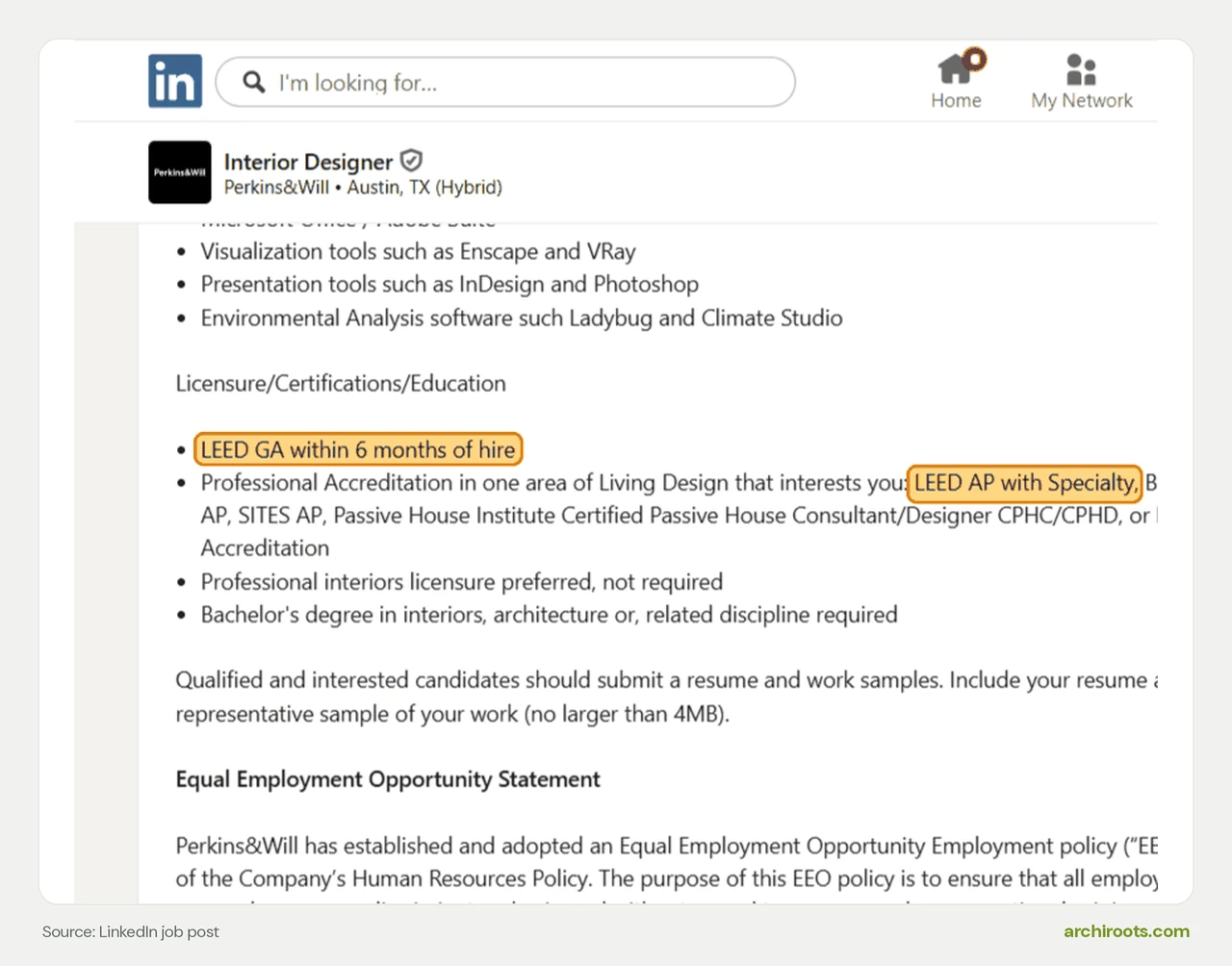
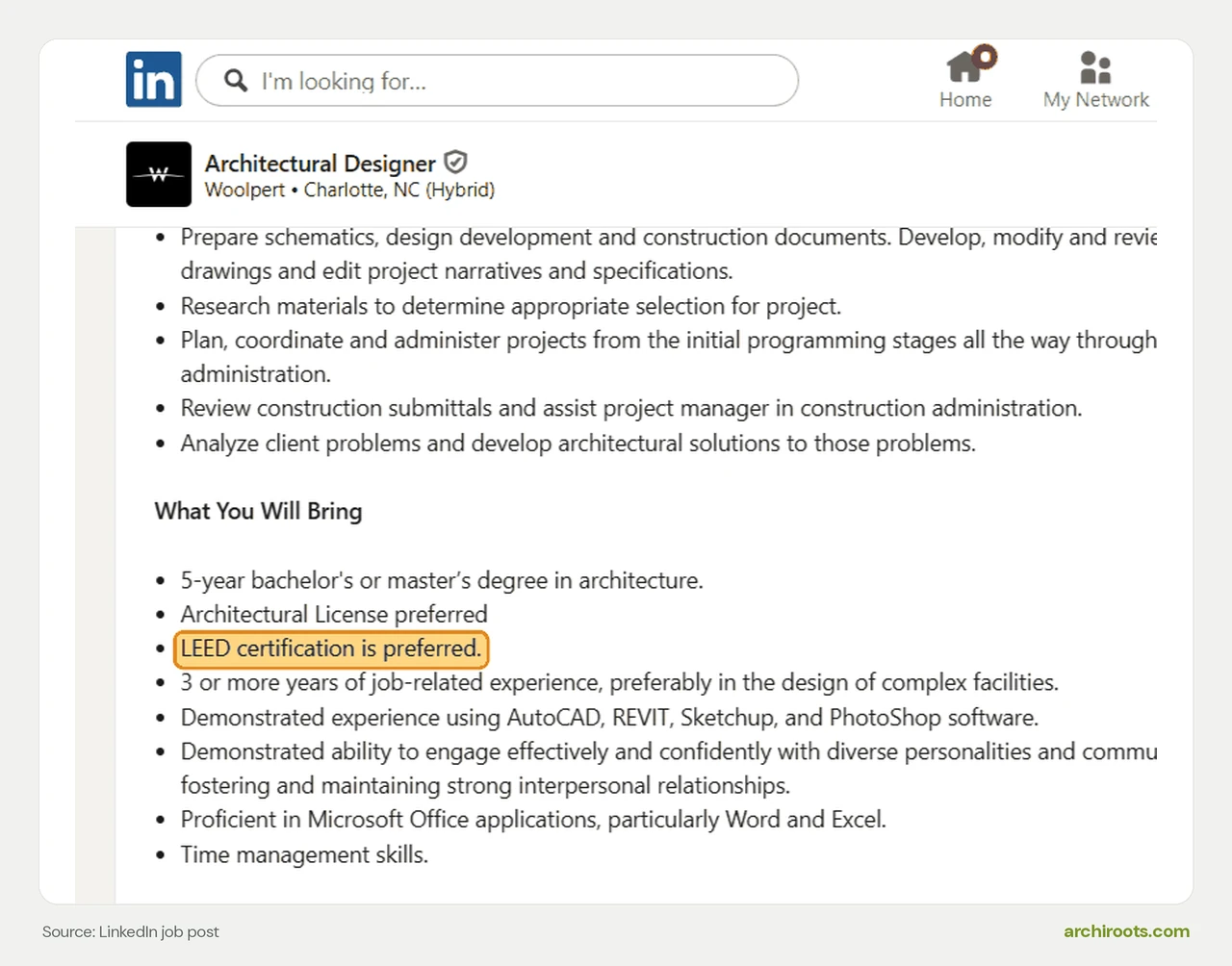
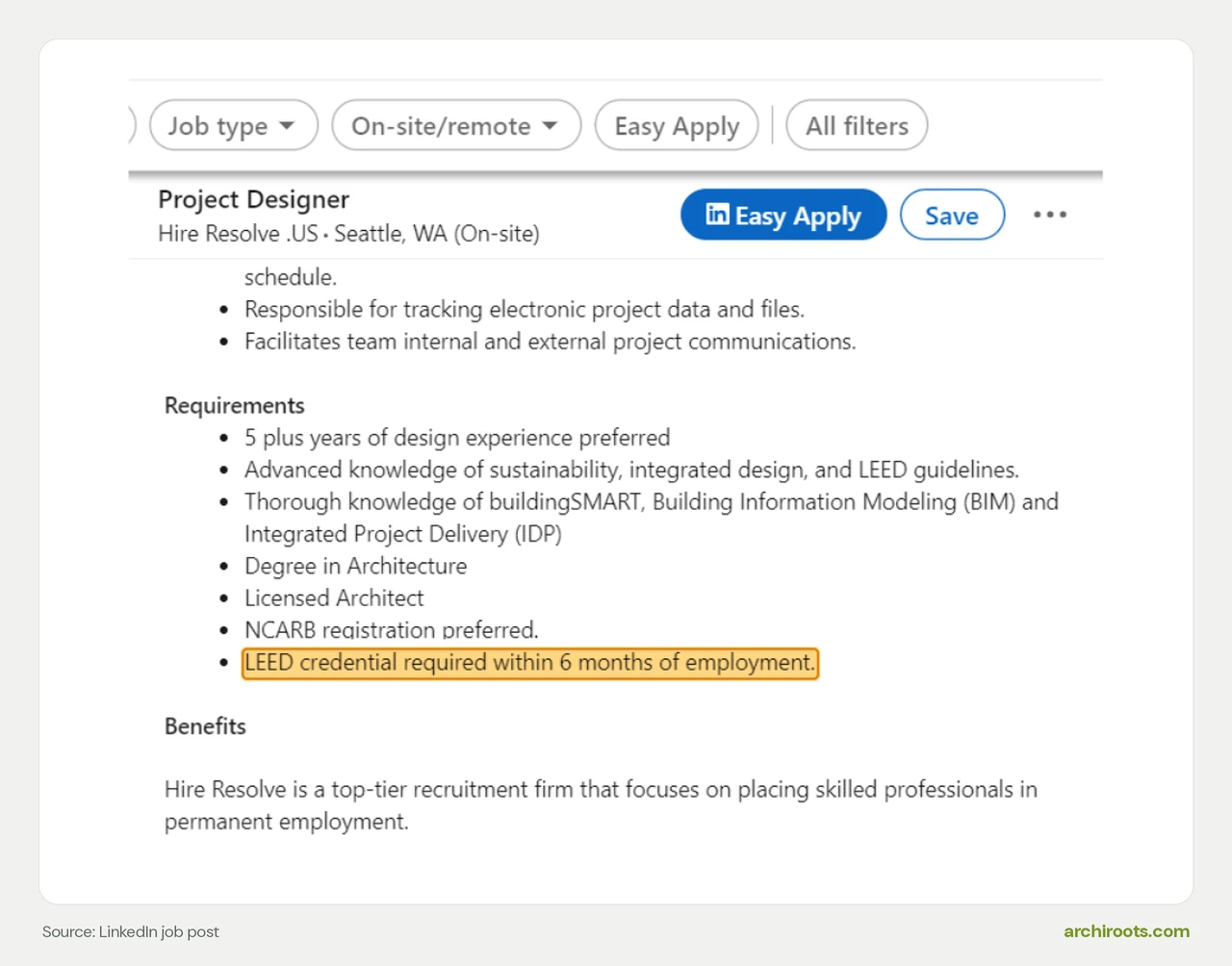
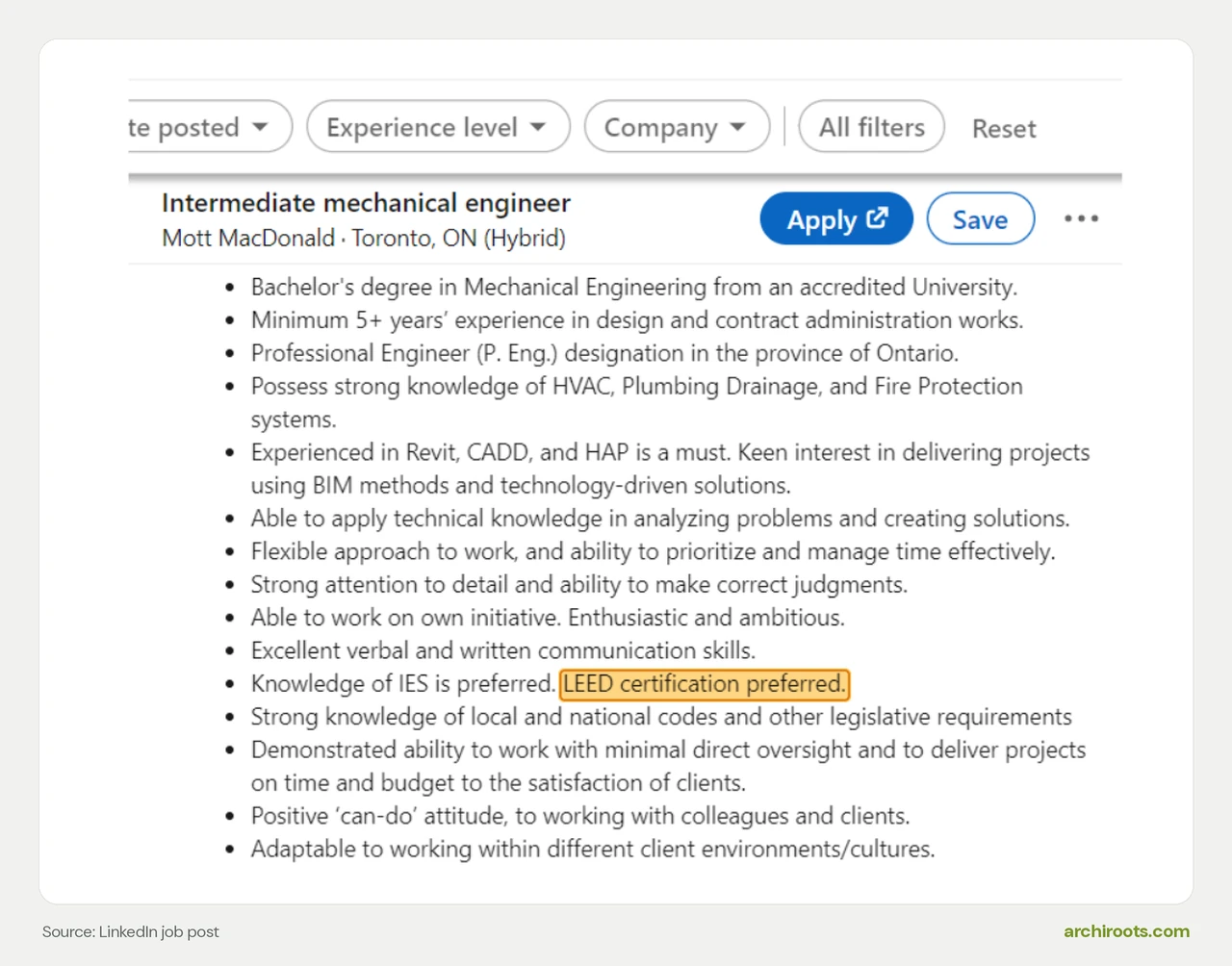
| Employer | Role | Location | What the ad says |
|---|---|---|---|
| Perkins&Will | Interior Designer | Austin, Texas | “LEED GA within 6 months of hire” |
| HDR | Interior Design Coordinator II | Glen Allen, Virginia | “LEED Green Associate preferred” |
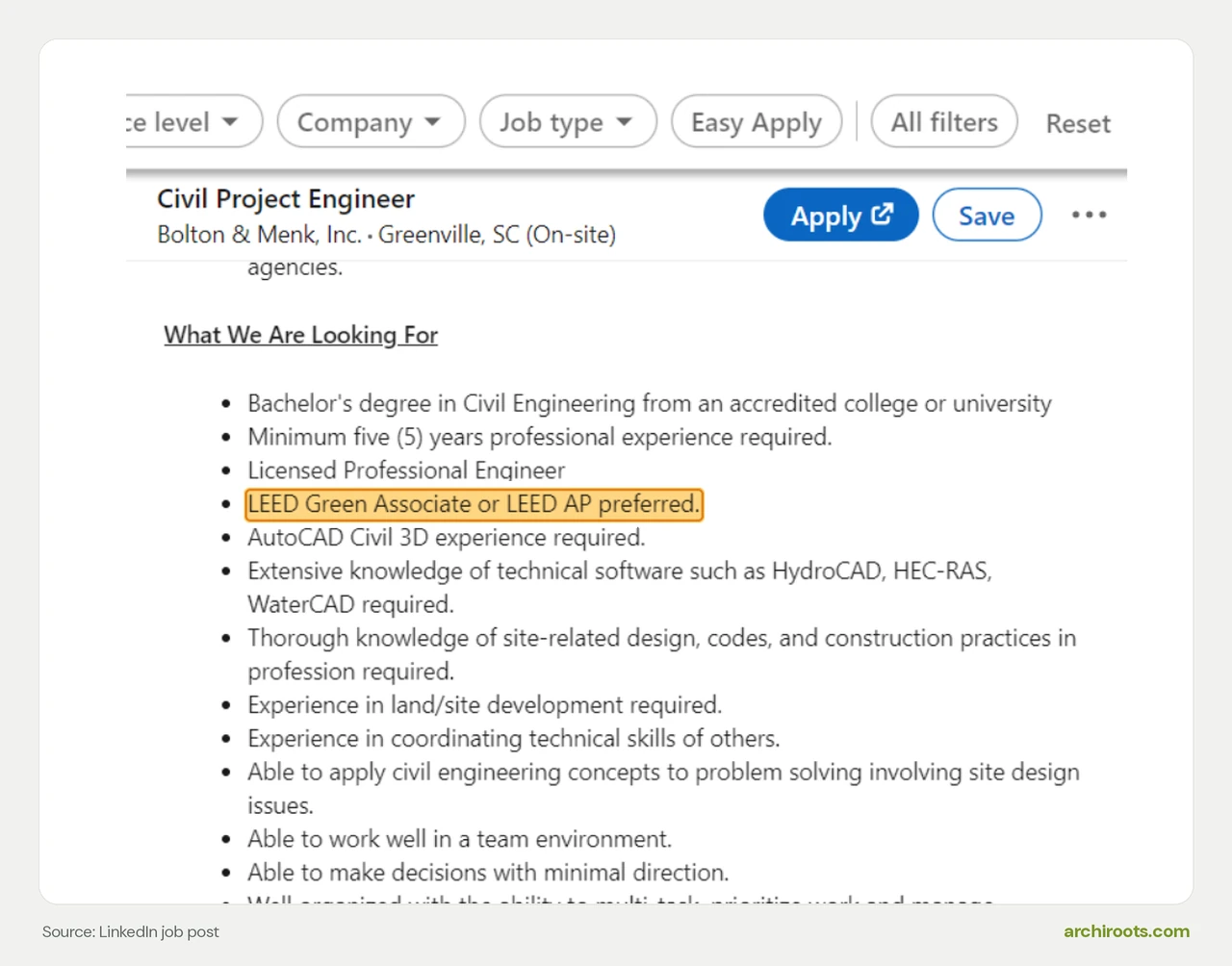
| Bolton & Menk | Civil Project Engineer | Greenville, South Carolina | “LEED Green Associate or LEED AP preferred” |
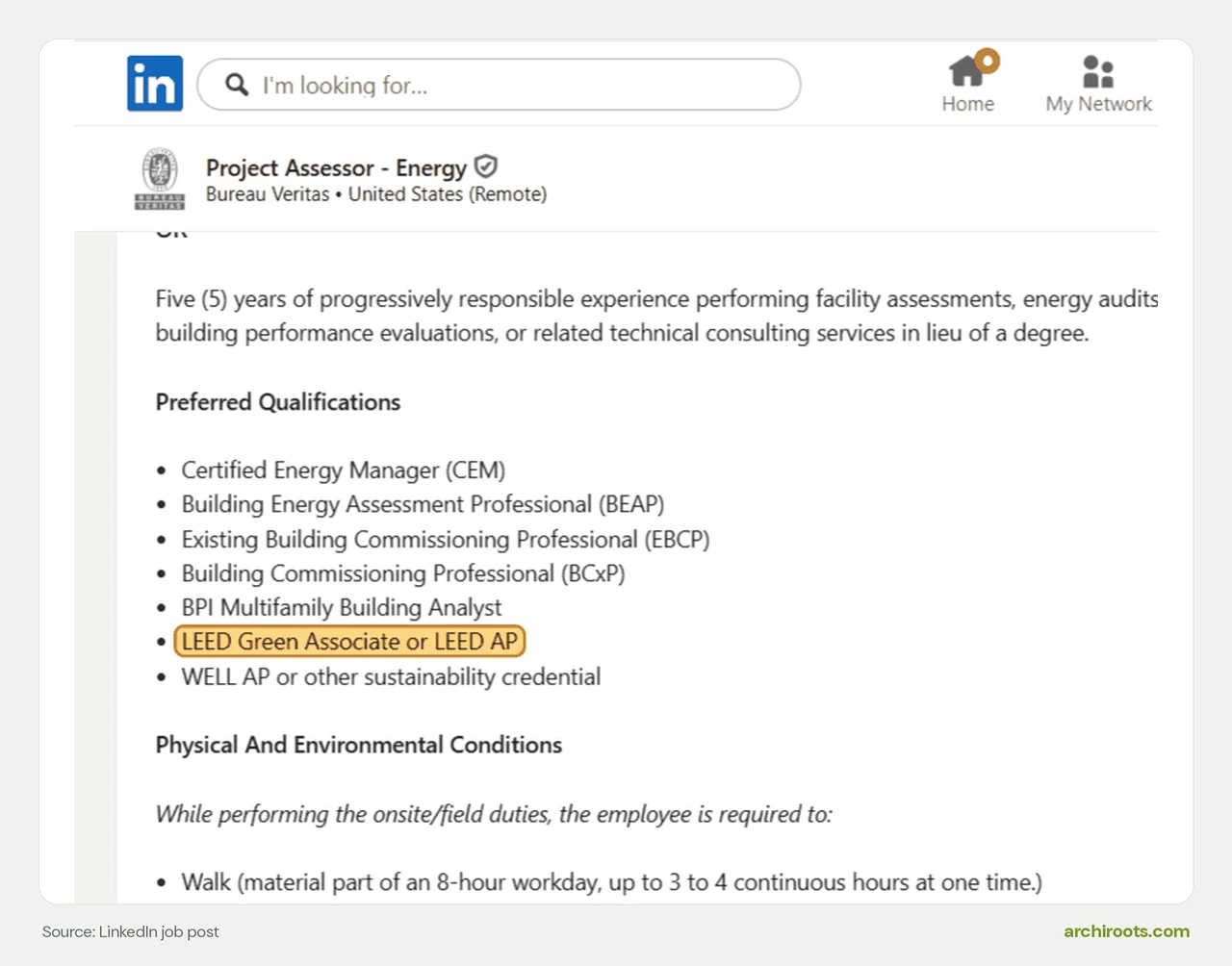
| Bureau Veritas | Project Assessor, Energy | United States, remote | “LEED Green Associate or LEED AP” |
| Woolpert | Architectural Designer | Charlotte, North Carolina | “LEED certification is preferred” |
| Gensler | Designer, Workplace Interiors | Charlotte, North Carolina | “LEED, Fitwell or WELL accreditation, NCIDQ preferred” |
| A recruiter for a design firm | Project Designer | Seattle, Washington | “LEED credential required within 6 months of employment” |
| Mott MacDonald | Intermediate Mechanical Engineer | Toronto, Ontario | “LEED certification preferred” |
| e.construct | Senior Mechanical Engineer | Dubai, UAE | “LEED-AP certification” |
| Jacobs | Senior Sustainability Consultant | Riyadh, Saudi Arabia | “Certified LEED Accredited Professional (AP)” |
What the ads show:
- Two of the ten give new hires a deadline: earn the credential within 6 months of starting. A candidate who already holds it removes that condition before the interview.
- The junior and mid level roles ask for the Green Associate or “a LEED credential”. The senior roles in Dubai and Riyadh ask for a LEED AP.
- The roles span interiors, architecture, civil engineering, mechanical engineering and energy assessment.
Job sites tell the same story at scale. ZipRecruiter listed about 660 open US jobs mentioning the LEED Green Associate in October 2026, mostly construction project managers, project superintendents and sustainability roles, and many asked for the credential at hire or within a year.
LEED Green Associate salary: what the numbers say
Payscale reports an average base salary of about $74,000 for people in the United States who list the LEED Green Associate, based on 1,568 profiles and updated in May 2026. Most of those profiles are early and mid career, at employers such as Turner, AECOM, Gensler and Jacobs.
That figure describes the people who hold the credential, so it cannot show what the credential adds: an architect and a project manager with the same credential earn different salaries.
What Archiroots students report is more specific. A raise follows a change: a move to a senior position, a move to a new company, or stepping up when a LEED project needs someone on it. The usual path looks like the job ads above. A role asks for an accredited person, the candidate with the credential gets it, and the new role pays more than the old one. Four students who reported their numbers saw raises of 20% to 50% with a new position, and one landed a first job.
So the credential pushes a salary up in the right context. It is not automatic, and nobody should expect a raise for passing an exam while everything else stays the same.
What does a LEED Green Associate do on a project?
A Green Associate usually works as a member of the project team who understands what the team is trying to earn, while someone more senior runs the certification.
LEED projects are managed on the Arc platform. Whoever handles the administration there, or is invited to the project as a team member, works faster with the credential because they know what each credit needs. They can also tell their own department and the other firms what is required to earn it.
Early in design, the team holds an integrative process charrette. A Green Associate is useful in that room. They know the LEED checklist and can help the owner decide which credits to target and which to leave, so the project reaches its certification level, its efficiency goals and the conditions of a green loan if there is one.
After that, the work follows the profession, as the table above shows. The architect designs for daylight and the mechanical engineer picks the refrigerants. The technical credit decisions usually sit with a LEED AP, which is covered further down.
LEED Green Associate requirements: who can take it?
Anyone. GBCI sets no prerequisites: no degree, no work experience and no minimum age. Candidates under 18 need a parent or guardian to file a consent form. GBCI recommends some exposure to LEED and green building concepts before testing, through a course, volunteering or work, but it does not check.
The people who ask “can I do this with no experience?” are mostly students, recent graduates and people outside the building industry. The answer is yes, and that is the purpose of this tier. It was created as the foundation level so that beginners have a way in.
Discipline is not a barrier either. One LEED Green Associate with ten years in manufacturing asked Archiroots in October 2026 whether a LEED AP was realistic without an architectural design background. It is. The credentials are recognized most in the building industry, but preparing for them does not depend on what you studied.
How to become a LEED Green Associate
The steps below show how to get the LEED Green Associate certification, from the first account to the result.
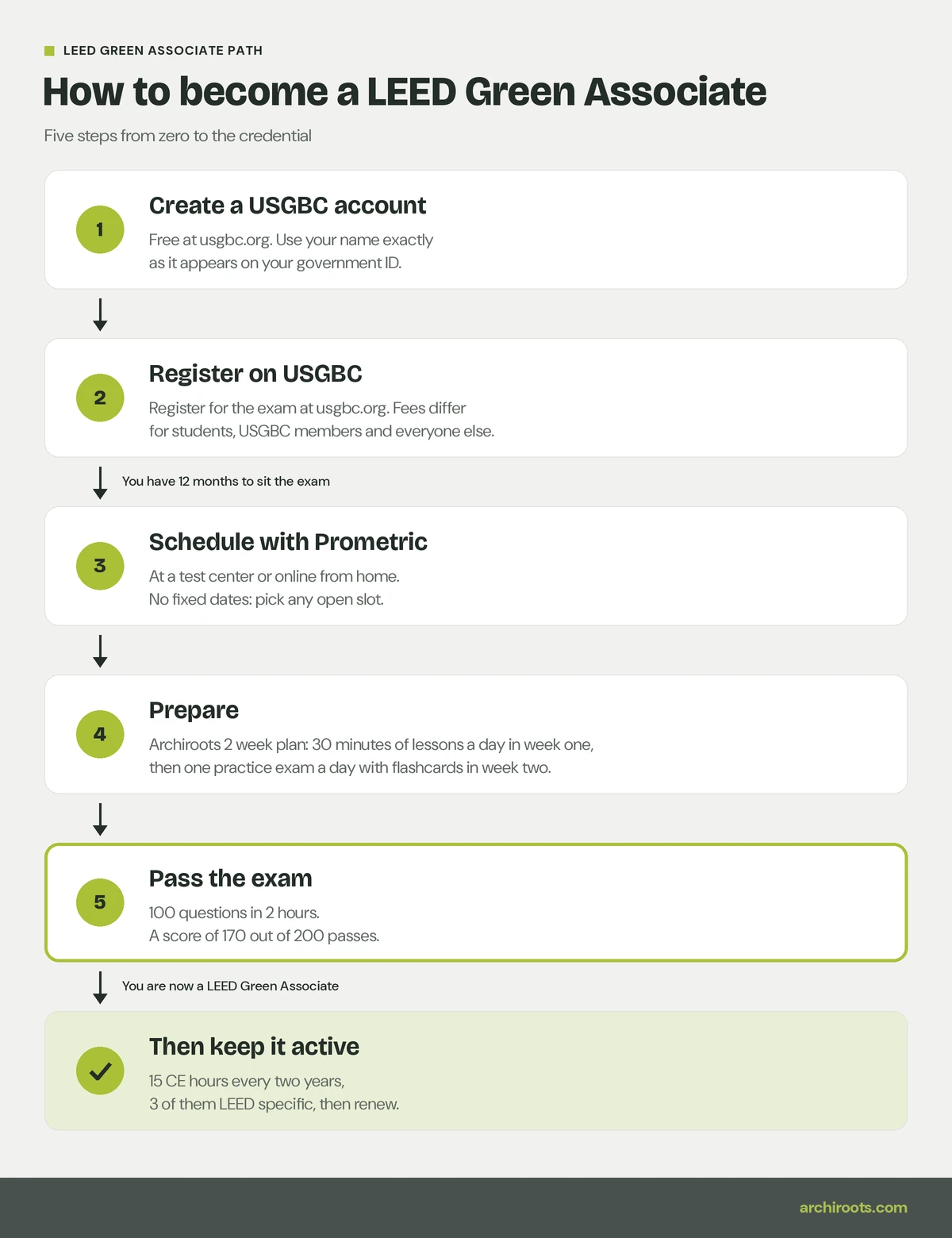
- Create a free account at usgbc.org. Use your name exactly as it appears on your government ID.
- Register for the LEED Green Associate exam and pay the fee. If your employer is a USGBC member, link your account to the organization first to get the member price.
- Schedule the exam at prometric.com/gbci. You can sit it at a Prometric test center or online from home. There are no fixed LEED Green Associate exam dates. You pick any open slot, and you have 12 months from registration to use it.
- Prepare. The usual Archiroots plan is two weeks: 30 minutes a day of lessons in the first week, then one practice exam a day with flashcard review in the second. The LEED Green Associate study guide lays out the materials.
- Sit the exam. Your score appears on the screen when you finish.
How long does it take?
It depends on the effort you put in. Some people prepare in one week, most in two or three, and some take months.
One week is realistic for someone who can give it full attention. A university student wrote to Archiroots after passing with a score of 173: “I only had about a week to prepare while dealing with a heavy university workload, and I was sick for around 3 of those days.”
The people who take much longer usually have a reason outside the material: a family matter, a health problem, or a start that stalled. Another student passed on her third attempt at studying for the exam. Her earlier tries, she wrote, left her “overwhelmed with too much information.”
Ready to become a LEED Green Associate? The LEED Green Associate exam prep follows the two week plan above, and the free LEED Green Associate practice exam shows where you stand before you start.
LEED Green Associate cost
The exam fee is the main cost. The table shows what the first two years add up to.
| Item | Cost | Notes |
|---|---|---|
| Exam fee, standard | $250 | Paid to GBCI at registration |
| Exam fee, USGBC member organization employee | $200 | Link your account to your employer before you register |
| Exam fee, student | $100 | School name and student ID entered at checkout |
| Retake | Full fee again | After three failed attempts in 12 months there is a 90 day wait |
| Certificate | $0 | Digital download from your account |
| Renewal after 2 years | $85 early, $100 otherwise | Plus 15 continuing education hours, which can be earned free |
| Study materials | Varies |
How the student price works
The student rate is open to bachelor’s, master’s and PhD students. At checkout on the USGBC site you enter your school and your student ID, and approval is almost instant.
It is recommended not to apply with an expired ID, and not to apply at all if you are not a student. A false claim can get a candidate banned, and a $150 saving is not worth that risk.
What is the LEED GA exam?
The LEED GA exam is the test that awards the credential. USGBC and GBCI call it the LEED Green Associate exam, and it is a computer based test delivered by Prometric.
| Detail | Fact |
|---|---|
| Questions | 100 multiple choice |
| Time | 2 hours (allow 2 hours 20 minutes in total) |
| Scoring | Scaled from 125 to 200 |
| Passing score | 170 |
| Version | LEED v5 |
| Language | English only. Translated versions are expected in 2027 |
| Where | A Prometric test center, or online with remote proctoring |
| When | On demand, any open slot within 12 months of registering |
| Result | Shown on screen at the end of the exam |
GBCI does not publish an official LEED Green Associate pass rate. The LEED exam guide covers what is known about the pass rate, the passing score, rescheduling fees and exam day.
After you pass: certificate, logo and directory
GBCI processes results within 72 hours of the exam. In practice the credential appears anywhere from an hour to two days later, so give it 24 hours before you look for it under Credentials in your USGBC account.
Once the result is processed, you download your certificate from the Credentials Dashboard in your account. It is a digital file. The current handbook states that hard copies are not available, so if you want one on the wall you print the file yourself.
As soon as you pass you may use the title and the LEED Green Associate logo, for example in an email signature. Both are covered by the USGBC Trademark Policy and Branding Guidelines.
Your name is also added to the public USGBC people directory, where an employer or client can look you up and verify the credential.
How to write LEED Green Associate after your name
| Where | Write this | Not this |
|---|---|---|
| After your name | Jane Smith, LEED Green Associate | Jane Smith, LEED GA |
| Resume, certifications section | LEED Green Associate, GBCI, 2026 | LEED Certified |
| Email signature | Jane Smith, LEED Green Associate | Jane Smith, Green Associate |
| LinkedIn, licenses and certifications | LEED Green Associate, issued by GBCI | LEED GA Certification |
| After earning a LEED AP | Jane Smith, LEED AP BD+C | Jane Smith, LEED Green Associate, LEED AP |
Two rules cover most cases. Write the title in full, because “LEED GA” is not approved. And when you earn a LEED AP with specialty, the AP designation takes the place of the Green Associate after your name. Also avoid “LEED certified” for a person: buildings are certified, people are credentialed.
Keeping the LEED Green Associate active
The credential lasts 2 years from the day you pass. To renew it you report 15 continuing education hours in that period, at least 3 of them LEED specific, and pay the renewal fee.
The recommendation here is simple: keep it active. The hours can be earned without paying for a single course, and the guide to free LEED CE hours shows four ways to do it and how to report them. The Green Associate is also the prerequisite for every LEED AP, so letting it expire closes that door until you test again.
Is the LEED Green Associate recognized outside the United States?
Yes. The exam is the same everywhere, and the credential is listed in the same USGBC directory whatever country you sit it in.
Demand is strong in the Gulf as well. Most LEED projects in the United Arab Emirates and Saudi Arabia are new construction and major renovations, and those markets need professionals who understand the system. Dubai and Riyadh stand out because of the volume of new development and because lenders offer green loans for certified projects. Developers there also find that a certified building markets better, sells faster and costs less to run. The directory reflects it. Among the countries counted, Saudi Arabia (2,889) and the UAE (2,504) come third and fourth for listed LEED professionals, behind the United States and Canada and ahead of China and India.
The knowledge transfers too. Green building rating systems share most of their main concepts. Someone who understands LEED will find Estidama in Abu Dhabi, Mostadam in Saudi Arabia and BREEAM familiar.
The instructor’s own start shows how it travels. Shadi AbouSamra earned the credential when he graduated, and it helped him land an internship as a sustainability consultant. He then moved to Italy for a master’s degree. When his professors learned that he was accredited and had some LEED project experience, they offered him part time work as a sustainability consultant at their firm, and it later became a full time job. His own summary is measured: the credential helped, and it was never the only reason.
LEED Green Associate or LEED AP: what comes next?
Stay at the Green Associate if you need general knowledge. Go on to a LEED AP when you want credibility on the technical side of a project.
A simple way to decide is by role. An owner can work well with the Green Associate, because the owner reviews the project at a general level. The commissioning agent or the principal architect should be a LEED AP, because they design and check the technical details.
The market is moving the same way. Stopping at the Green Associate is less competitive than it used to be, since firms prefer to present their team as LEED APs and clients value that more. In the USGBC directory, 57% of people on the current credential track have already gone on to an AP.
Two practical points:
- Pick the specialty that matches your work. Architects and civil engineers usually choose LEED AP BD+C, mechanical engineers BD+C or LEED AP O+M, and interior designers LEED AP ID+C. See what a LEED AP is for all five.
- Take the exams on separate dates. A combined 4 hour sitting was offered until April 26, 2026 and is not available at the moment. Even when it was, two dates suited most people better, because you arrive rested for each exam. A single long sitting only made sense for someone with years of LEED project work who was used to 4 hour exams.
What changed for the LEED Green Associate with LEED v5?
The exam is now based on LEED v5, and three questions come up again and again.
Can you study with LEED v4 material?
No. Use material written for v5.
Is LEED v5 a major change?
Yes, for the rating system. It adds three impact areas, new credits such as electrification, and several items that used to be optional credits are now prerequisites, which makes certification harder for projects. The LEED v5 guide explains each change.
Does LEED v5 change what the credential means?
No. The version is new and the concepts are the same. A LEED Green Associate earned on an earlier version is still a LEED Green Associate, and it is kept current through continuing education.
Frequently asked questions
What is a LEED Green Associate?
A LEED Green Associate is a person who has passed the GBCI exam on green building and the LEED rating system. It is the entry level LEED credential and has no prerequisites.
What does it mean to be LEED GA certified?
It means you hold the LEED Green Associate credential. People say “LEED GA certified” in conversation, but the approved title is LEED Green Associate, and the precise word is credentialed or accredited.
Who issues the LEED Green Associate certification?
Green Business Certification Inc. (GBCI) runs the exam and awards the credential on behalf of the U.S. Green Building Council (USGBC).
How much does the LEED Green Associate cost?
The exam costs $250, or $200 for employees of USGBC member organizations and $100 for students. Renewal every two years costs $85 if paid early and $100 otherwise.
How long does the LEED Green Associate last?
Two years. It is renewed with 15 continuing education hours and a renewal fee.
How do you register for the LEED Green Associate exam?
Create a free account at usgbc.org, register and pay for the exam there, then schedule a date at prometric.com/gbci. You have 12 months to sit the exam after registering.
Can a student get the LEED Green Associate?
Yes. There are no prerequisites, students pay a reduced exam fee of $100, and the rate covers bachelor’s, master’s and PhD students.
Can you download the LEED Green Associate certificate?
Yes. After your result is processed, the certificate is available as a digital download in the Credentials Dashboard of your USGBC account.
How do employers verify a LEED Green Associate?
Through the public USGBC people directory, which lists every active credential holder by name.
Is the LEED Green Associate enough, or do you need a LEED AP?
It is enough for general knowledge and for many job ads. For technical roles on a LEED project, such as the lead architect or the commissioning agent, a LEED AP with specialty carries more weight.