A LEED AP is a professional credential for people, not buildings. GBCI awards it to someone who holds the LEED Green Associate and passes a LEED AP exam in one of five specialties: BD+C, O+M, ID+C, ND or Homes. It shows the holder can guide a project through that LEED rating system.
In short
• LEED AP stands for LEED Accredited Professional. The full name of the credential is LEED AP with specialty.
• Buildings earn LEED certification. People earn LEED credentials, and the LEED AP is the level after the LEED Green Associate.
• Each exam covers one specialty, and BD+C is by far the most common choice.
• The credential stays active with 30 continuing education hours every two years, 6 of them in your specialty.
• Employers ask for it mostly in project manager, architect and engineer roles.
What does LEED AP stand for?
LEED stands for Leadership in Energy and Environmental Design, the green building rating system developed by USGBC. AP stands for Accredited Professional, so a LEED AP is a professional accredited in LEED. Whereas GBCI runs the exams and the credential. For the rating system itself, see what LEED is and how it works.
The full name is LEED AP with specialty, and the specialty follows the letters: LEED AP BD+C, LEED AP O+M, LEED AP ID+C, LEED AP ND or LEED AP Homes. Each exam covers one rating system in depth, so the specialty tells a client which kind of project the holder knows. A LEED AP BD+C works on new construction. A LEED AP O+M works on buildings already in operation.
People often say “LEED AP certification” or “certified LEED AP”. Strictly speaking, a building is certified and a person holds a credential, but job posts and recruiters use both wordings for the same thing.
The LEED AP is the second step on a ladder. The LEED Green Associate comes first; it is open to anyone and is the only requirement for sitting a LEED AP exam. Some people who passed the original LEED AP exam before 2009 still write “LEED AP” with no specialty. That older credential is the legacy LEED AP, covered in the credential comparison and the history of LEED.
What does a LEED AP do on a project?
A LEED AP helps the team win the work, choose its credits and document them for certification. The credential comes into play at three points in a project.
When the firm bids
Design and construction firms put their team’s resumes into proposals. A LEED AP on the team tells the client that the people designing and building the project know how to deliver it sustainably and take it through certification without wasted rounds. For most employers, this is the main reason to ask for the credential.
LEED rewards it as well. Under LEED v5, a project earns a point in the Project Priorities category when a principal participant on the team holds a LEED AP with a specialty that matches the project. The sustainability consultant often brings that point, but each discipline still benefits from having its own LEED AP, because every department has credits to deliver.
During design
A LEED AP knows the requirements behind each prerequisite and credit, and the different ways to earn the same points. That includes pilot credits, which USGBC tests on live projects before adding them to the rating system.
On a project for a large supermarket chain, that knowledge added two measures the design brief never mentioned. The team installed a bicycle maintenance station with tools for customers, which earned an innovation point at the time. It also hired a hauler to collect batteries and electronic waste, which counted toward points as well. The second measure lasted well beyond certification. People in the neighborhood started bringing their used batteries, old phones and electronic waste to the supermarket instead of sending that toxic waste to landfill.
The same knowledge helps before a project even commits to LEED. On a development financed with a green loan, the owner compared LEED with BREEAM. The site’s public transit access scored better under LEED’s transportation credits, and that helped the owner choose LEED.
During certification
The project’s LEED AP assigns credits to the right team members, checks that each submission answers what the credit asks, and helps respond when a reviewer comes back with questions. When a credit’s wording leaves room for doubt, a LEED AP knows where to look for an official answer; the guide to LEED interpretations and CIRs explains the two routes.
The habit carries over to projects that never certify. Architects and engineers who hold a LEED AP tend to design with the credits in mind anyway, and their buildings perform better for it whether or not the owner pays for certification.
Does a LEED AP make you a sustainability consultant?
No. This is the most common misunderstanding about the credential: that passing the exam turns an architect or engineer into a sustainability consultant.
Sustainability consultants usually bring more than one credential, often a WELL AP next to one and more LEED AP specialties, plus experience in energy modeling. Energy modeling is a separate skill. Late in design, the modeler builds a digital version of the building with its wall assemblies, U-values, insulation, orientation and window specifications, the expected number of occupants and every internal heat source down to the light bulbs. The model predicts how much heating and cooling the building needs over a year, and that result drives the energy credits. The LEED AP exam does not teach it.
The LEED AP proves something narrower. The holder knows one rating system well enough to take a project through it. A mechanical engineer with a LEED AP is still a mechanical engineer, and the same goes for architects, interior designers and civil, electrical or landscape engineers. They keep their duties, but they design, specify and document with the credits and prerequisites in mind, which makes them more useful on any project pursuing certification.
Who hires LEED APs?
Mostly firms hiring project managers, architects and engineers. An Indeed search of US job posts in September 2026 found 1,396 that mention “LEED AP”. Filtered by job title, project manager roles lead, followed by architects and mechanical engineers.
US job posts that mention “LEED AP”, by job title
| Job title contains | Job posts |
| Project manager | 338 |
| Architect | 142 |
| Mechanical engineer | 111 |
| Director | 68 |
| Commissioning | 60 |
| Electrical engineer | 59 |
| Energy | 45 |
| Sustainability | 30 |
| Interior designer | 27 |
| Superintendent | 18 |
| Plumbing | 18 |
| Estimator | 14 |
| Construction manager | 10 |
| Civil engineer | 10 |
The same search found 144 posts that mention “LEED Green Associate”, so employers asked for the AP almost ten times as often.
Job post wording points the same way. Here is what four LinkedIn posts asked for:
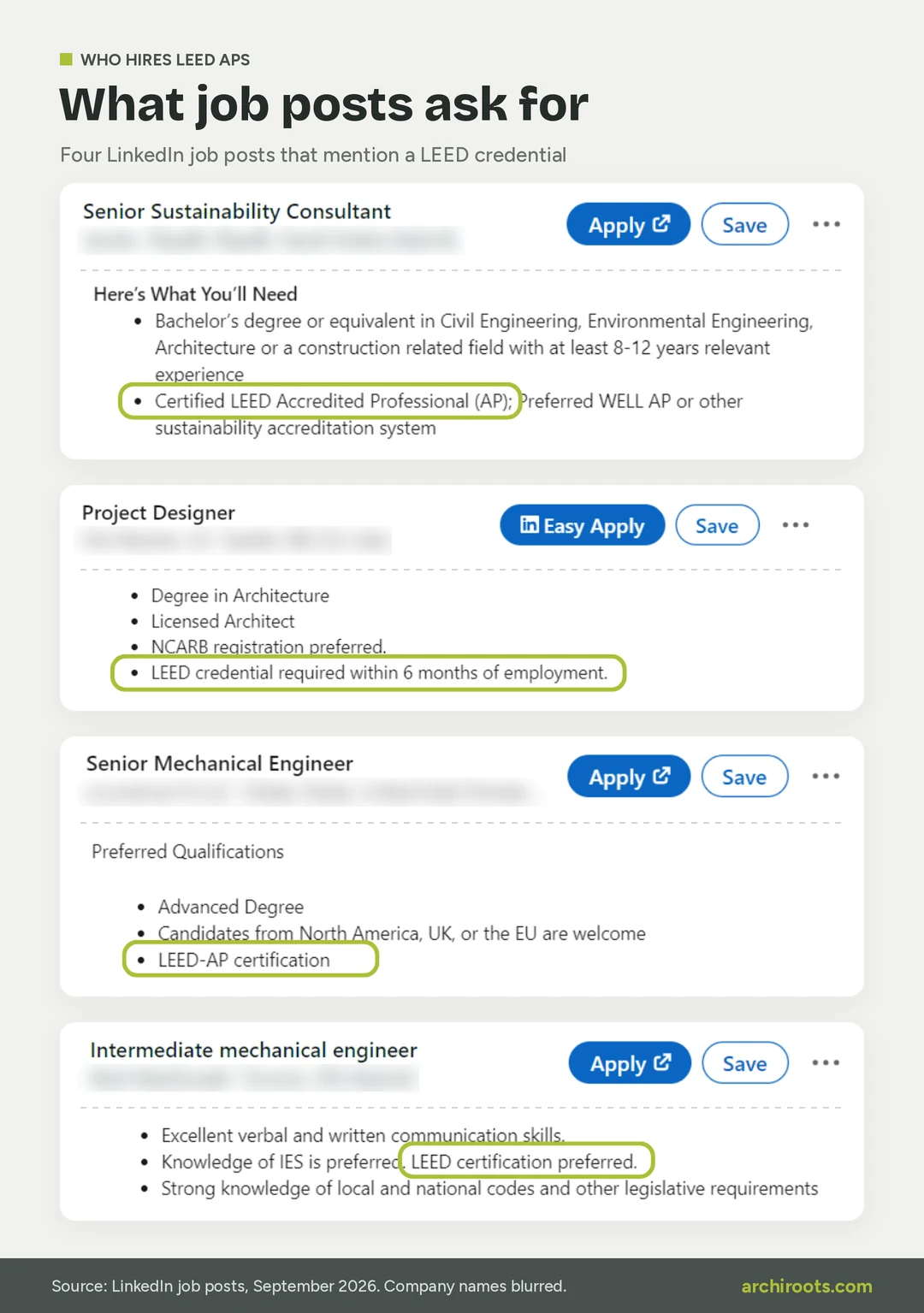
What four job posts asked for
| Role | What the post asks for | What it shows |
| Intermediate mechanical engineer | “LEED certification preferred”, listed with HVAC design experience and a Professional Engineer designation | An engineering job that uses the credential, and calls it “LEED certification” |
| Project designer (licensed architect) | “LEED credential required within 6 months of employment” | Some employers hire first and expect the credential soon after |
| Senior mechanical engineer | “LEED-AP certification” as a preferred qualification, next to load and energy calculation software | The credential sits beside the engineer’s everyday technical tools |
| Senior sustainability consultant | “Certified LEED Accredited Professional (AP); preferred WELL AP or other sustainability accreditation”, plus knowledge of other rating systems | The consultant role expects the LEED AP and more on top of it |
What are the five LEED AP specialties?
Each specialty matches a LEED rating system.
The five LEED AP specialties
| Specialty | Covers | Suits |
| LEED AP BD+C | Building Design + Construction: new construction and major renovation | Architects, engineers, contractors and project managers |
| LEED AP O+M | Building Operations + Maintenance: existing buildings in operation | Facility managers, owners’ teams and operations consultants |
| LEED AP ID+C | Interior Design + Construction: fit-outs and tenant spaces | Interior designers and interior architects |
| LEED AP ND | Neighborhood Development | Planners and developers working at neighborhood scale |
| LEED AP Homes | Single family and multifamily homes | Residential designers and builders |
BD+C is the usual choice. Of the Archiroots students who move on from the LEED Green Associate to an AP, about 85% choose BD+C, 10% choose O+M and 5% choose ID+C. That matches where most project teams work: new construction and major renovation. If your work splits between new and existing buildings, the credential comparison helps you choose, and the LEED AP BD+C and LEED AP O+M pages cover each exam.
What are the LEED AP requirements?
To register for a LEED AP exam, you need to:
- be 18 or older
- hold an active LEED Green Associate credential, or an active LEED AP with specialty, from registration through exam day
- agree to GBCI’s policies and credential maintenance requirements
A LEED Green Associate earned on an earlier version of the exam still qualifies. LEED project experience is strongly recommended but not required.
What if you have no project experience?
GBCI writes the LEED AP exams from a job task analysis, a survey of what working LEED professionals do on projects. So the questions check whether you know how to carry out a task. Knowing what LEED Online is, for example, is different from knowing how a project gets registered and how credits get assigned inside it.
You can close much of that gap before the exam:
- Follow one credit from requirement to documentation, using the credit language and sample form in USGBC’s credit library.
- Learn the certification steps in order: registration, credit assignment, submission, review and response.
- Sit in on a project kickoff or credit workshop at your firm if one is running.
- Use practice exams written in the style of the real exam, such as the free LEED AP BD+C practice exam.
What is the LEED AP exam like?
The LEED AP exam is a multiple-choice test on one specialty. According to the LEED AP with specialty candidate handbook, it has 100 questions in two hours, and you need a score of 170 or higher to pass. You can take it at a Prometric test center or online with a remote proctor. The questions cover the credit categories of your specialty’s rating system and how LEED certification works in practice. The weight of each topic and the scoring details are in the LEED exam guide.
It is harder than the LEED Green Associate because it tests credit-level detail and how requirements apply on a real project. Candidates with project experience have an edge, and the steps above help close the gap for everyone else.
People who have passed most often say the credit-level numbers took the most study: thresholds, calculations and exemplary performance levels. Many also walk out unsure whether they passed, including people who passed comfortably. Steady practice exam scores are a better guide to readiness than how the exam felt.
How do you become a LEED AP?
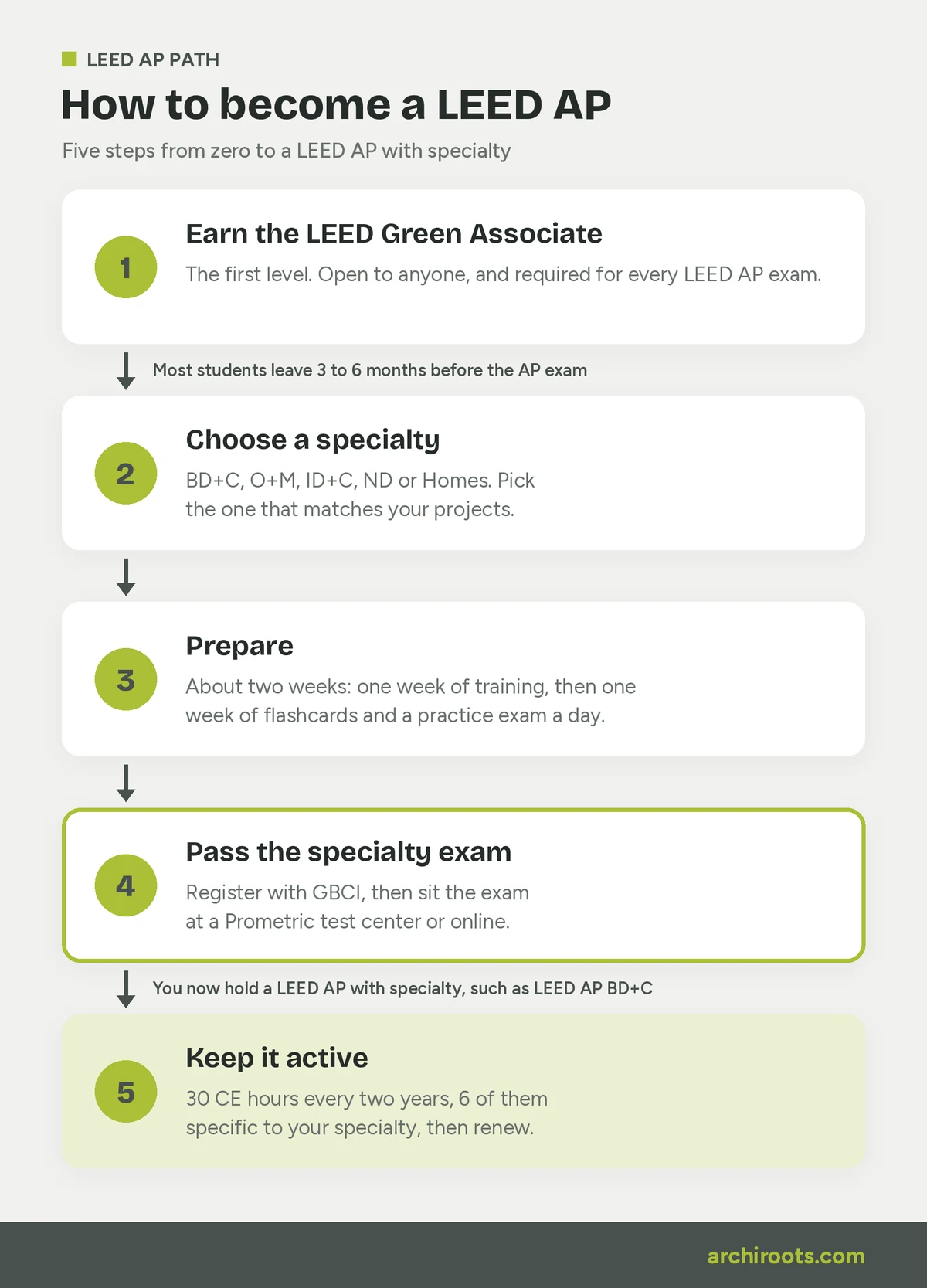
- Earn the LEED Green Associate. It is the first level and required for every AP exam; the LEED Green Associate exam prep covers it in about two weeks.
- Choose your specialty to match the projects you work on.
- Prepare. The Archiroots plan takes about two weeks for either exam: one week of training, then one week of flashcard revision with one practice exam a day. Book the exam once your practice scores hold at 80%.
- Register with GBCI, then book and sit the exam at a Prometric test center or online. Registration gives you 12 months to take it, so there is no need to book before you are ready.
- Keep the credential active with 30 continuing education hours every two years.
Most Archiroots students leave three to six months between the two exams. Some take a break after the LEED Green Associate. Others go straight on while the material is fresh, since the AP builds on the same foundation.
Preparation has changed a lot. Candidates once studied straight from the LEED reference guide and found few practice exams to test themselves with. The reference guides are the authoritative manuals for project teams, written to answer every question a real project can raise, and GBCI lists them among the references for each exam. Structured exam prep organizes that material around the exam’s knowledge domains and checks your readiness with exam style questions.
How much does it cost to become a LEED AP?
LEED AP costs
| Item | Standard fee | USGBC member |
| LEED Green Associate exam | $250 | $200 (students $100) |
| LEED AP with specialty exam | $350 | $250 |
| Credential renewal, every two years | $100, or $85 if renewed early | Same |
| Continuing education | Free options exist; paid courses vary | Same |
| Exam preparation | Varies by provider | Same |
Over five years, a non-member who passes both exams and renews twice at the early rate pays $770 in GBCI fees ($250 + $350 + $85 + $85). A USGBC member pays $620. Study materials come on top.
Two things keep the cost down. Earning the AP replaces your LEED Green Associate, so you only renew one credential. And between a quarter and a half of Archiroots AP students have their employer pay; firms training several people at once often use group training.
How do you keep a LEED AP active?
A LEED AP with specialty stays active with 30 continuing education (CE) hours every two years: 24 general or LEED specific hours, plus 6 LEED specific hours in your specialty. The hours can come from several places.
Ways to earn CE hours
| Activity | CE hours earned |
| Working on a registered or certified LEED project | 1 hour per credit you work on, plus 2 per project for the project administrator |
| Approved courses and webinars | 1 hour per hour of learning |
| Writing about green building | 3 hours per published article, 10 per book |
| Volunteering | 1 hour per hour, up to half of your total |
Working on LEED projects is the easiest source, since each credit you work on counts. For the rest, this list of free LEED CE hours is kept up to date. Renewing within your two year reporting period also gets you the lower renewal fee.
Timing can save you some hours too. Passing the AP replaces your LEED Green Associate and starts a new two year reporting period. If you pass while the LEED Green Associate is still active, you no longer need to finish its 15 CE hours.
Can you hold more than one LEED AP specialty?
Yes. Once you hold one LEED AP with specialty, you can sit another specialty exam without repeating the LEED Green Associate. A second specialty suits people whose work crosses rating systems, such as consultants who handle both new and existing buildings.
Each extra specialty adds 6 specialty specific CE hours. A LEED AP BD+C who adds O+M needs 36 hours every two years: 24 general or LEED specific, 6 for BD+C and 6 for O+M. The renewal fee stays the same, because one renewal covers all your specialties.
What changed for LEED APs in LEED v5?
When USGBC releases a new version of LEED, GBCI updates the exams to match. People who already hold a LEED AP keep it and stay current through continuing education. LEED v5 changed enough that anyone who learned on v4 should treat parts of it as new material. A fuller overview is in the LEED v5 guide.
Decarbonization carries the most weight
About half of the LEED v5 credits address decarbonization, a quarter address quality of life and a quarter address ecological conservation and restoration, according to the AIA’s overview of LEED v5. Carbon now appears in almost every category.
Assessments come first
Every project now starts with a carbon assessment, a climate resilience assessment and a human impact assessment. The Integrative Process category grew into Integrative Process, Planning and Assessments, with more prerequisites and credits than before, so the LEED AP has work to do before the first design meeting.
Embodied carbon is a prerequisite
Under MRp2 Quantify and Assess Embodied Carbon, every LEED v5 BD+C project has to measure the carbon in its materials. New credits also reward electrifying building systems.
Some innovation ideas became regular credits
Bicycle maintenance, the idea behind the supermarket innovation point above, is now one path inside LTc4 Transportation Demand Management. It earns one point for a permanent, secure repair station with a complete set of tools and an air pump, in the same credit that rewards reduced parking. A LEED AP who learned the system under v4 needs to know where things moved.
Is a LEED AP worth it?
For most people who work on buildings that pursue LEED or want to build sustainably, yes. The credential shows up where decisions get made: in proposals, in team resumes and on the certification itself.
Archiroots students give the same reasons again and again:
- their employer or client requires it
- their firm uses team resumes to win bids, and the credential adds authority
- the Project Priorities point for having a LEED AP on the team
- a promotion or pay rise
- credibility as a consultant
- a move toward sustainability work
Authority in bids comes up most often. Be careful with the last reason. The AP helps, but on its own it does not make someone a sustainability consultant, as explained above.
Mostly LEED APs are the technical people who deliver the credits. The LEED Green Associate draws a wider group, including developers who want to understand the options on a LEED project and monitor it without running the calculations themselves.
Demand also depends on the sector and the market. LEED requirements come up most on public and federal buildings, schools and universities, large commercial projects and at firms that deliver LEED certification for clients. A quick test is to read a dozen job posts for the role you want and count how many mention LEED.
The AP is harder to justify for people who never touch a LEED project, such as residential designers in markets where clients do not ask for certification. For them, the LEED Green Associate often covers what they need. The same goes for architecture students and graduates working toward licensure: the LEED Green Associate is the usual first step, and the AP makes more sense once you are on LEED projects.
How do you read LEED AP after someone’s name?
Many people look up “LEED AP” after seeing it in an email signature or on a proposal. Here is how to read the common combinations.
Reading LEED credentials in a signature
| Signature | What it means |
| Jane Doe, AIA, LEED AP BD+C | An architect who is a member of the American Institute of Architects and holds the LEED AP with the Building Design + Construction specialty |
| John Smith, PE, LEED AP O+M | A licensed Professional Engineer who holds the LEED AP with the Operations + Maintenance specialty |
| Sam Lee, LEED AP | A LEED AP with no specialty shown. It may be a legacy LEED AP earned before 2009, or a current holder who left the specialty off |
| Maria Cruz, LEED Green Associate | The first level LEED credential |
GBCI’s own example for a business card is “John Smith, LEED AP”, and trademark symbols are not needed where space is tight. The approved designation adds the specialty, such as LEED AP BD+C, and is never spelled out as “LEED Accredited Professional”. The LEED exam guide covers the naming rules.
A LEED AP is a credential, and it does not license anyone to stamp drawings or practice architecture or engineering. To check whether someone holds it, search their name in the USGBC people directory. Listing there is optional, so a missing name is not proof on its own.
Frequently asked questions
Is LEED AP a license?
No. It is a professional credential awarded by GBCI. It does not replace an architecture or engineering license.
Is a LEED AP the same as LEED certification?
No. A building earns LEED certification; LEED certification requirements explains how. A person earns the LEED AP by passing a specialty exam.
What is the difference between a LEED Green Associate and a LEED AP?
The LEED Green Associate is the first level and covers general green building and LEED knowledge. The LEED AP adds depth in one rating system and requires the LEED Green Associate first. The full comparison goes further.
How long does it take to become a LEED AP?
With structured prep, about two weeks for the LEED Green Associate and two weeks for the AP. Most Archiroots students leave three to six months between the two exams.
How do I know I’m ready for the LEED AP exam?
Take a full practice exam after your first week of study. A score of 60% or more means you are on track; below that, go back over your weakest categories before moving on. Book the exam once your practice scores hold at 80%. The free LEED AP BD+C practice exam is a good first check.
Can I study from older LEED AP material?
Older material still explains how LEED and the certification process work, but credit names, thresholds and prerequisites change between versions. The candidate handbook lists the rating system and references each exam is based on, so check that your main study source matches them.
How much does it cost to become a LEED AP?
$600 in exam fees for a non-member ($250 for the LEED Green Associate and $350 for the AP), or $450 for a USGBC member, plus study materials. Renewal costs $85 to $100 every two years.
Does a LEED AP raise your salary?
In theory yes, but it’s not the only thing that will effect a salary. Pay follows the role, and the roles that ask for a LEED AP are mostly project managers, architects and engineers. A promotion or pay rise is one of the reasons Archiroots students give for taking the exam.
Can you become a LEED AP without experience?
Yes. Experience is strongly recommended but not required. You need to be 18 or older and hold an active LEED Green Associate credential.
Does a LEED AP expire?
It stays active as long as you complete 30 CE hours every two years, 6 of them specific to your specialty, and renew.
Which LEED AP should I get?
The one that matches your projects: BD+C for new construction and major renovation, O+M for existing buildings, ID+C for interiors. Most people choose BD+C.
Should I get a LEED AP or a WELL AP?
They cover different things. LEED scores a building’s environmental performance, while WELL scores its effect on the people inside. Many professionals hold both; the credential comparison and the WELL AP exam prep page explain the difference.
Should I get a LEED AP or a Passive House certification?
They build different skills. Passive House training goes deep on energy design for very low energy buildings. The LEED AP covers a whole rating system: energy, water, materials, site, indoor environment and the certification process itself. Choose the one your clients and projects ask for; some designers hold both.
Ready to become a LEED AP? The LEED AP BD+C course is built on the current LEED v5 reference guide and follows the two week plan above: training, flashcards and full practice exams. Start the LEED AP BD+C course. Want to see where you stand first? Take the free LEED AP BD+C practice exam. Not a LEED Green Associate yet? Start with the LEED Green Associate.