What you need to pass the LEED Green Associate exam
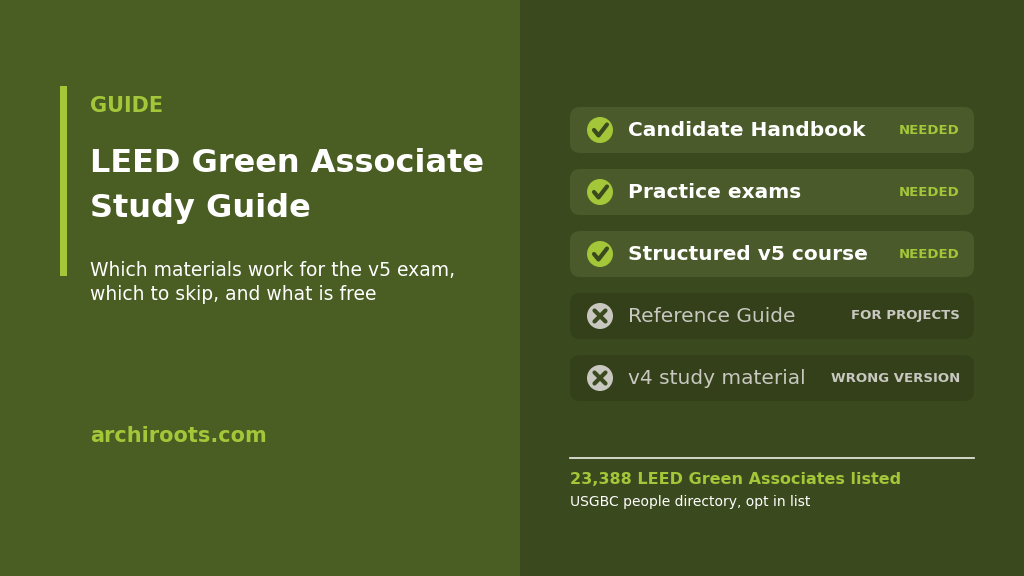
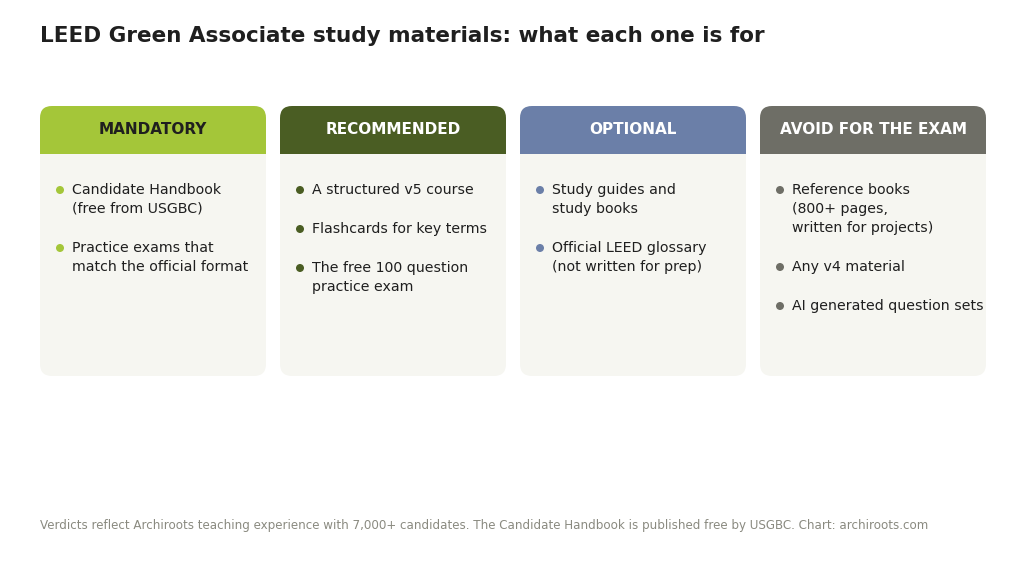
To pass the LEED Green Associate exam you need three things: the free LEED Green Associate Candidate Handbook, one current LEED v5 course or guide that filters the material down to what the exam tests, and practice exams that match the official format. The LEED Reference Guide is not on that list. Everything else is optional, and some of it, including anything written for LEED v4, will cost you marks. This guide sorts the common study materials into needed, optional and avoid, based on what has worked for more than 7,000 Archiroots candidates, and it lists everything that is free.
Search for a LEED Green Associate study guide and the first result is the official book, the second is a list of links, and the third is a thread of strangers comparing notes. None of them answer the question that decides whether preparation takes two weeks or four months: what to skip. The USGBC people directory lists 23,388 Green Associates, and since the directory is opt in, the real number is higher. The ones who got there fastest read less than you might expect. They read the right things in the right order and spent the rest of their time on practice.
What the exam rewards
Concept based, not calculation based
The Green Associate exam tests whether you understand how green building works and how LEED organizes it: the rating systems, the credit categories, the process a project follows from registration to certification, and the vocabulary that runs through all of it. You will not memorize formulas or do calculations. That is the most useful fact about the exam, because it rules out most of the reading people do. The LEED exam guide covers format, timing and scoring, and the LEED certification requirements article covers eligibility. In short, anyone can sit it.
The LEED AP exams work differently. AP BD+C rewards judgment on credit thresholds and trade offs, and candidates who have taken both call it the trickier exam, because it invites you to trust what you think you know. The Green Associate is the logical one: if a concept makes sense, the question about it usually does too. Which credential fits which career is covered in the comparison of LEED GA, LEED AP and WELL AP, so this guide does not repeat it.
Why that decides your materials
A concept exam punishes two kinds of material. One goes deeper than the exam ever will, which describes the Reference Guide and parts of the official textbooks. The other is written for the wrong version, which describes most of what is free online. What the exam does reward is a clear map of the categories and how they relate, precise definitions of the terms the rating system uses, and repetition under something close to exam conditions. The verdicts below all come from that.
The Candidate Handbook: the only mandatory read
What to take from it
USGBC publishes the LEED Green Associate Candidate Handbook free online, and every candidate should read it before buying anything. It is the official statement of what the exam covers: the knowledge domains and how heavily each is weighted, the eligibility rules, the exam policies, and how scoring works. It is short, and it is the only document that can tell you whether a study material is aimed at the right target, because every other material is supposed to follow it.
Take three things from it. First, the domain list and the weights, so you know where the marks concentrate. Second, the exam policies, which govern what you can bring into a test center, how a remotely proctored exam runs, and what your identification has to match. Third, the version statement. The current handbook says LEED v5, and any material that does not say the same is suspect from then on.
What it does not do
The handbook is a syllabus. It names topics without teaching them, and candidates who try to prepare from it alone end up opening the Reference Guide to fill the gaps, which is the trap described in the next section. For the practical side (registering on USGBC, scheduling on Prometric, the fee, and choosing between a test center and an online exam), the LEED exam guide walks through each step.
Books and guides
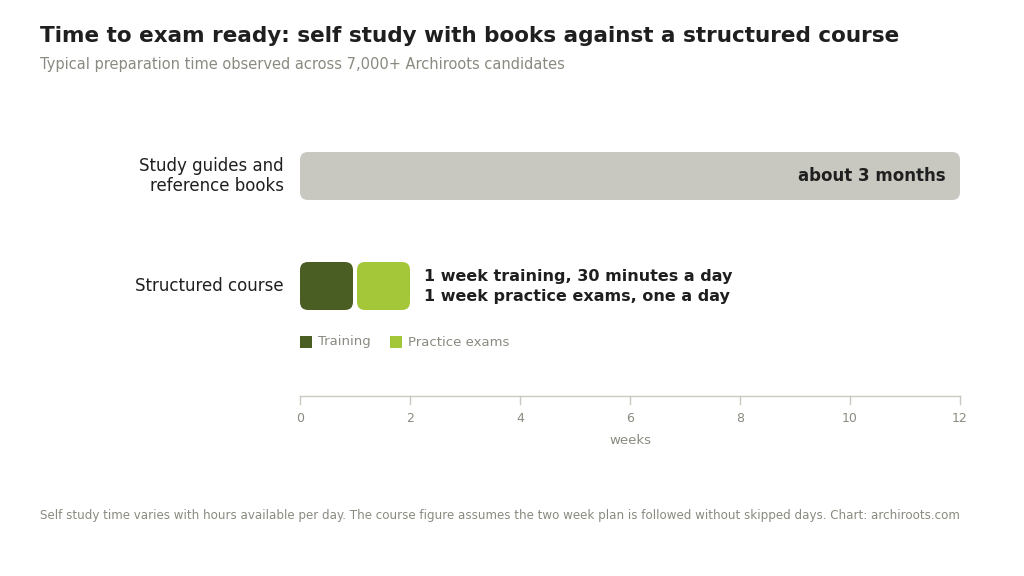
Study guides and books can cover everything, and they do help. They are not required, though, and they are not built for speed. They run anywhere from 300 to 800 pages, written as textbooks to be read cover to cover, and the exam does not reward reading cover to cover. It rewards knowing which part of the material carries the marks, and a textbook, by design, does not tell you which part that is. If you have the time and learn best by reading, books are a sound foundation. If you have a job or a course load, a deadline and thirty minutes a day, they are the slow road to the same place.
Last week a candidate wrote to Archiroots because her employer had handed her a Core Concepts Guide and told her she could sit the exam once she finished the book. The fee was already paid. She had a month, and every time she opened the book she got bored and put it down. Nothing was wrong with her, and nothing was wrong with the book. A 300 page textbook is the wrong shape for someone with a job, a deadline and thirty minutes a day, and it gave her no way to find out whether she was ready. What she was asking for, without using the words, was a filter and a scoreboard.
The Reference Guide deserves a separate verdict. It is the manual for certifying a building, around 800 pages of credit by credit implementation detail, and it does that job very well. It was never written for exam prep and is slow when used that way, and it cannot replace practice exams. The LEED Reference Guide article explains which version exists and when a project team actually needs it. For the exam, leave it on the shelf until you have a project.
Course or book: the time and efficiency question
In practice, what separates a textbook from a course built for the exam is the filter. A textbook gives you everything and leaves the selecting to you. A course has already done the selecting. It defines the key terms once, shows the credit structure visually so the categories stay in your head as a shape rather than a list, and ends each lesson with practice questions so you find out right away whether the idea landed. Books cannot do that last part at all.
The Archiroots LEED Green Associate course is about three hours of video, which thirty minutes a day covers in a week. The second week is practice exams, one a day, with flashcards in the gaps. People pass with books every month, so this is about time. For the same coverage of what the exam tests, three hundred pages against three hours separates the candidate who sits the exam in two weeks from the one still reading in month three.
The exam prep page has a three minute overview of LEED and the course, showing how a lesson runs and where the practice questions sit at the end of it. Watch it before you decide anything. It also works as a short first look at sustainability and green building.
Practice exams are not optional
Practice exams are the one material no candidate should skip, including people who have worked on LEED projects. Project experience teaches how LEED works on one building, in one rating system, with one team. The exam asks how it works in general, in the rating system’s own words, against a clock. Those are different skills, and it is exactly why experienced professionals fail the Green Associate: they answer the question they would have asked instead of the one on the screen.
What a credible practice exam looks like
It is written to LEED v5 and says so. It matches the real format: 100 multiple choice questions, one best answer, timed. It explains every answer, right and wrong, so a miss teaches you something instead of just lowering a score. And there are enough exams to take one a day for a week without seeing the same question twice. A question bank that fails any of these is training you for an exam other than the one you booked.
The 60 and 80 rule
Archiroots arrived at this rule after 7,000 candidates. Finish the training first, then take one full practice exam. If you score 60 or above, carry on through the rest of the set, one a day. If you score below 60, stop and go back through the flashcards or the lessons before taking another, because more exams on a weak base only rehearse the gaps.
Once you are scoring 80 or above consistently, across different exams and not the same one repeated, students report feeling ready, and that is when to book a date. Nobody can guarantee an exam result, so treat 80 as a threshold. It is the point at which the people who go on to pass describe the exam afterwards as fair.
The free 100 question practice exam
Archiroots publishes a free LEED Green Associate practice exam: 100 questions, written to v5, no signup. Use it as your diagnostic before buying anything. Score 60 on it cold and you may need less preparation than you think. Score 30 and you know what the next two weeks are for. Either way, two hours tells you more about your readiness than a week of reading would.
Flashcards: where they fit
Flashcards handle the vocabulary. The exam is written in the rating system’s language, and a surprising share of wrong answers come from not knowing a term rather than not understanding a concept. Flashcards fix that in the gaps of a day, on a phone, in the time it takes a coffee to cool. The Archiroots LEED Green Associate flashcards are a paid product, said plainly. Free decks exist online, and almost none of them say which version of LEED they were built for. A v4 deck teaches v4 definitions, which brings us to the next section.
The v4 trap: studying the wrong version
The Green Associate exam moved to LEED v5 in 2026. The LEED v5 article covers what changed in the rating system, and the LEED exam guide covers the transition dates. Most study material online was written before the change, and most of it does not say so. Studying v4 material for the v5 exam is one of the few reasons a candidate who genuinely did the work still fails. It is also the most frustrating reason, because the work was real and the problem stayed invisible until the results screen.
A credit that disappeared is easy to spot. The dangerous one kept its name in v5 while its requirement changed: a distance, a percentage, a threshold. You recognize the name, you remember the v4 number, and you pick the wrong answer with complete confidence. Because the name matches, nothing about the question warns you. The only defense is knowing, before you start, which version the material in front of you was written for.
Six signs that a material is v4
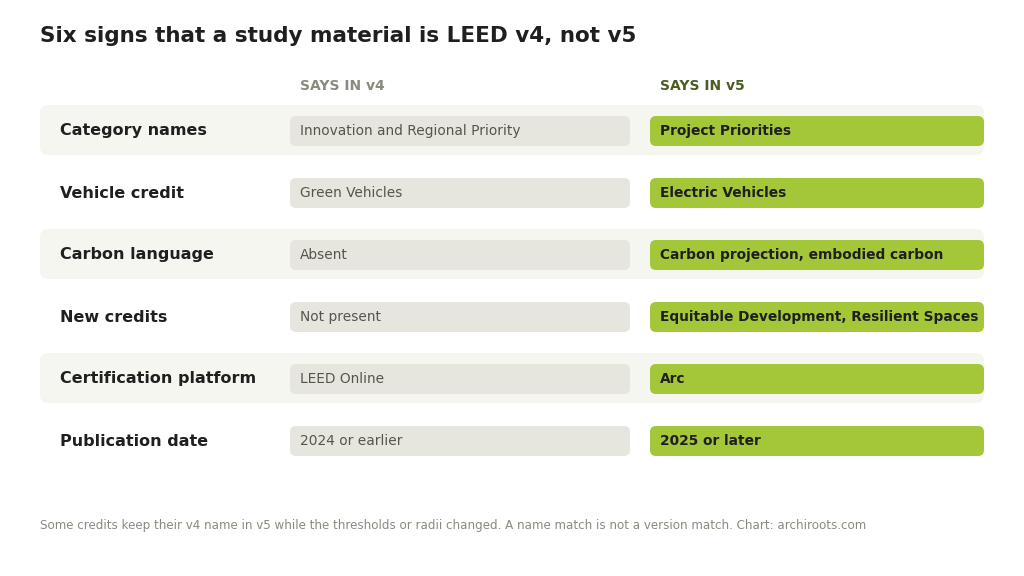
Here they are, in the order most people notice them. Category names: sections called Innovation and Regional Priority mean v4, because in v5 that material sits under Project Priorities. Vehicle credit: v4 says Green Vehicles, v5 says Electric Vehicles. Carbon language: v5 talks about carbon projection and embodied carbon throughout, and v4 material has none of it. New credits: Equitable Development and Resilient Spaces did not exist in v4. Certification platform: v4 material describes LEED Online, while v5 projects run on Arc. Publication date: anything dated 2024 or earlier is v4 unless it explicitly says otherwise, and if it does say otherwise, check the other five.
What changed in v5, briefly
Three changes matter for a candidate. Carbon runs through v5 as a theme rather than a single credit, so decarbonization language shows up in categories where v4 never mentioned it. Equity and resilience now have credits of their own. And the mechanics moved: v5 projects are registered and documented on Arc instead of LEED Online. The LEED v5 article has the full picture. For the exam, what matters is that the vocabulary shifted enough that v4 material is no longer a safe approximation.
The AI trap: chatbots and generated questions
Chatbots bring the same problem in a new form. They are trained on the internet, and the internet is mostly v4. Ask one for LEED Green Associate practice questions and you get a blend of v4 and v5 with nothing to tell you which is which. Ask it to explain a credit and it will fluently describe the v4 version. Push back and it apologizes and agrees with you, whether or not you were right. It never admits a mistake until you point it out, and by then you have studied the wrong number. One quick tell: a chatbot that describes certification through LEED Online is describing the old process, since v5 projects run on Arc. If an AI generated study aid mentions LEED Online in a v5 context, treat everything else in it as suspect.
Format is the second problem. A real question has one best answer among plausible options, and the wrong options are built from real misconceptions. Generated questions tend to be either trivially easy or oddly worded, with distractors no candidate would choose, so practicing on them trains you for an exam that does not exist. The verdict is narrow: use AI to explain a concept you are stuck on, then check the explanation against the Candidate Handbook or a v5 course. Do not use it as a question bank or as a source of numbers.Chatbots bring the same problem in a new form. They are trained on the internet, and the internet is mostly v4. Ask one for LEED Green Associate practice questions and you get a blend of v4 and v5 with nothing to tell you which is which. Ask it to explain a credit and it will fluently describe the v4 version. Push back and it apologizes and agrees with you, whether or not you were right. It never admits a mistake until you point it out, and by then you have studied the wrong number. One quick tell: a chatbot that describes certification through LEED Online is describing the old process, since v5 projects run on Arc. If an AI generated study aid mentions LEED Online in a v5 context, treat everything else in it as suspect.
Format is the second problem. A real question has one best answer among plausible options, and the wrong options are built from real misconceptions. Generated questions tend to be either trivially easy or oddly worded, with distractors no candidate would choose, so practicing on them trains you for an exam that does not exist. The verdict is narrow: use AI to explain a concept you are stuck on, then check the explanation against the Candidate Handbook or a v5 course. Do not use it as a question bank or as a source of numbers.
Vocabulary and question technique for non native English speakers
Among candidates who did the work and still struggled, two problems keep coming up, and neither has anything to do with intelligence or effort. The first is vocabulary: the rating system uses words that everyday English does not, or gives ordinary words a specific meaning. The second is the multiple choice format, which rewards a technique nobody teaches you unless you grew up with it.
Terms GBCI uses that you have never met
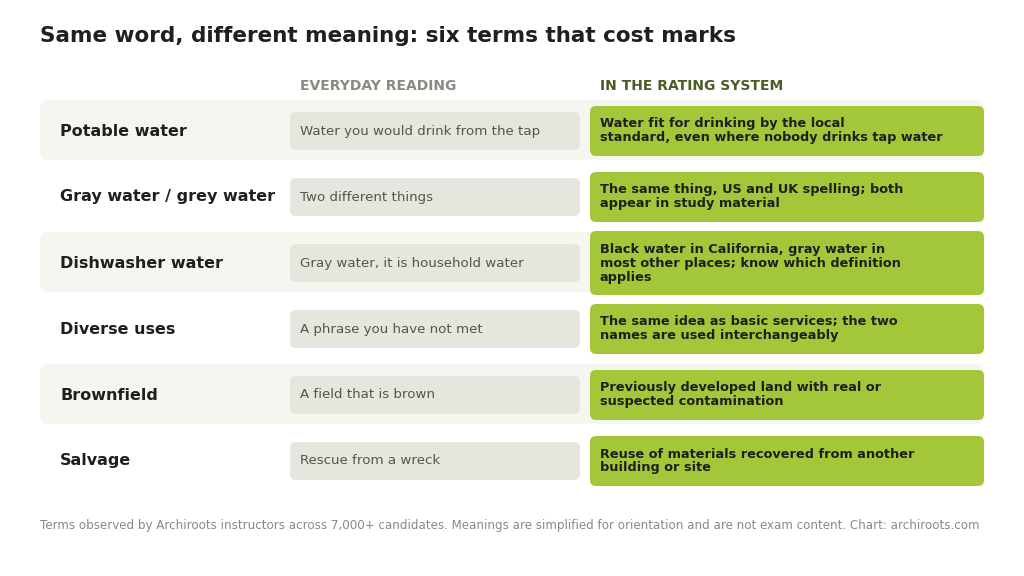
Potable water catches the most people. In the rating system it means water fit for drinking by the local standard, and that definition holds even if nobody drinks the tap water where you live. Candidates from countries where everyone drinks bottled water read potable and think of the bottle, when the question is about the pipe. Gray water and grey water are the same thing spelled two ways, US and UK, and both spellings turn up in study material.
Gray water and black water are different, and the line between them moves. Dishwasher water is black water in California and gray water in most other places, so the correct answer depends on knowing which definition the question uses. Diverse uses and basic services are treated as synonyms, and a candidate who learned one and then meets the other has no way to connect them without practice. Brownfield, wetlands, erosion, salvage and pruning are ordinary words in one trade and foreign in every other, and the exam assumes you know them.
USGBC also publishes a free glossary. It is accurate and alphabetical, and useful as a reference, but it gives no hint of which fifty entries actually show up in questions. Sorting that out is the job of a course and of flashcards built for the exam.
Key terms and elimination
The technique is simple, and it has to become automatic. Read the question and find the word that carries it: most, least, prerequisite, required, minimum, first. That word decides what kind of answer is correct before you have read any of the options. Then eliminate the two options that belong to a different category or a different stage of the process. There are almost always two.
Of the remaining pair, choose the one that uses the rating system’s own definition of the term over the everyday one. You learn this by doing practice exams until the pattern is reflex, and a book cannot teach it. That is why candidates with a language barrier who complete the whole practice set close the gap, and the ones who skip it do not.
The free LEED GA ebook
Every new Archiroots signup gets a free LEED Green Associate ebook. It is a starter roadmap rather than a textbook. It covers why the credential is worth earning, how it differs from LEED AP, the three step preparation, how to register on USGBC and schedule on Prometric, what happens on the results screen and after it, and how the credential is maintained. It also includes links to the free resources and the two week study plan. It is version neutral, so it will not put a v4 number in your head, and it arrives by email the moment you sign up.
Every free study material
- The LEED Green Associate Candidate Handbook, published free by USGBC.
- The free LEED Green Associate practice exam, 100 questions, written to v5, with no signup.
- The three minute course preview on the LEED GA exam prep, which shows how a lesson runs and how the practice questions sit inside it.
- The free LEED GA ebook, delivered on signup.
- The Archiroots two week study plan, that guides how to plan and earn the credential.
- The USGBC glossary, free, useful as a reference once you know which terms to look up.
- After you pass, the guide to earning free LEED continuing education hours, because the credential has to be maintained and most of that can be done at no cost.
Frequently asked questions
Do you need a book or study guide to pass the LEED Green Associate exam?
No book is required. The only required reading is the Candidate Handbook, which is free. The official USGBC study guides are authoritative references and worth reading if you have the time, but they are optional, because a structured v5 course and a full set of practice exams cover what the exam tests in a fraction of the time.
Can LEED v4 study materials be used for the v5 exam?
Not safely. The exam is written to LEED v5, and some credits kept their v4 names while their requirements changed, so v4 material can lead to a confident wrong answer with no warning. Check any material for the six v4 tells above before using it, and prefer material that states its version on the cover.
Is there a free LEED Green Associate study guide PDF?
The free official document is the Candidate Handbook, which is the exam specification rather than a study guide. Archiroots gives a free LEED GA ebook and a free two week study plan PDF to everyone who signs up, and both are version neutral. Whereas Study Guides are paid books and is not available as a free PDF from any legitimate source.
Can ChatGPT or another AI be used to prepare for the LEED Green Associate exam?
For explaining a concept you are stuck on, yes, provided you verify the answer against the Candidate Handbook or a v5 course. As a question bank or a source of numbers, no. AI tools blend v4 and v5 without labeling which is which, and they agree with you when challenged whether or not you were right. A tool that describes certification through LEED Online is working from outdated material, since v5 projects run on Arc.
What is the LEED Green Associate Candidate Handbook and is it required?
It is the free official document from USGBC that defines what the exam covers, how it is weighted, who is eligible, and what the exam day policies are. It is the only mandatory read for the exam. It does not teach the material; it tells you what the material has to cover.
How can I tell which LEED version my study material is?
Look for the major changes. Sections called Innovation and Regional Priority, the phrase Green Vehicles, no mention of carbon, no Equitable Development or Resilient Spaces credits, references to LEED Online rather than Arc, and a publication date of 2024 or earlier all indicate v4. Any one of them is enough to stop and check.
Where to start
Read the Candidate Handbook, which takes under an hour. Then take the free practice exam cold and write down your score. That number tells you what to do next better than any list of materials can. If it is 60 or above, you are closer than you thought, and the course is a two week finishing job. If it is 30, the course is where the next two weeks go, and the exam is still two weeks away, not four months. Register on USGBC and schedule on Prometric only once you are scoring 80 consistently, because the twelve month clock starts the day you pay.