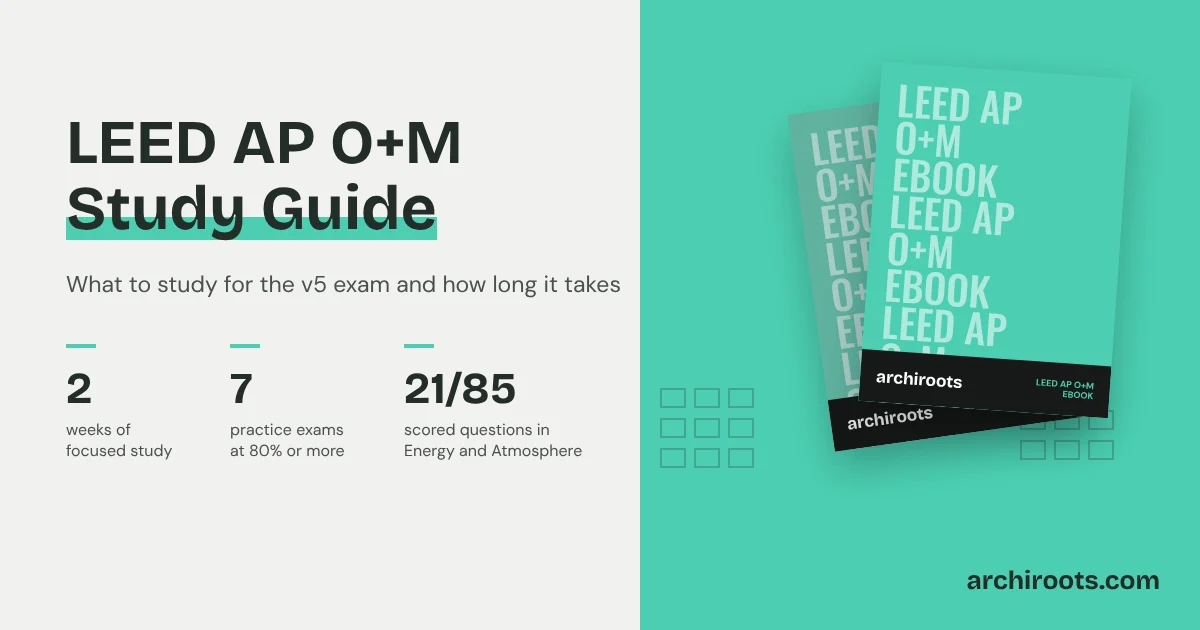
Most people pass the LEED AP O+M v5 exam after about 2 weeks of study with archiroots. Week 1, LEED AP O+M training at about 30 minutes a day, then a second week with one of the 7 LEED AP O+M practice exams a day and 30 minutes of LEED AP O+M flashcards. Put the most time into Energy and Atmosphere, which alone is 21 of the 85 scored questions, and learn the performance data behind it: ENERGY STAR scores, baselines, greenhouse gas and refrigerant tracking. You are ready to book when you have passed all 7 practice exams with 80% or more. The 15 other questions on the exam are pretest questions and don’t count toward your score.
This LEED AP O+M study guide is for engineers, sustainability consultants and facility managers preparing for the Operations and Maintenance specialty (also written O&M) on LEED v5.
| Detail | LEED AP O+M exam |
|---|---|
| Version | LEED v5 (O+M: Existing Buildings) |
| Questions | 100 multiple choice, 85 of them scored |
| Time | 2 hours, about 72 seconds per question |
| Passing score | 170 on a scale of 125 to 200 |
| Before you can sit it | An active LEED Green Associate credential |
| Official reference | LEED v5 Reference Guide for Operations and Maintenance, July 2026 edition |
Start with the free LEED AP O+M practice exam: 100 questions on LEED v5 with an explanation for every answer. Your score shows how far you are from ready.
How long does it take to study for the LEED AP O+M?
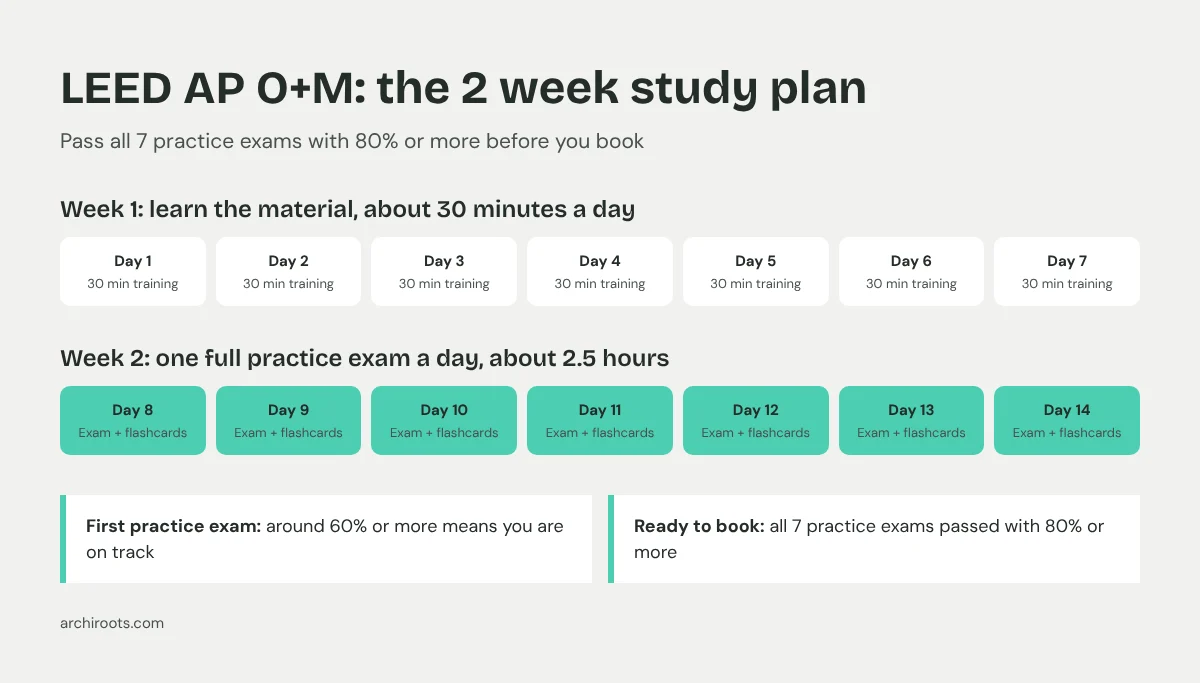
Two weeks is enough for most people, and any pace from 1 week to 3 months works as long as you finish the training and all 7 practice exams.
| Week | What you do | Time per day |
|---|---|---|
| Week 1 | Go through the training material | About 30 minutes |
| Week 2 | One full practice exam a day, then review the flashcards | About 2.5 hours |
The second week is the heavier one, because a full practice exam takes 2 hours. Squeezing two practice exams into one day sounds faster, but at 4 hours a day little of it sticks.
Where to spend your study time
Energy and Atmosphere carries 21 scored questions, a quarter of your score, and it is also the category students find hardest. Indoor Environmental Quality follows with 17. Together they are 38 of the 85 scored questions.
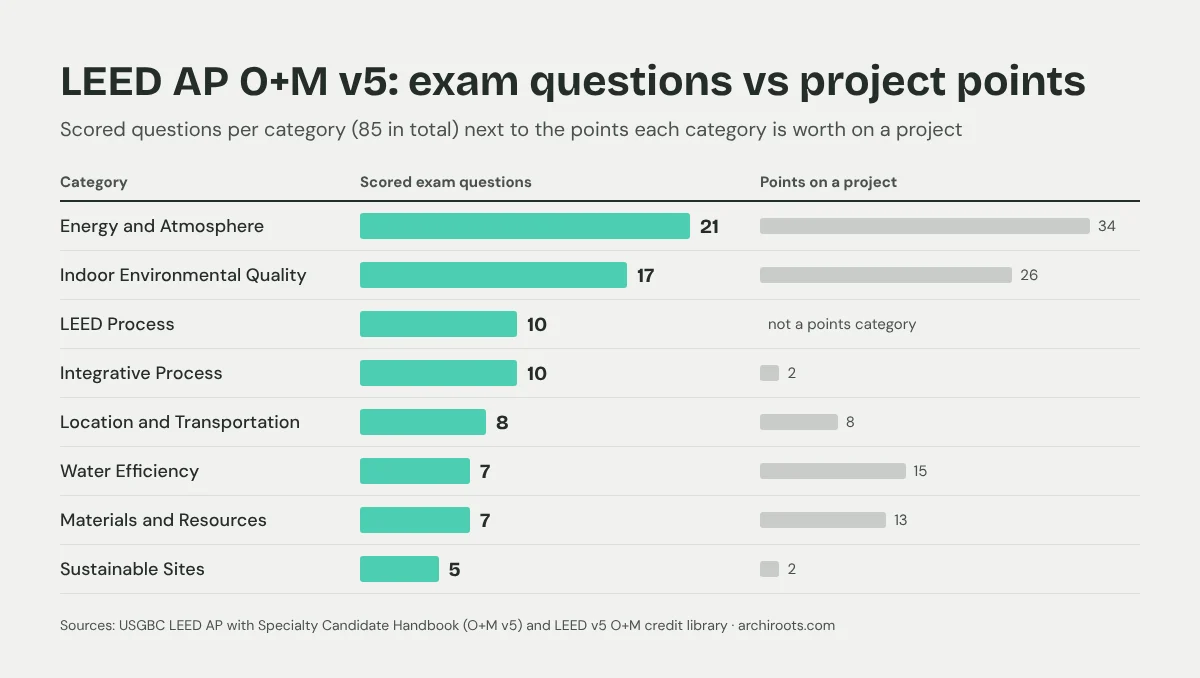
| Category | Scored questions | Share of the score | Points on a project |
|---|---|---|---|
| Energy and Atmosphere | 21 | 25% | 34 |
| Indoor Environmental Quality | 17 | 20% | 26 |
| LEED Process | 10 | 12% | Not scored |
| Integrative Process, Planning and Assessments | 10 | 12% | 2 |
| Location and Transportation | 8 | 9% | 8 |
| Water Efficiency | 7 | 8% | 15 |
| Materials and Resources | 7 | 8% | 13 |
| Sustainable Sites | 5 | 6% | 2 |
Plan your study time from the question count in the second column. The project points in the last column send many people the wrong way: Integrative Process is worth only 2 points on a building but gets 10 exam questions, as many as the LEED Process, while Materials and Resources is worth 13 points and gets only 7 questions.
Why Energy and Atmosphere is the hardest part
Energy and Atmosphere has the most information of any category, so there are more tables to memorize and more room for confusion. O+M certifies how a building performs over a 12 month reporting period, so these questions are about data: which ENERGY STAR score earns how many points, how a historical baseline works, what counts toward greenhouse gas emissions and how refrigerants are tracked. You need to know whether the building qualifies and how many points it earns at each level.
Here is a question in the style of the exam. An office building in Chicago reports an ENERGY STAR score of 74 for its 12 month reporting period. Does it meet the energy prerequisite, and how many points does it earn for Optimized Energy Performance?
It meets the prerequisite, which needs a score of at least 60. For the credit it earns 4 points: 73 earns 4 and the next level, 5 points, starts at 75. The trap is rounding 74 up. Buildings in the U.S. and Canada that can get an ENERGY STAR score must use that path, so the other two options (energy use intensity targets and the historical baseline) do not apply here.
| Credit | What to know |
|---|---|
| Minimum Energy Performance (prerequisite) | ENERGY STAR score of at least 60 over the 12 month reporting period. Without a score: meet the EUI target, or show at least 8% less energy than a historical baseline from the last eight years (4% for high process load buildings) |
| Optimized Energy Performance | 2 to 12 points. ENERGY STAR 69 earns 2, 75 earns 5, 81 earns 8, 92 earns 12. Historical baseline path: 15% earns 2 and 48% earns 12 |
| Greenhouse Gas Emissions Reduction Performance | Up to 12 points, a credit of its own |
| Decarbonization and Efficiency Plans | Up to 4 points |
| LEED Platinum requirements | 7 points in Optimized Energy Performance, at least 2 points in Option 1 and 2 points in Options 2 or 3 of Greenhouse Gas Emissions Reduction Performance, and 2 points in Decarbonization and Efficiency Plans |
The LEED AP O+M flashcards cover the full set of thresholds for daily review.
Who takes the LEED AP O+M, and does experience help?
Most people who take the O+M are facility managers, mechanical engineers working on existing buildings, and consultants who improve the efficiency of older buildings that are already running. Experience on a LEED O+M project helps, because you have already been through the exercise of collecting the data and documenting the credits. It is not required. The training and the practice exams cover the same requirements and thresholds.
When are you ready to book the exam?
The most common mistake in the last week is taking too few practice exams: people pass one or two and book the exam. Take your first full practice exam after the training. Around 60% or more means you are on track, so carry on with one exam a day. Below that, go back to the lessons and flashcards first. You are ready when you have passed all 7 full practice exams with 80% or more.
Can you still study from LEED v4 O+M material?
No. LEED v5 O+M is very different, and the change that trips up people who studied old material is the new prerequisites. v4 credit names and requirements will mislead you on the exam. The rating system also scores measured performance over a reporting period, and most credits say so in their name: Water Efficiency Performance, Greenhouse Gas Emissions Reduction Performance, Waste Reduction Performance, Indoor Air Quality Performance.
| LEED v5 O+M: Existing Buildings | Count |
|---|---|
| Prerequisites | 11 |
| Credits | 26 |
| Total points | 110 |
Four of the 11 prerequisites are new Integrative Process requirements: a Climate Resilience Assessment, a Human Impact Assessment, an Operations Assessment and Policy, and a Current Facilities Requirements and O+M Plan. Greenhouse gas reduction is now a credit worth up to 12 points next to Optimized Energy Performance, and there is a new credit for Decarbonization and Efficiency Plans. The full comparison between versions is in the LEED v5 guide.
LEED AP O+M study materials
| Material | Free or paid | What it is good for |
|---|---|---|
| Free LEED AP O+M practice exam | Free | A first check: 100 questions on LEED v5 with explanations |
| Free LEED AP O+M flashcards | Free | 50 LEED v5 cards to try before the full deck |
| Candidate Handbook | Free | The exam rules and the questions per category |
| Free LEED AP O+M ebook | Free | The exam facts and the 2 week plan in one PDF |
| LEED v5 O+M credit library | Free | Checking a credit’s requirements and thresholds |
| LEED v5 Reference Guide for O+M | Paid | Looking up a credit in depth, optional for the exam |
| LEED AP O+M practice exams | Paid | 7 full v5 exams with explanations |
| LEED AP O+M flashcards | Paid | The numbers and thresholds for daily review |
| LEED AP O+M exam prep | Paid | The training, the practice exams and the flashcards, following the plan above |
| LEED group training for companies | Paid | Training a team: per user pricing, one invoice or purchase order |
Get the free LEED AP O+M ebook
The free Archiroots LEED AP O+M ebook is a short PDF with the exam facts, the 2 week plan and links to the free resources.
Frequently asked questions
How do you pass the LEED AP O+M exam?
Finish the training, then take full practice exams until you pass all 7 with 80% or more, reviewing your mistakes with flashcards between them. Spend the most time on Energy and Atmosphere and Indoor Environmental Quality, which carry 38 of the 85 scored questions. Most people who fail took too few practice exams.
Which LEED AP O+M topics have the most questions?
Energy and Atmosphere has 21 scored questions, about 25% of the score. Indoor Environmental Quality follows with 17, then LEED Process and Integrative Process with 10 each.
Is there a free LEED AP O+M study guide PDF?
Yes. Archiroots offers a free LEED AP O+M ebook in PDF with the exam facts and the 2 week plan, and the USGBC candidate handbook is free. Avoid free PDFs of v4 study guides, since the exam is now on LEED v5.
What ENERGY STAR score does LEED v5 O+M require?
At least 60 over the 12 month reporting period for the Minimum Energy Performance prerequisite. Optimized Energy Performance starts at 69 for 2 points and reaches 12 points at 92.
How many people hold the LEED AP O+M?
The USGBC people directory lists 2,480 LEED AP O+M holders, about a tenth of the 25,446 who hold the LEED AP BD+C.