Last updated: July 2026 — reflects LEED v5 and current USGBC fees.
To start of, LEED certification requirements can mean 2 different things depending on who’s asking. If you’re certifying a building, you need to meet minimum program requirements, earn enough points for a certification level, and pay USGBC’s registration and review fees. Whereas If you’re an individual wanting to become LEED accredited, the requirements are entirely different, and much simpler. This guide covers both, starting with buildings.
LEED Certification Requirements for Buildings
Every project pursuing LEED must satisfy three Minimum Program Requirements (MPRs) before any points are counted. Miss one and the project can’t be certified, regardless of how many credits it earns.
1. Must Be in a Permanent Location
The project must be built on existing land, no temporary or mobile structures. A building that moves cannot be LEED certified.
This requirement reflects the program’s commitment to assessing and certifying projects that contribute to the long-term sustainability and environmental responsibility of existing urban or natural landscapes. It also helps in excluding transient or temporary structures, emphasizing LEED’s focus on promoting environmental stewardship in lasting, fixed locations.
2. Must Use Reasonable LEED Boundaries
The LEED project boundary must include all contiguous land associated with the project and accurately reflect what’s being certified, no gerrymandering the boundary to game the results.
his ensures that the frontier set for assessment aligns with the actual scope of the project and its environmental impact. Reasonable LEED boundaries help prevent projects from inappropriately extending or excluding areas to enhance their certification prospects. This requirement underscores the importance of accurately reflecting the environmental efforts and impacts of each project. It promotes transparency and integrity.
3. Must Meet Minimum Floor Area Requirements
The project must include at least 1,000 square feet (approximately 93 square meters) of gross floor area for most rating systems.
Project size requirements vary depending on the specific LEED rating system and project type. These qualifications define the minimum and maximum size thresholds that a project must fall within to be eligible for certification. Meeting project size requirements ensures that LEED certified buildings are of a substantial size, and capable of making a meaningful environmental impact.
How to Register and Certify a LEED Project
LEED certification follows four stages:
- Register, the project on Arc platform for v5, (used to be LEED Online for past versions) and pay the flat registration fee upfront.
- Apply credits, document how the project meets prerequisites and earns points.
- Submit for review, GBCI conducts a preliminary and final review (standard or split-review path).
- Certify, GBCI awards the certification level based on points achieved.
Every registered project gets automatic access to the Arc performance platform and can request a dedicated LEED Coach at no extra cost.
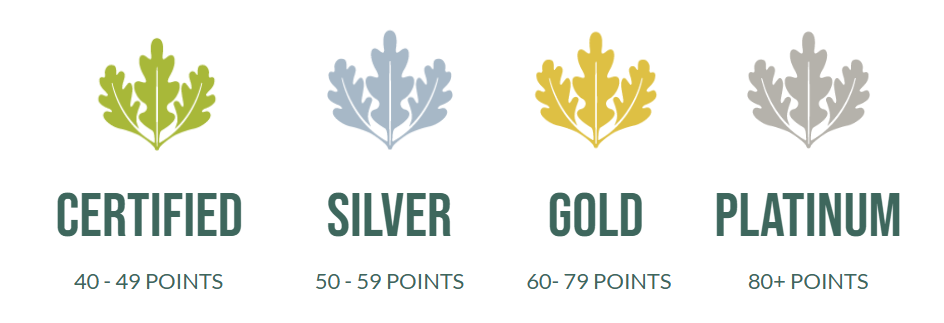
By fulfilling a diverse set of LEED requirements, you can achieve suitable LEED certification levels. Based on a comprehensive evaluation of various aspects of a building’s design and construction by the USGBC, a project receives its LEED score. This score is a numerical representation of a building’s environmental performance and overall sustainability. The total number of points received by a project determines the LEED certification level it will receive. Below is a detailed description of all the LEED certification levels a project can qualify for.
LEED Certification Levels (Point Thresholds)
LEED uses a 110-point scale. The more points a project earns, the higher its certification tier:
| Certification Level | Points Required |
|---|---|
| Certified | 40–49 points |
| Silver | 50–59 points |
| Gold | 60–79 points |
| Platinum | 80+ points |
LEED Certified
The first level is “LEED Certified.” To attain this level, a building must earn between 40 and 49 points on the LEED scorecard. These points are awarded based on a range of sustainable practices, from energy efficiency to water conservation and indoor air quality. Achieving LEED Certified means it earned the base level, whereas LEED certified with a lower case “c” means it earned the certification but we do not know the level (the amount of points it earned).
LEED Silver
LEED silver requirements are points earned between 50 and 59 points. LEED Silver certification recognizes a more substantial commitment to sustainability and a higher level of environmental performance. Achieving this status involves implementing more advanced green building strategies and technologies, such as improved energy efficiency and better use of renewable resources.
LEED Gold
The “LEED Gold” level signifies a substantial dedication to sustainability and a highly efficient building design. To achieve LEED Gold certification, a building must earn between 60 and 79 points on the LEED scorecard. This level often requires the incorporation of cutting-edge technologies, renewable energy sources, and innovative construction methods to significantly reduce environmental impact.
LEED Platinum
At the pinnacle of the LEED rating system is “LEED Platinum.” This represents the highest level of certification and requires a building to earn 80 or more points on the LEED scorecard. LEED Platinum structures are often considered environmental champions, setting new standards for sustainability and resource efficiency. Achieving LEED Platinum certification typically involves a comprehensive approach to sustainability, such as net-zero energy consumption, the use of advanced building materials, and innovative water and waste management systems.
LEED Certification Cost & Fees (2026)
LEED costs have two official parts, both paid to GBCI: a flat registration fee paid upfront, and a certification fee based on your project’s size and rating system, paid when you submit for review.
Registration fee (all rating systems):
| USGBC Member | Non-Member | |
|---|---|---|
| Registration (flat) | $1,350 | $1,700 |
Certification review fee (BD+C):
| Project size (excl. parking) | Member rate | Member minimum | Non-member rate | Non-member minimum |
|---|---|---|---|---|
| Under 250,000 sq ft | $0.064/sf | $3,200 | $0.076/sf | $3,825 |
| 250,000–499,999 sq ft | $0.062/sf | $16,000 | $0.074/sf | $19,000 |
| 500,000–749,999 sq ft | $0.056/sf | $31,000 | $0.067/sf | $37,000 |
| 750,000+ sq ft | Custom quote | — | Custom quote | — |
A worked example: a 100,000 sq ft office pursuing BD+C as a USGBC member pays $1,350 registration + roughly $6,400 certification review (100,000 × $0.064) ≈ $7,750 in direct USGBC fees. Interior (ID+C) and existing-building (O+M) rating systems have their own, generally lower, fee schedules.
Two things most cost guides get wrong:
These are only the hard fees to GBCI. The soft costs, consultant time, energy modeling, commissioning, documentation. Usually exceed the USGBC invoice itself. Fees change. As of March 27, 2026, USGBC consolidated supplemental review (appeal) fees into a single flat $700/credit rate. Always confirm current figures on USGBC’s official schedule.
For the complete, current fee tables across all rating systems, see USGBC’s official LEED certification fees page.
Types of LEED Certification (Rating Systems)
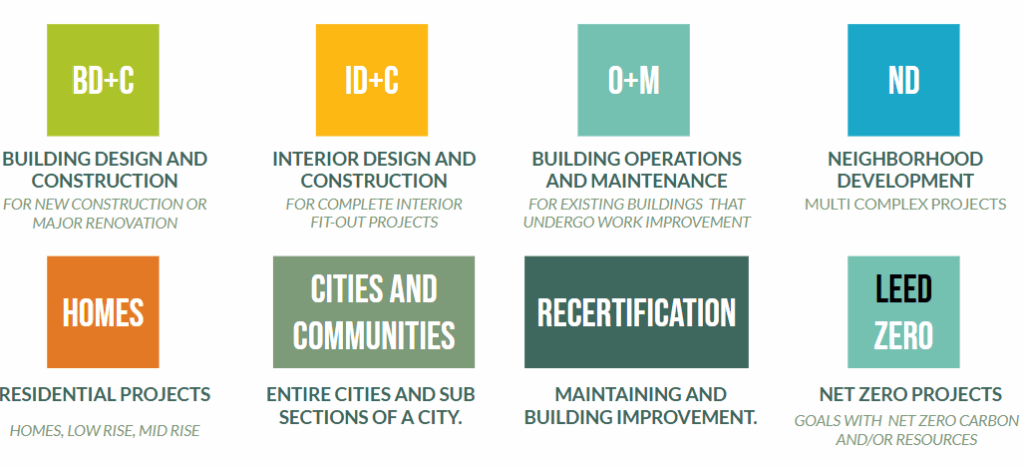
The versatility of LEED is not limited to specific project types; it encompasses a wide range of construction and development projects. Below is a list of the different types of LEED certification that a project can qualify for.
Building Design and Construction (BD+C)
The first type and most in-demand of all the types of LEED certification is the BD+C category is one of the most common types of projects. It covers new construction and major renovation projects, including commercial and residential buildings, schools, healthcare facilities, and more. BD+C projects aim to create sustainable structures from the ground up.
Interior Design and Construction (ID+C)
ID+C projects encompass the interior fit-out and renovation of existing spaces. This category applies to commercial interiors such as offices, retail spaces, and hospitality venues. It focuses on creating healthy, efficient, and environmentally responsible interior environments, often involving energy-efficient lighting, HVAC systems, and sustainable interior finishes.
Building Operations and Maintenance (O+M)
O+M projects involve existing buildings and focus on optimising the building’s operational performance and environmental impact. These projects aim to improve energy efficiency, water conservation, and indoor air quality in ongoing building operations, including commercial, institutional, and residential structures.
Neighbourhood Development (ND)
ND projects pertain to entire communities or neighbourhoods. This category encourages sustainable planning, design, and development of communities that prioritise walkability, green spaces, and sustainable transportation options.
Cities and Communities
Expanding the scope beyond individual neighborhoods, the Cities and Communities category focuses on the sustainability of entire cities and regions. It emphasizes urban planning, infrastructure, transportation, and community well-being.
Homes
LEED for Homes is designed for residential buildings, including single-family homes and multi-family buildings. These projects aim to create energy-efficient, healthy, and environmentally responsible living spaces for residents.
LEED Recertification
LEED Recertification is applicable to projects that have previously earned LEED certification and wish to maintain their sustainable status. This process ensures that the building continues to meet LEED standards over time.
LEED Zero
LEED Zero is a performance-based certification for existing LEED-certified projects that want to achieve net-zero energy, water, or carbon emissions. It reflects a commitment to reducing environmental impact further.
LEED Certification Requirements for Professionals
Certifying a building is different from becoming a LEED accredited professional. If you want the credential after your name, here’s what’s required.
LEED Green Associate (Entry Level)
The LEED Green Associate has almost no barriers: you must be 18 or older and pass the exam. No degree, no work experience, no prerequisite credential. The exam costs $250 ($200 for USGBC member employees, $100 for students, free for eligible veterans). It’s the required foundation for every other LEED credential.
LEED AP with Specialty (Advanced Level)
A LEED AP (in BD+C, O+M, ID+C, and others) requires you to hold the LEED Green Associate in good standing, or earn both together by taking the two exams in one combined sitting. The AP exam costs $350 ($300 for members). LEED APs maintain their credential with 30 continuing education hours every two years, versus 15 for the Green Associate.
| LEED Green Associate | LEED AP with Specialty | |
|---|---|---|
| Prerequisite | 18+, none else | Must hold or earn LEED GA |
| Experience required | None | None (project experience recommended) |
| Exam cost | $250 standard | $350 standard |
| CE to maintain | 15 hrs / 2 yrs | 30 hrs / 2 yrs |
New to the credentials? Start with our simplified LEED Green Associate course, most students pass in two weeks.
Benefits of LEED-Certified Buildings
The principal reason for striving for a LEED building is to demonstrate the earnest intention in practicing sustainable design and construction. It is easy to claim that a building is green, but a third-party rating, especially one with a tremendous reputation, indicates to many in the industry that the building has successfully achieved a high standard.
Gaining the LEED certification building requirements would also grant a competitive edge in the market. It assists investors in meeting their ESG (Environmental, Social, and Governance) goals by providing a globally recognized green building framework for measuring and managing their real estate performance.
Earning professional credentials is a way of advancing your specialty knowledge amongst those around you, including potential employers. USGBC recognizes that many industry professionals are inclined to prove their expertise and offers LEED credentials for that intention.
There are economic, environmental, and health benefits associated with LEED buildings, which will be elaborated on below.
1. Economic Benefits
Having a LEED building provides an edge in the competitive building industry. Experts in the market estimate that integrating sustainability results in market differentiation and improved financial performance.
A LEED building can also greatly attract tenants due to it being less expensive to maintain and having less waste production. LEED’s principles in saving energy and water results in reducing the building’s energy and water consumption, thus ending up with a cost-effective building.
2. Environmental Benefits
Buildings that are LEED certified buildings have features that help conserve energy and water and reduce carbon emissions and waste. According to a UC Berkeley study done in 2014, LEED buildings had a 50% reduction in GHGs than the conventionally constructed buildings because of water consumption.
With LEED’s strong encouragement of sustainable or green material use, certified buildings are estimated to have specified more than $100 billion in green materials. Energy-efficient buildings also reduce pollution and benefit outdoor air quality in industrialized areas, potentially mitigating smog. Cities are now seizing the idea of green buildings becoming a mitigation strategy towards the effects of climate change, making air and the environment healthier for its inhabitants. Such strategies reduce the emission of toxic carbon emissions, ultimately helping the environment.
3. Health Benefits
Encouraging wellness is a high priority for employers, buildings, and city planners alike. LEED has an entire credit category dedicated to the quality and state of the indoor environment: Indoor Environmental Quality (EQ). Buildings that utilize LEED enable occupants to live, play, learn, and work in environments that optimize human health.
Enhancement of the indoor air quality can potentially reduce absenteeism and work hours inflicted by asthma, respiratory allergies, stress, and depression in buildings with leed certification.
With green technology gaining more interest from companies, LEED certified buildings are becoming more attractive to tenants and organizations. It is also important for professionals who plan, design, and construct.
Frequently Asked Questions
What are the 4 levels of LEED certification?
Certified (40–49 points), Silver (50–59), Gold (60–79), and Platinum (80+), on a 110-point scale.
What is the highest level of LEED certification?
Platinum, awarded to projects earning 80 or more points.
What are the minimum program requirements (MPRs) for LEED?
Three: the project must be in a permanent location, use reasonable LEED boundaries, and meet the minimum floor area (typically 1,000 sq ft of gross floor area).
How many points do you need for LEED Silver / Gold?
Silver requires 50–59 points; Gold requires 60–79.
How much does LEED certification cost?
flat registration fee ($1,350 member / $1,700 non-member) plus a size-based certification review fee, for BD+C, from a $3,200 minimum up to tens of thousands for large buildings. Soft costs usually exceed the USGBC fees.
What are the requirements to become LEED Green Associate?
Be 18 or older and pass the exam. No degree or experience is required.
Do you need LEED Green Associate before LEED AP?
Yes, you must hold the Green Associate, or earn it simultaneously by taking both exams in one combined sitting.