A WELL AP (WELL Accredited Professional) is a person who has passed the International WELL Building Institute (IWBI) exam on the WELL Building Standard, the rating system that measures how buildings affect the health of the people inside them. Anyone 18 or older can sit the exam. No degree or work experience is required.
The credential is still rare. IWBI counts 16,110 credentialed WELL APs and another 13,658 registered candidates, across 138 countries. That is about half the number of people who hold a LEED AP specialty. The exam costs $299, or $150 for students, and has 115 questions in 2.5 hours, with 170 out of 200 needed to pass. A WELL AP stays active by reporting 30 continuing education hours every two years.
| Fact | Detail |
|---|---|
| Full name | WELL Accredited Professional |
| Issued by | International WELL Building Institute (IWBI) |
| Credentialed WELL APs | 16,110, plus 13,658 registered candidates |
| Countries | 138 |
| Requirements | Age 18 or older. No degree or experience required |
| Exam | 115 multiple choice questions in 2.5 hours, based on WELL v2 |
| Passing score | 170 on a scale of 125 to 200 |
| Exam fee | $299. Students $150. Groups of 10 or more $164 to $213 each |
| Renewal | Every 2 years: 30 CE hours (6 WELL specific) and $125 |
| US job ads that mention it | About 600 on Indeed |
Further down: who takes the WELL AP and why it is growing, what a WELL AP does on each part of a project, four real job ads that ask for it, the full price list with student and group rates, and how to write it after your name. For readers who have already decided, the WELL AP exam prep and the free WELL AP practice exam are the places to start.
The short version
- It is IWBI’s professional credential for the WELL Building Standard, earned with one exam and no prerequisites.
- Interior designers and the teams behind offices, retail and healthcare buildings make up most candidates, and most of them are in the United States.
- Firms such as Perkins&Will and WATG list WELL in their job ads, and each ad collected here pairs it with LEED.
- No WELL AP discount codes exist. The real savings are the $150 student price and group pricing from 10 people.
- It does not replace a LEED credential, and many professionals hold both.
What is a WELL AP?
WELL is run by IWBI, a public benefit corporation based in New York. The current version, WELL v2, groups its requirements into 10 concepts: Air, Water, Nourishment, Light, Movement, Thermal Comfort, Sound, Materials, Mind and Community. The WELL Building Standard guide explains each one.
A WELL AP knows those concepts and how a project moves through WELL Certification. On a project team, that person can explain what each requirement asks for, help choose which features to pursue and keep the documentation on track.
What does WELL AP stand for?
WELL Accredited Professional. WELL is the name of the standard and is written in capitals, though unlike LEED it is not an acronym. After a name, the credential is written as WELL AP.
Is a WELL AP the same as WELL Certification?
No, and search results mix the two up all the time. People earn the WELL AP by passing an exam. Buildings and spaces earn WELL Certification, at Bronze, Silver, Gold or Platinum, after an on site performance verification. The levels, scoring and certification costs for buildings are covered in how WELL Certification works.
The two meet on the project. WELL v2 awards a point under its Innovation concept when a WELL AP sits on the project team, which is one reason firms that pursue WELL Certification look for the credential.
Who takes the WELL AP?
According to Archiroots, most WELL AP test takers are in the United States, followed by the Gulf (the United Arab Emirates, Saudi Arabia), Canada and the UK. About a third of them also prepare for a LEED credential at the same time.
By profession, the biggest groups are interior designers and the people who design and build offices, shops and healthcare facilities. Hospitals stand out: many now certify the same project under both LEED and WELL, because WELL’s attention to patient and staff well-being matches how a hospital already thinks about its building.
People who work for themselves take it too. Archiroots instructor Shadi AbouSamra knows many freelance interior designers who hold it, as well as manufacturers. One maker of office and kitchen furniture built his whole product line around the requirements of WELL Certification.
Why it is growing
Almost everyone in the industry already knows what LEED is, and many already hold a LEED credential. WELL still feels new and far from saturated, and its requirements center on the occupant:
- Ergonomic chairs and workstations
- Letting people adjust the lighting in their own space
- A private room for nursing mothers
- Fitness incentives and gym access for employees
- Healthy and vegetarian choices in the cafeteria
LEED does not address most of these. An employer sees them as support for staff productivity, and a hospital sees them as support for patient wellness.
Is the WELL AP certification worth it?
For people who design, build or run interiors, offices, healthcare facilities and workplaces, yes. It adds a health and well-being specialty that most of their colleagues do not have yet, and with about 16,000 holders worldwide it still sets a candidate apart.
Clients notice it. A WELL AP on the team tells a client that the project is designed around the people who will use it, and owners find that a WELL certified property sells more easily and faster.
Employers ask for it because companies want to be seen supporting their staff. They pursue WELL certified offices and facilities, and those projects need a WELL AP on the team.
WELL AP for architects and interior designers
Three of the four job ads further down are for architects, and the fourth is for a sustainability designer. On a WELL project, architects and interior designers own the Movement concept: ergonomic workstations, a circulation network that invites walking and active furnishings. They also choose the products that keep VOCs and hazardous materials out and, with the acoustic engineer, the surfaces that absorb sound. For interior designers, the credential matches their daily work: designing for the people who use a space.
When it is less useful
On projects with no health or occupant focus, such as warehouses or infrastructure, a LEED credential will get more use. The WELL AP also sits on top of a profession. Someone with no design, engineering or operations background will not become a wellness consultant by passing one exam.
What does a WELL AP do on a project?
Every discipline on a WELL project has a share of the work. A WELL AP from any of them can guide their own part and talk to the rest of the team in the same terms.
| Role | WELL concepts they lead | Examples of the work |
|---|---|---|
| Mechanical engineer | Air, Thermal Comfort | Air filtration, enhanced supply air, microbe and mold control, humidity control, thermal zoning, giving occupants control over temperature |
| Lighting designer | Light | Circadian lighting design, visual balance |
| Architect and interior designer | Movement, Materials | Ergonomic workstation design, a circulation network that invites walking, active furnishings, product selection |
| Acoustic engineer | Sound | Sound mapping, sound barriers, reverberation time, sound reducing surfaces, enhanced audio devices |
| Management and operations | Nourishment, Community | Nutritional transparency, portion sizes, special diets, responsible food sourcing, occupant surveys, support for new parents and mothers, diversity and inclusion, responsible labor practices |
| Specialist in the psychology of indoor spaces | Mind | Mental health services and education, stress management, substance use services |
Materials overlap with LEED. Both restrict VOCs and hazardous interior materials and both deal with waste, and WELL goes further. The acoustic engineer and the architect often work together here, picking products that absorb sound and isolating the spaces that need quiet.
For a firm, following WELL principles shows clients and staff that it cares about the people in its buildings. That is good marketing as well as good practice.
Who asks for a WELL AP? What job ads say
WELL AP jobs are rarely advertised under that title. The credential shows up inside ads for architects and sustainability designers, usually next to LEED.
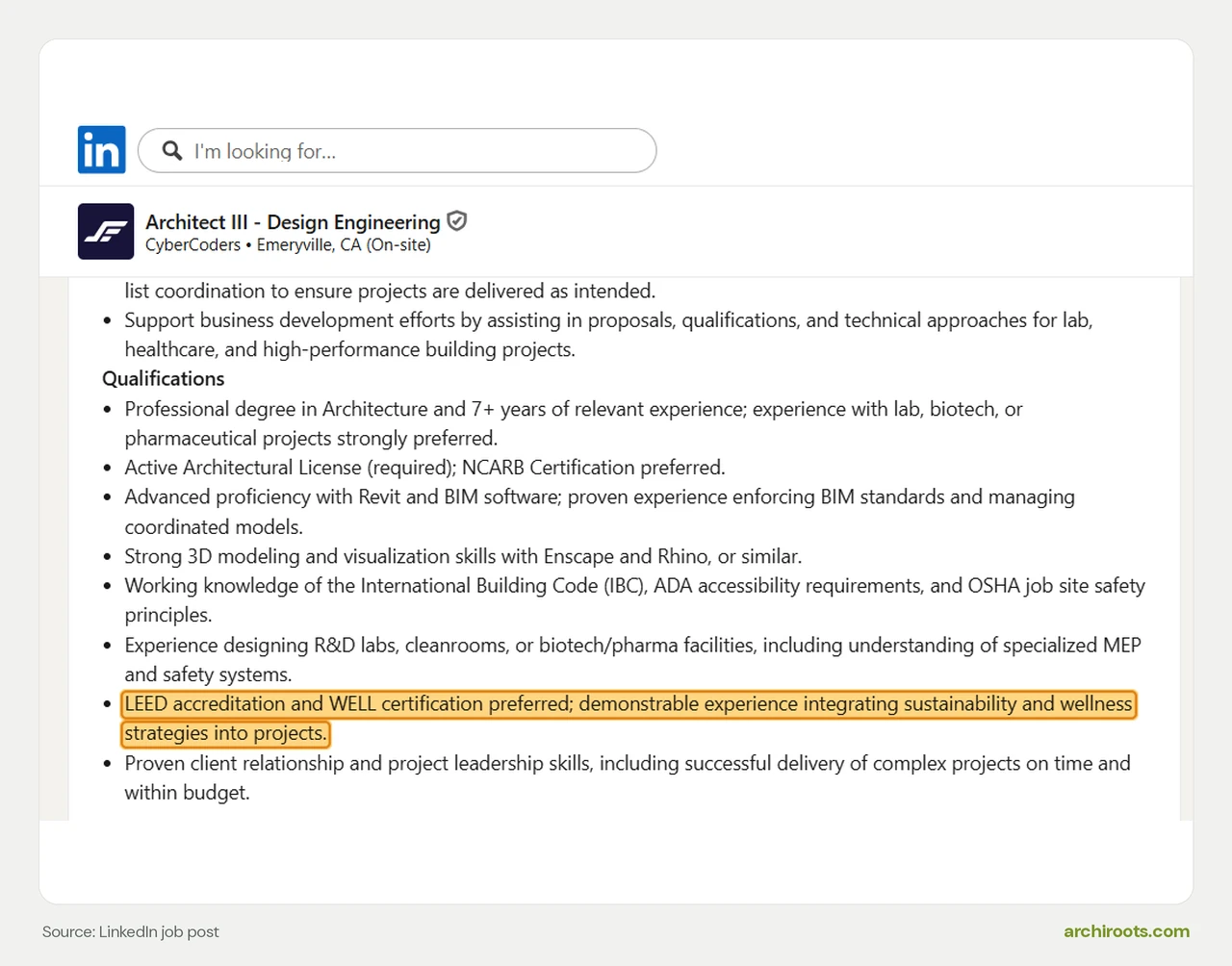
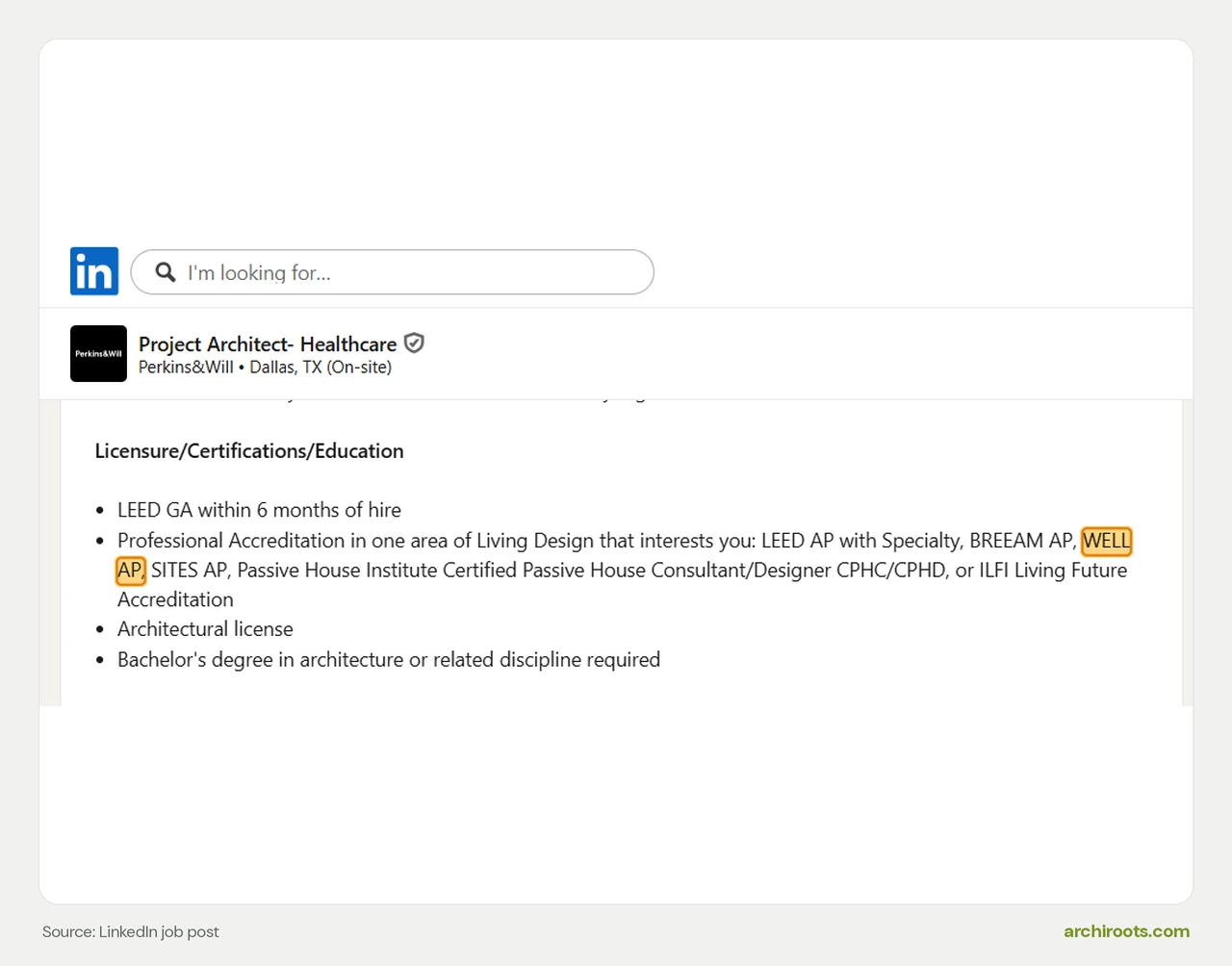
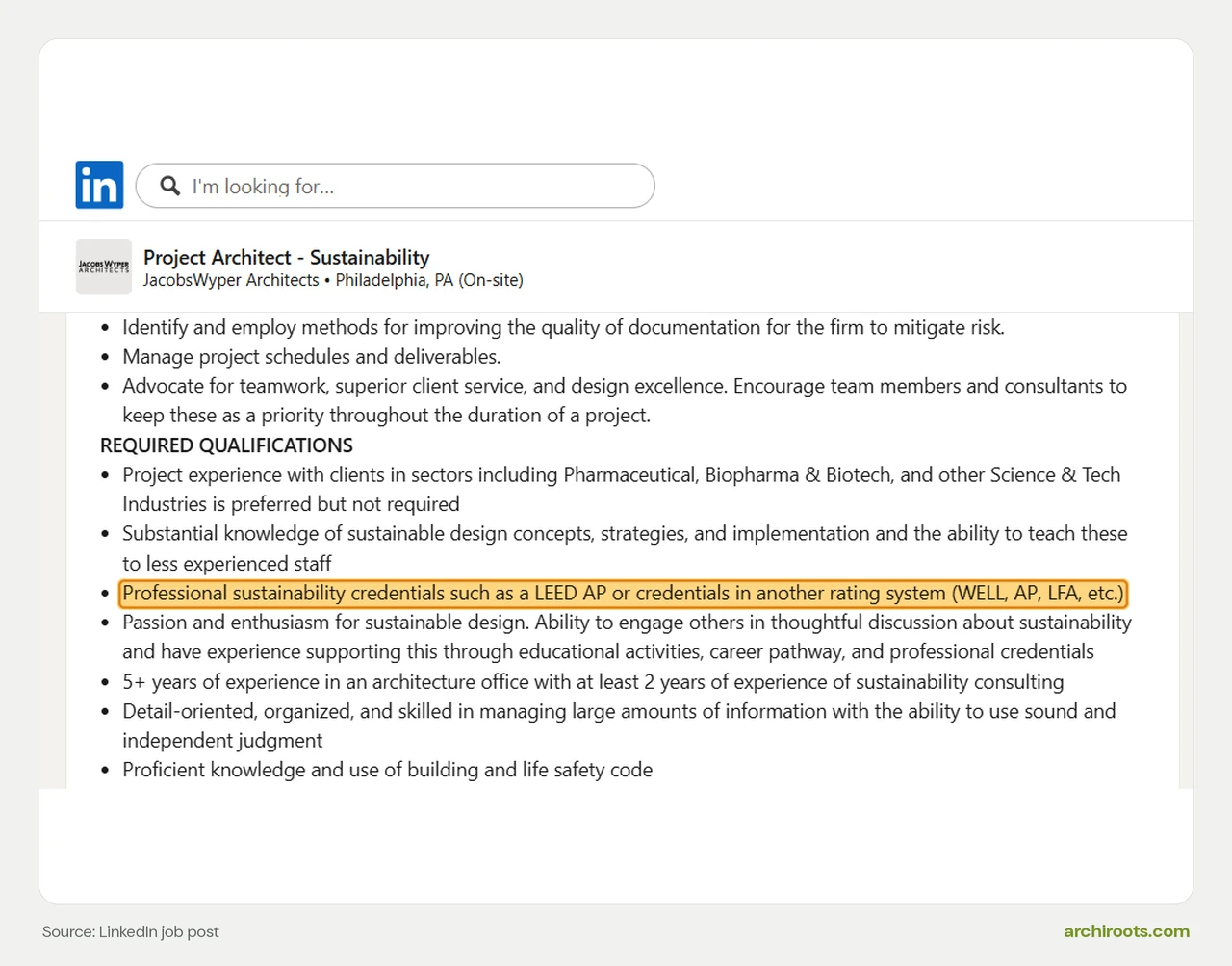
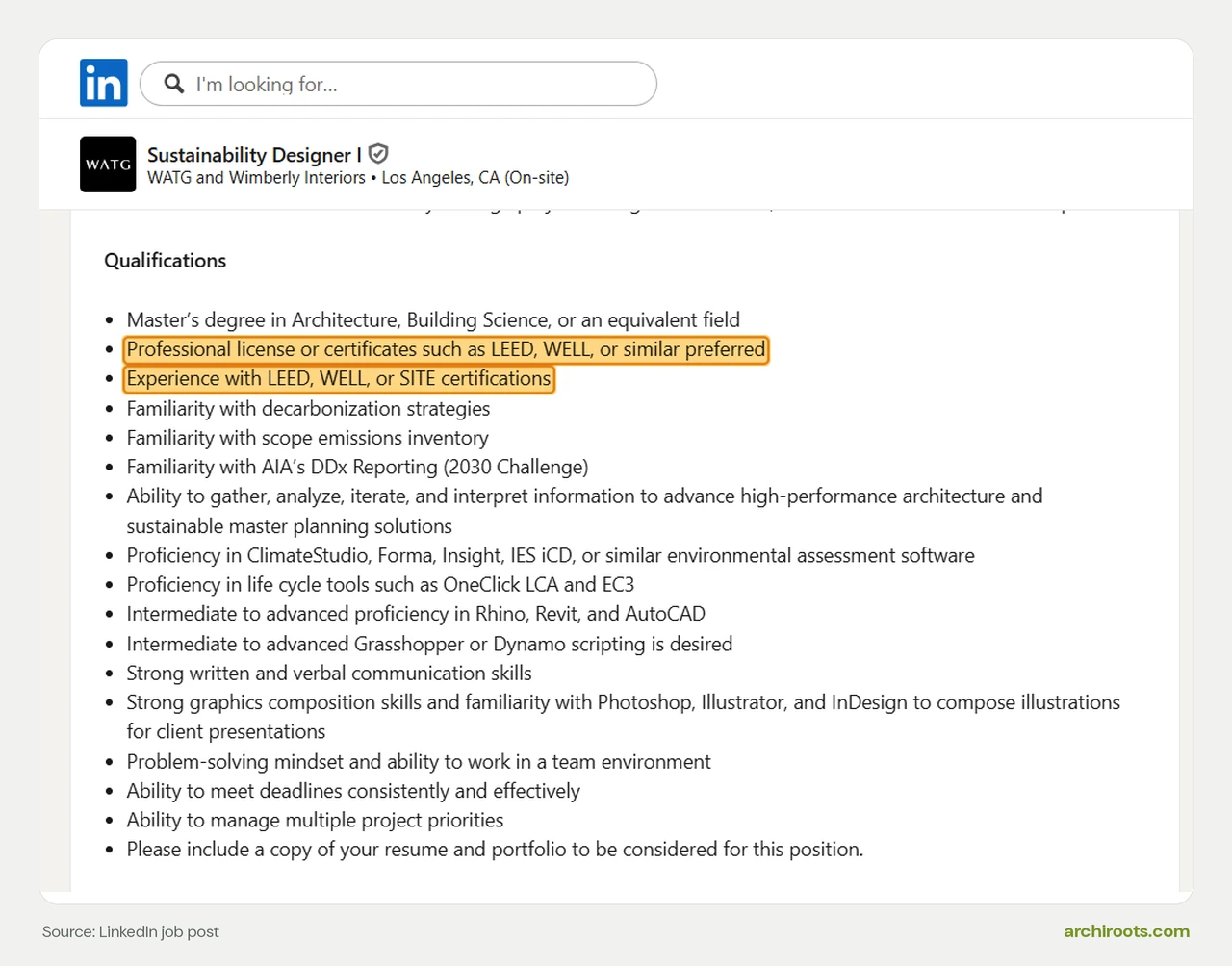
Archiroots collected the four ads below from LinkedIn. The wording is quoted as posted.
| Employer | Role | Location | What the ad says |
|---|---|---|---|
| CyberCoders | Architect III, Design Engineering | Emeryville, California | “LEED accreditation and WELL certification preferred” |
| Perkins&Will | Project Architect, Healthcare | Dallas, Texas | “Professional Accreditation in one area of Living Design that interests you: LEED AP with Specialty, BREEAM AP, WELL AP, SITES AP…” |
| JacobsWyper Architects | Project Architect, Sustainability | Philadelphia, Pennsylvania | “Professional sustainability credentials such as a LEED AP or credentials in another rating system (WELL, AP, LFA, etc.)” |
| WATG and Wimberly Interiors | Sustainability Designer I | Los Angeles, California | “Professional license or certificates such as LEED, WELL, or similar preferred” |
A few things stand out in these ads:
- Each one pairs WELL with LEED, so employers treat the two as companions.
- Perkins&Will asks for a LEED Green Associate within 6 months of hire plus one further credential, and the WELL AP is one of the options.
- The CyberCoders role covers lab, healthcare and high performance buildings, the project types where occupant health matters most.
Across the US, a search for “WELL AP certified” on Indeed returns about 600 open jobs.
WELL AP salary
No reliable salary figure exists for the WELL AP. The numbers on salary sites are built from job ads that contain the word “well”, so they mix in unrelated roles.
What happens in practice matches the LEED credentials. Pay rises when the credential helps a person move into a senior role, to a new employer, or onto a WELL project that needs an accredited person on the team.
WELL AP requirements: who can take it?
Anyone 18 or older. IWBI sets no degree, license or experience requirement. It recommends some familiarity with WELL projects but does not require it.
Students and recent graduates take it, and so do people outside design, such as the furniture and product manufacturers mentioned above.
How to become a WELL AP
The steps below show how to get the WELL AP certification, from the first account to the credential.
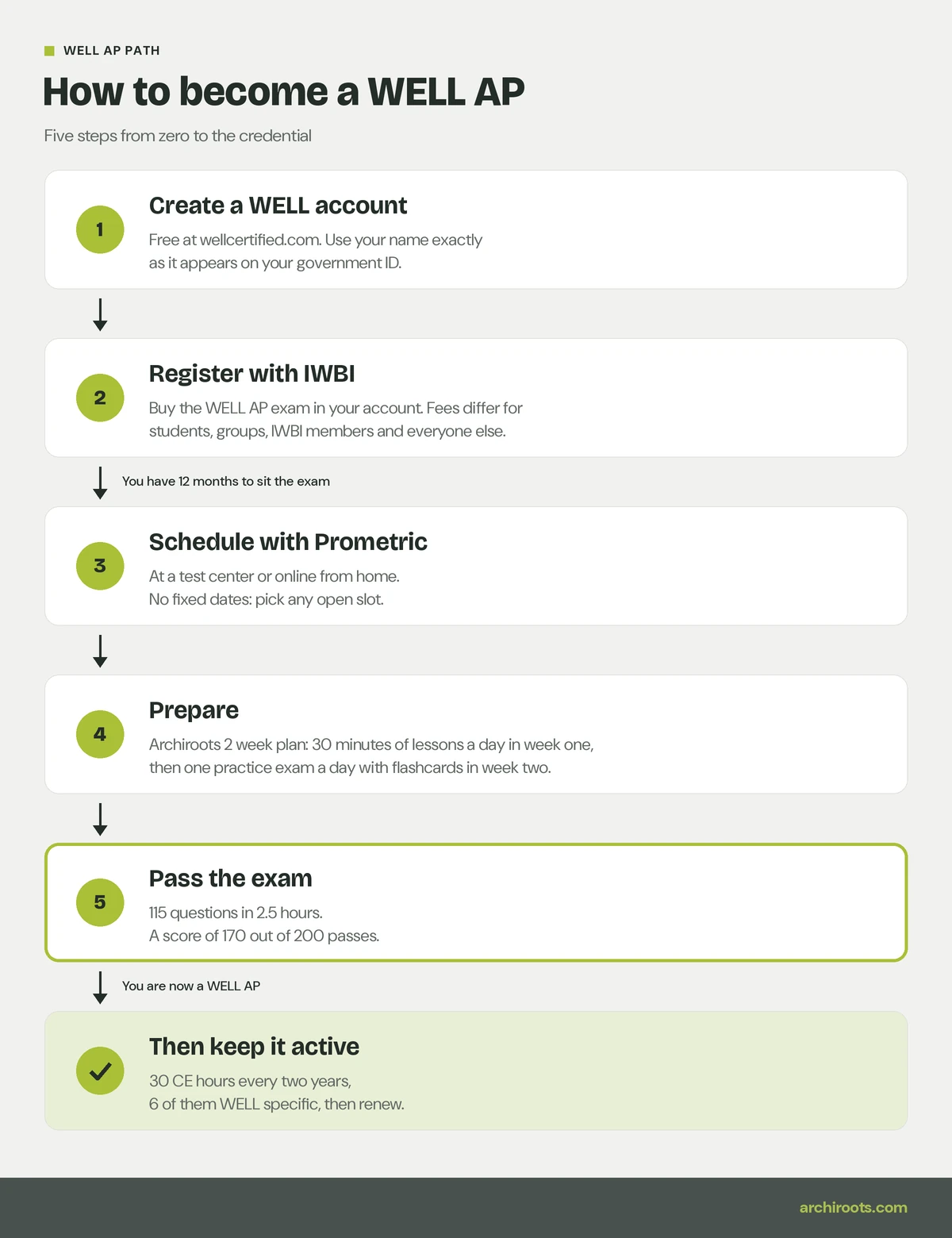
- Create a free account at wellcertified.com, using the name on your ID.
- Buy the WELL AP exam in your account. The fee depends on whether you are a student, part of a group or on the staff of an IWBI member organization.
- Schedule the exam with Prometric, at a test center or online from home. You have 12 months from purchase to sit it, with one 6 month extension available.
- Prepare. The usual Archiroots plan takes two weeks: 30 minutes of lessons a day in the first week, then one practice exam a day with flashcard review in the second.
- Sit the exam and score 170 or more.
| Detail | Fact |
|---|---|
| Questions | 115 multiple choice, with a short project scenario |
| Time | 2.5 hours |
| Scoring | Scaled from 125 to 200, 170 to pass |
| Version | WELL v2 |
| Languages | English and Chinese |
| Where | A Prometric test center, or online with remote proctoring |
| Retakes | Up to three attempts, then a 90 day wait |
How long does it take?
Most people prepare in about two weeks, the same as for the LEED credentials. Some take longer when work or family gets in the way. The WELL AP study guide sets out the plan step by step.
How difficult is the WELL AP?
Shadi AbouSamra, who teaches both, puts it at about the same level as the LEED AP and below the PMP. The comparison of the LEED Green Associate, LEED AP and WELL AP goes through the difficulty of each credential side by side.
IWBI gives candidates a reference document during the exam, shown on screen as an embedded PDF. IWBI describes it in its own guide, Get to know the WELL AP exam. With that available, less has to be memorized.
Good material is harder to find. The WELL AP is less than ten years old, so far fewer study resources exist than for LEED.
Why people fail
They fail for the same reason people fail any credential exam: they were not well prepared. The usual pattern is booking the exam before passing a credible practice exam. It is recommended to pass several full length practice exams under timed conditions first.
What is the WELL AP pass rate?
IWBI does not publish one, and the pass rates quoted online have no source. Candidates who pass full practice exams under timed conditions before booking go in knowing where they stand.
Ready to become a WELL AP? The WELL AP exam prep follows the two week plan above, and the free WELL AP practice exam shows where you stand before you start.
WELL AP cost: exam fee, student price and renewal
The exam fee is the main cost. These are IWBI’s official prices.
| Item | Cost | Notes |
|---|---|---|
| Exam fee, standard | $299 | Paid to IWBI in your WELL account |
| Exam fee, student | $150 | For students currently enrolled |
| Group of 2 to 9 | $299 each | Same as the standard fee |
| Group of 10 to 25 | $213 each | |
| Group of 26 to 50 | $196 each | |
| Group of 51 to 100 | $180 each | |
| Group of 101 or more | $164 each | |
| IWBI member organization staff | Discounted | IWBI does not publish the amount |
| Renewal every 2 years | $125 | Plus 30 CE hours |
WELL AP student discount and other savings
There are no public WELL AP discount codes, and the same is true for LEED. IWBI does not issue them. The savings that do exist are the student price, group pricing for firms and universities, and the member discount for staff of IWBI member organizations.
It is recommended not to buy at the student price without a valid student status. A false claim puts the credential at risk, and the saving is not worth it.
Who pays for it?
It depends. Employers often pay, especially when the firm is pursuing WELL projects. More often the person pays, and that is almost always the case for freelancers and people between jobs. Asking an employer about reimbursement before buying costs nothing.
After you pass: certificate, logo and directory
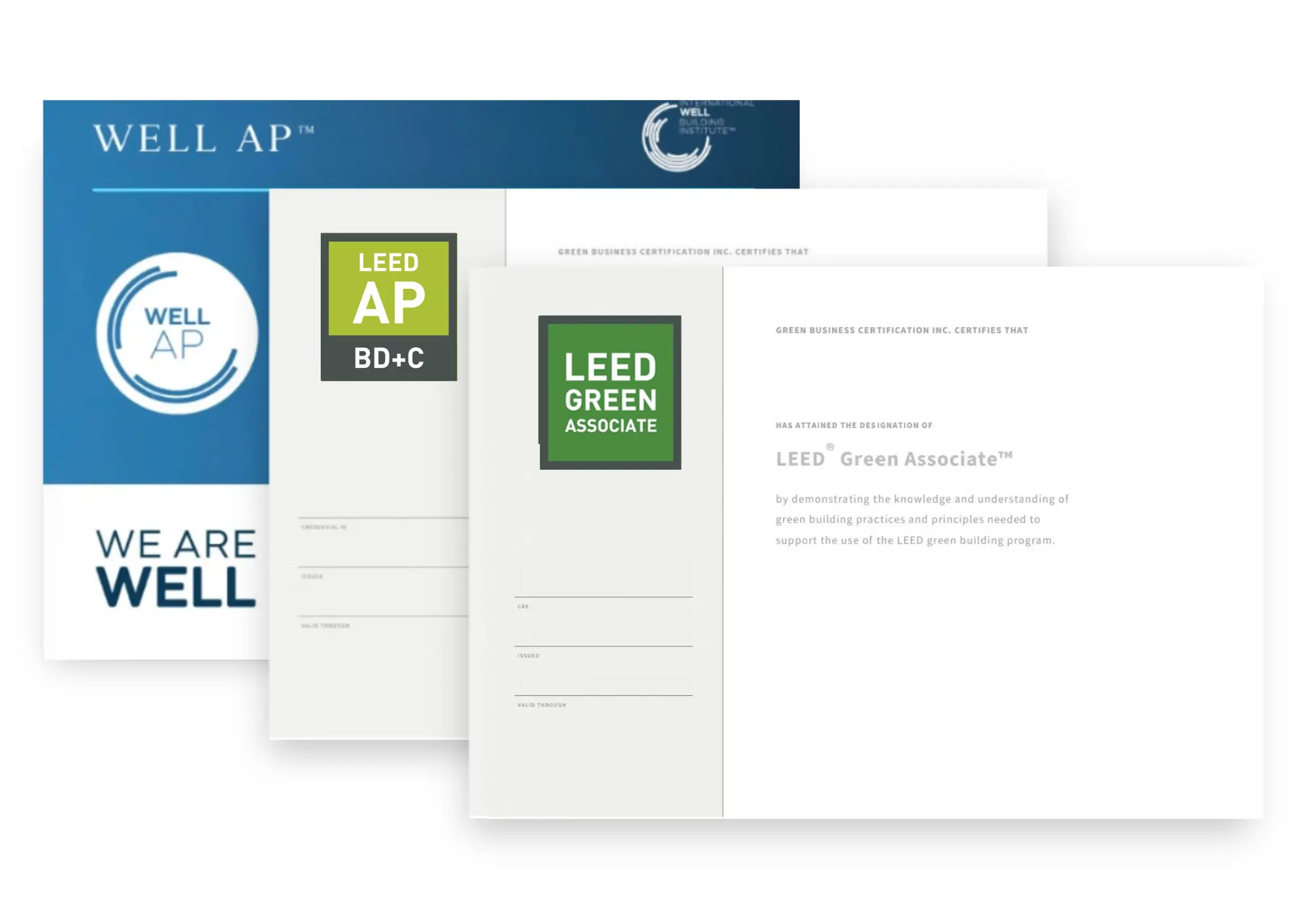
Passing works the same way as with the LEED credentials, and people often describe themselves as “WELL AP certified” from then on. You download a digital certificate from your WELL account and may use the WELL AP logo, for example in your email signature. Your name also appears in the public WELL directory, where employers and clients can verify it.
How to write WELL AP after your name
| Where | Write this | Not this |
|---|---|---|
| After your name | Jane Smith, WELL AP | Jane Smith, WELL Certified |
| With a LEED AP | Jane Smith, LEED AP BD+C, WELL AP | Jane Smith, LEED and WELL Certified |
| With a LEED Green Associate | Jane Smith, LEED Green Associate, WELL AP | Jane Smith, LEED GA, WELL AP |
| Resume, certifications section | WELL AP, International WELL Building Institute | WELL Certification |
| LinkedIn, licenses and certifications | WELL Accredited Professional (WELL AP), issued by IWBI | WELL Certified Professional |
The rule matches LEED: buildings are WELL certified, and people are WELL APs. IWBI does not stress this as strongly as USGBC does, yet writing it correctly looks more professional.
Keeping the WELL AP active
The credential lasts two years. To renew it, you report 30 continuing education hours in that period, at least 6 of them WELL specific, and pay the $125 renewal fee. IWBI sets out the details in Maintain your WELL AP credential.
Some of those hours can come from the WELL community itself. IWBI’s post Earn CE hours in the WELL Forum explains that taking part in the forum counts.
It is recommended to keep the credential active, because letting it lapse means paying for and passing the exam again.
Where the WELL AP fits with LEED credentials
One does not replace the other. LEED covers a building’s impact on the environment and WELL covers its impact on people, and many projects now pursue both. About a third of Archiroots WELL AP students also prepare for a LEED credential.
WELL has no entry level credential like the LEED Green Associate certification; it goes straight to the WELL AP. The order Shadi AbouSamra usually suggests:
- LEED Green Associate first. It has the least material and lays the foundation.
- WELL AP next. Its concepts are new and engaging, and they build on that LEED foundation.
- A LEED AP last. It takes the Green Associate material into technical detail. See what a LEED AP is for the five specialties.
Other routes work too. Some people stop at the LEED Green Associate and the WELL AP, some earn all three, and some finish the LEED track before starting WELL.
Is the WELL AP recognized outside the United States?
Yes. The exam and the credential are the same everywhere, and IWBI counts people in 138 countries.
The United States, Canada and the UK are the largest markets. Growth there comes from new construction, from countries with diverse populations, and from large corporations that invest in sustainability and in their employees’ well-being. WELL is also emerging in Europe, where many projects target WELL Certification while LEED is less common.
Who wrote this guide
Shadi AbouSamra, who teaches the Archiroots courses, is a WELL AP and a member of IWBI’s WELL Faculty. His WELL Faculty profile is listed in the IWBI directory.
He came to WELL through a family member who manages construction projects in Europe. Many of those projects were being certified under WELL, and he wanted to learn more. Once he read the concepts, optimizations and features he was hooked, and the many similarities with LEED made the move easy. IWBI tells the full story in Rooted in education: How Shadi AbouSamra is cultivating a global movement for healthy buildings.
IWBI also lists the Archiroots WELL AP Exam Training and the Archiroots sample practice exam in its own resources library.
Frequently asked questions
What is a WELL AP?
A WELL AP is a person who has passed the IWBI exam on the WELL Building Standard. It is the professional credential for WELL and has no prerequisites beyond being 18 or older.
What does WELL AP stand for?
WELL Accredited Professional. The International WELL Building Institute (IWBI) awards it.
Is a WELL AP the same as WELL Certification?
No. People earn the WELL AP. Buildings and spaces earn WELL Certification, at Bronze, Silver, Gold or Platinum.
How much does the WELL AP cost?
The exam costs $299, or $150 for students. Groups of 10 or more pay between $164 and $213 each. Renewal every two years costs $125.
Is there a WELL AP discount code?
No. IWBI does not publish discount codes. The official savings are the student price, group pricing and a discount for staff of IWBI member organizations.
Is the WELL AP worth it?
For people working on interiors, offices, healthcare and workplaces, yes. It is still a rare credential, it appears in job ads next to LEED, and a WELL AP on the team earns a project a point toward WELL Certification.
Can students become WELL APs?
Yes. There is no degree requirement, and students pay a reduced exam fee of $150.
What is the WELL AP pass rate?
IWBI does not publish an official pass rate. Passing full practice exams under timed conditions before booking is the best guide to being ready.
How long does the WELL AP last?
Two years. It is renewed with 30 continuing education hours, 6 of them WELL specific, and a $125 fee.
Can you hold the WELL AP and a LEED credential together?
Yes, and it is recommended, because one does not replace the other. A common order is the LEED Green Associate first, then the WELL AP, then a LEED AP.