What is LEED? LEED stands for Leadership in Energy and Environmental Design, and it is the most widely used green building rating system in the world. Developed by the USGBC and administered by GBCI, it is a framework for designing, constructing, operating and maintaining buildings that are healthy, efficient and low in environmental impact.
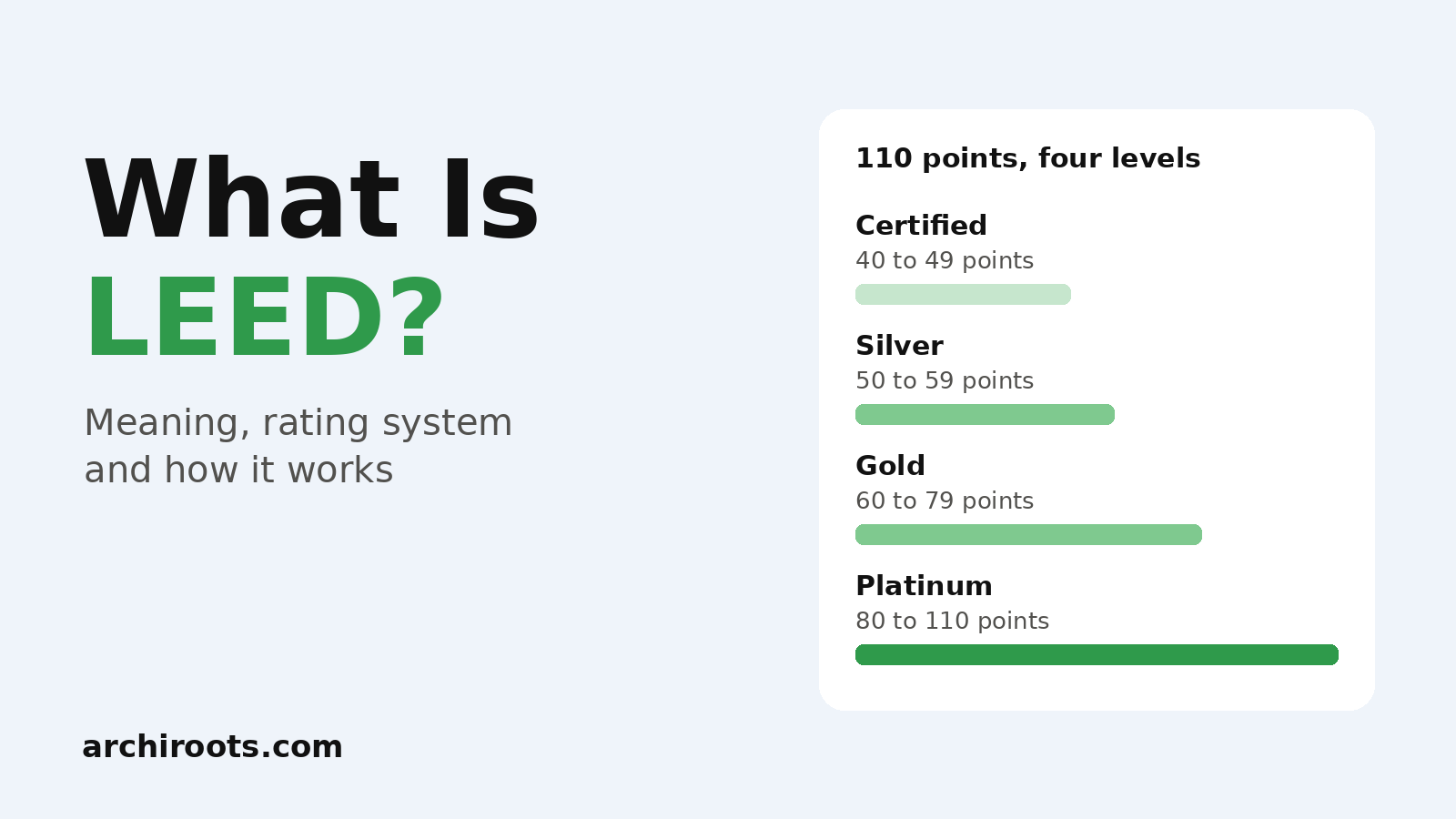
A project earns points for the choices it makes about site, water, energy, materials and indoor environment, and the total out of 110 decides whether it is LEED Certified, Silver, Gold or Platinum. The same program also issues professional credentials, the LEED Green Associate and the LEED AP, to the people who apply it.
That is the one-paragraph answer to what is LEED. The rest of this guide covers what the system actually measures, how the points work, what the different rating systems are for, what changed with LEED v5 and with the v4 deadline, what expires and what does not, and the five things most people get wrong about LEED.
| What is LEED in 60 seconds | |
| What it is | A voluntary green building rating system, not a law or a code |
| Who runs it | USGBC writes it; GBCI reviews projects and issues credentials |
| How it scores | Up to 110 points; Certified 40, Silver 50, Gold 60, Platinum 80 |
| Most common outcome | Gold (36% of certified projects); Platinum is 11% |
| Current version | LEED v5, ratified March 2025; v4 and v4.1 registration closes June 30, 2027 |
| How long it takes | Median 37.5 months for new construction, 11 months for interiors |
| Does it expire | BD+C and ID+C never; O+M after 3 or 5 years |
| Buildings vs people | Buildings are certified; people are accredited (LEED Green Associate, LEED AP) |
| Where | 158 countries; 60% of 2025 certifications were outside the US |
LEED meaning: what LEED is and who runs it
The acronym is Leadership in Energy and Environmental Design. The program began as a pilot in 1998, five years after a group of architects, engineers and environmentalists founded USGBC in 1993, and the first widely adopted version, LEED 2.0, arrived in 2000. Since then it has gone through LEED 2009, LEED v4 in 2013, LEED v4.1 in 2019 and LEED v5, which USGBC members ratified on March 28, 2025. The full timeline is in the history of LEED.
| Year | Milestone |
| 1993 | USGBC founded |
| 1998 | LEED pilot (v1.0) tested on 19 projects |
| 2000 | LEED 2.0, the first widely adopted version; GSA adopts LEED for federal projects |
| 2008 | GBCI created to run certification and credentials independently |
| 2009 | LEED 2009 (v3): 100-point base plus 10 bonus points |
| 2013 | LEED v4 |
| 2019 | LEED v4.1 |
| March 28, 2025 | LEED v5 ratified by USGBC members |
| November 3, 2025 | LEED v5 project certification opens |
| April and June 2026 | LEED Green Associate and LEED AP exams move to v5 content |
| June 30, 2027 | LEED v4 and v4.1 commercial registration closes (extended from June 30, 2026) |
| June 30, 2033 | LEED v4 and v4.1 certification sunset |
Two organizations are involved, and the split matters. USGBC writes the rating systems, publishes the reference guides and runs the membership. GBCI, set up in 2008, does the independent work: it reviews project submissions and awards certification, and it administers the exams and the credentials for professionals. When a building is certified, GBCI certified it. When a person passes the LEED Green Associate exam, GBCI issued the credential.
By USGBC’s own figures, LEED is the most widely used green building rating system in the world.
| LEED by the numbers | Figure |
| Participating projects | close to 100,000 |
| Gross floor area in the program | more than 24 billion square feet |
| Countries and territories with LEED projects | more than 180 |
| Floor area certified on an average day | more than 2 million square feet |
| Professionals who have earned a LEED credential since 2001 | more than 203,000 |
| Maximum points available to a project | 110 |
| Certification levels | 4 |
USGBC’s headline numbers count everything in the program. The public project directory, which anyone can export, is more specific, and the figures below come from Archiroots’ analysis of the full export of 221,643 projects exported on September 7, 2026. They are used throughout this guide and are not published anywhere else.
| USGBC public project directory | Figure |
| Projects listed (certified plus registered) | 221,643 |
| Projects certified with a level | 129,568 |
| Projects registered but not certified | 91,923 (41%) |
| Countries and territories with at least one certified project | 158 |
| Certified floor area recorded in the directory | 15.9 billion square feet |
| Projects listed as confidential | 19% |
| Most common single score among certified projects | 60 points, the Gold minimum |
| Median time from registration to certification, new construction | 37.5 months |
Five things people get wrong about LEED
Most of the confusion about LEED comes down to five assumptions. All five are wrong, and the first four turn up as exam questions.
1. “LEED certified” and “LEED accredited” mean the same thing. They do not. Certification applies to buildings, interiors, neighborhoods and cities: a project registers, documents what it did, is reviewed by GBCI and receives a level. Accreditation applies to people: a professional sits an exam and earns a credential, first the LEED Green Associate, then optionally a LEED AP with a specialty. A building is LEED certified. A person is LEED accredited, never LEED certified. Job posts and résumés mix the two up constantly, which is part of why candidates get it wrong under exam pressure.
2. LEED is a law or a building code. It is neither. Building codes set the legal minimum; LEED is a voluntary standard that sits above code and is adopted by choice. Governments do write LEED into their own rules, the U.S. General Services Administration has required it for new federal buildings since 2000, at Gold since 2010, and many states and cities require it for public projects, but a private owner who never registers a project has broken nothing. LEED documentation is reviewed by GBCI, not by a building inspector, and a project can be fully code compliant and still fail to certify.
3. LEED is only about energy. Energy and Atmosphere is the largest category, but it holds about a third of the points. The rest come from location, site, water, materials, indoor environmental quality and integrative process. A project can reach Gold with an ordinary energy score if it performs well elsewhere, and under LEED v5 the quality of life and ecological conservation impact areas together carry half of all points. Candidates who study LEED as an energy standard consistently lose the process, site and materials questions.
4. LEED only applies in the United States. It was written by a U.S. organisation and the reference guides use U.S. units and ASHRAE standards, but the rating systems, the review process and the credentials are identical in every country. Projects exist in more than 180 countries and territories, USGBC publishes alternative compliance paths for projects outside the U.S., and the Regional guidance change by location so the system can apply anywhere. A LEED Gold plaque in Milan was reviewed against the same credits as one in Chicago.
5. A product can be LEED certified. It cannot. Manufacturers advertise “LEED certified” flooring, paint and glass, and buyers search for it, but USGBC’s position is unambiguous: LEED does not certify, endorse or promote any products, services or companies. Only buildings and spaces are certified. A product can contribute to a credit, for example by carrying an environmental product declaration that counts toward Materials and Resources, or by meeting the low-emitting materials thresholds in Indoor Environmental Quality, but no single product earns a point on its own.
The credit is awarded when a set percentage of everything permanently installed in the building meets the requirement. The correct phrase is “contributes to LEED credits”, and a supplier who says “LEED certified product” has told you something about their marketing, not about LEED.
| What people assume | What is true |
| “LEED certified” and “LEED accredited” mean the same thing | Buildings are certified; people are accredited |
| LEED is a law or a building code | LEED is voluntary and sits above code; codes set the legal minimum |
| LEED is only about energy | Energy and Atmosphere holds about a third of the points; the rest come from six other categories |
| LEED only applies in the United States | Same credits, review and credentials in more than 180 countries and territories |
| A product can be LEED certified | Only buildings and spaces are certified; products contribute to credits |
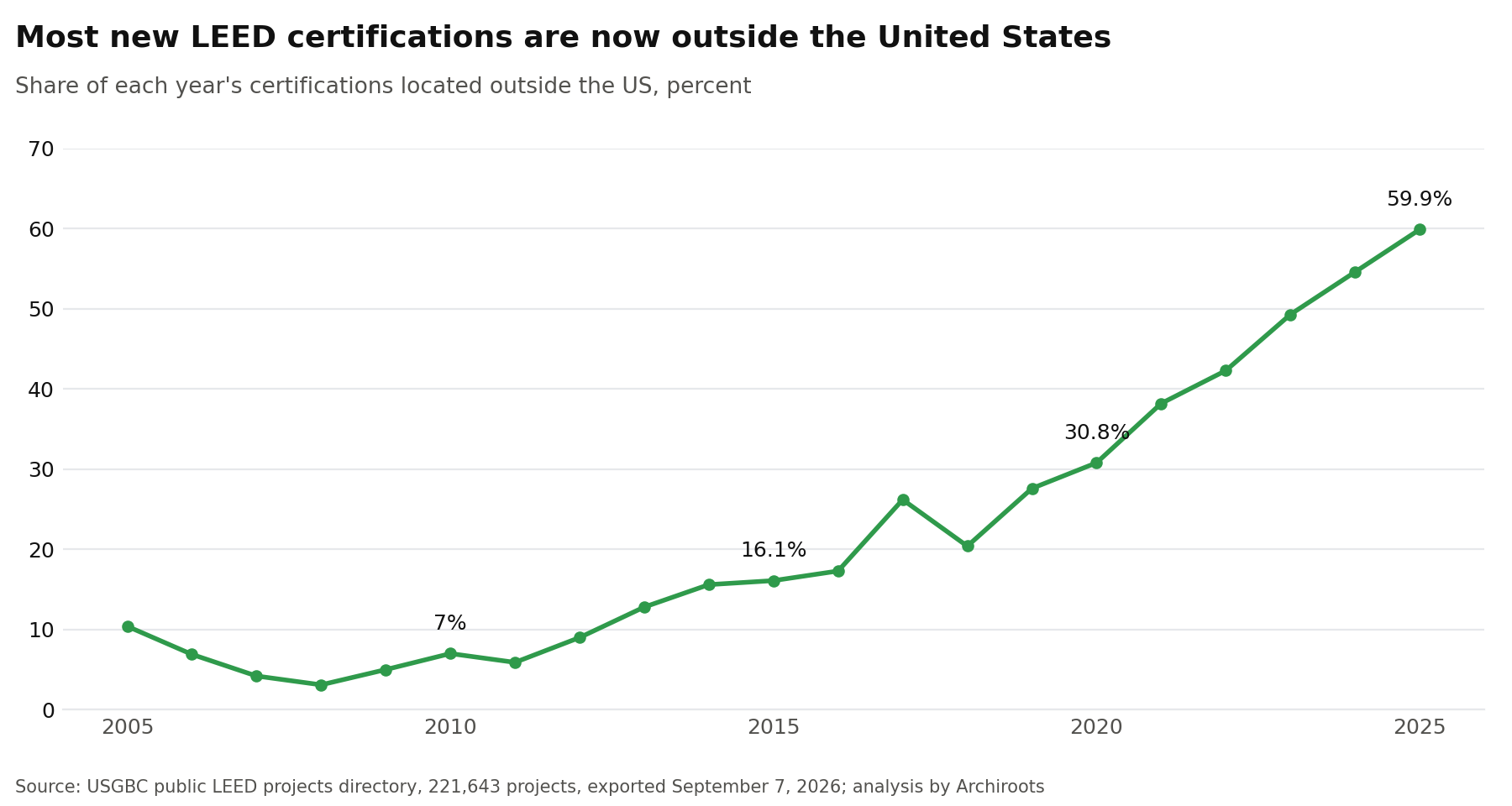
The fourth one deserves a number, because it is changing faster than most people realise. In 2010, 7 percent of the year’s LEED certifications were outside the United States. In 2015 it was 16 percent, in 2020 31 percent, and in 2025, for the first time, a majority: 60 percent of all projects certified that year were outside the US, led by China, India, Canada, Spain, Italy, Brazil and the UAE. The United States still holds 72 percent of everything certified since 2000, but the program’s growth is now international.
| Certified projects, all time | Count | Certified projects, US states | Count | |
| United States | 93,716 | Texas | 13,808 | |
| China | 11,202 | California | 12,413 | |
| Canada | 2,818 | Arizona | 5,950 | |
| India | 2,612 | New York | 4,690 | |
| Saudi Arabia | 1,443 | Ohio | 4,514 | |
| Brazil | 1,269 | Maryland | 3,693 | |
| Spain | 1,237 | Florida | 3,653 | |
| Italy | 1,134 | Colorado | 3,246 | |
| Mexico | 989 | Pennsylvania | 2,987 | |
| United Arab Emirates | 982 | North Carolina | 2,803 |
The next sections are about the building side. The “LEED for professionals” section near the end is about the people side, and the LEED exam guide covers the exams themselves in detail.
How does the LEED rating system work?
LEED is a points system. Under LEED v4 and v4.1 a project can earn up to 110 points: 100 across the main credit categories plus up to 10 bonus points for innovation and regional priority. LEED v5 keeps the 110 total with a slightly different structure, covered below.
Before any points count, a project has to clear two gates:
The first is the Minimum Program Requirements. There are three: the project must be in a permanent location on existing land, it must use a reasonable LEED boundary that includes all the land it actually uses, and it must meet a minimum floor area, 1,000 square feet of gross floor area for most building rating systems.
The second is the prerequisites. Every credit category contains a small number of mandatory items, such as minimum energy performance, minimum indoor air quality performance, indoor water use reduction and construction waste planning. Prerequisites carry no points. A project that misses a single one cannot certify at any level regardless of how many points it has.
Once the prerequisites are met, the credits decide the level:
| Level | Points required (out of 110) |
| LEED Certified | 40 to 49 |
| LEED Silver | 50 to 59 |
| LEED Gold | 60 to 79 |
| LEED Platinum | 80 or more |
Credits are weighted by impact. Optimizing energy performance is worth up to 18 points; installing bicycle facilities is worth one. That weighting is why two projects with very different strategies can both land on Gold, and why the energy category dominates most LEED scorecards. The Minimum Program Requirements, the full point tables and the fee schedule are in the LEED certification requirements guide.
Which level do projects actually reach?
Gold is the most common outcome, not Certified. Of the 129,568 projects in the public directory that hold a level, 36 percent are Gold, 29 percent Silver, 24 percent Certified and 11 percent Platinum. Platinum is rare, but not as rare as its reputation: about one certified project in nine.\
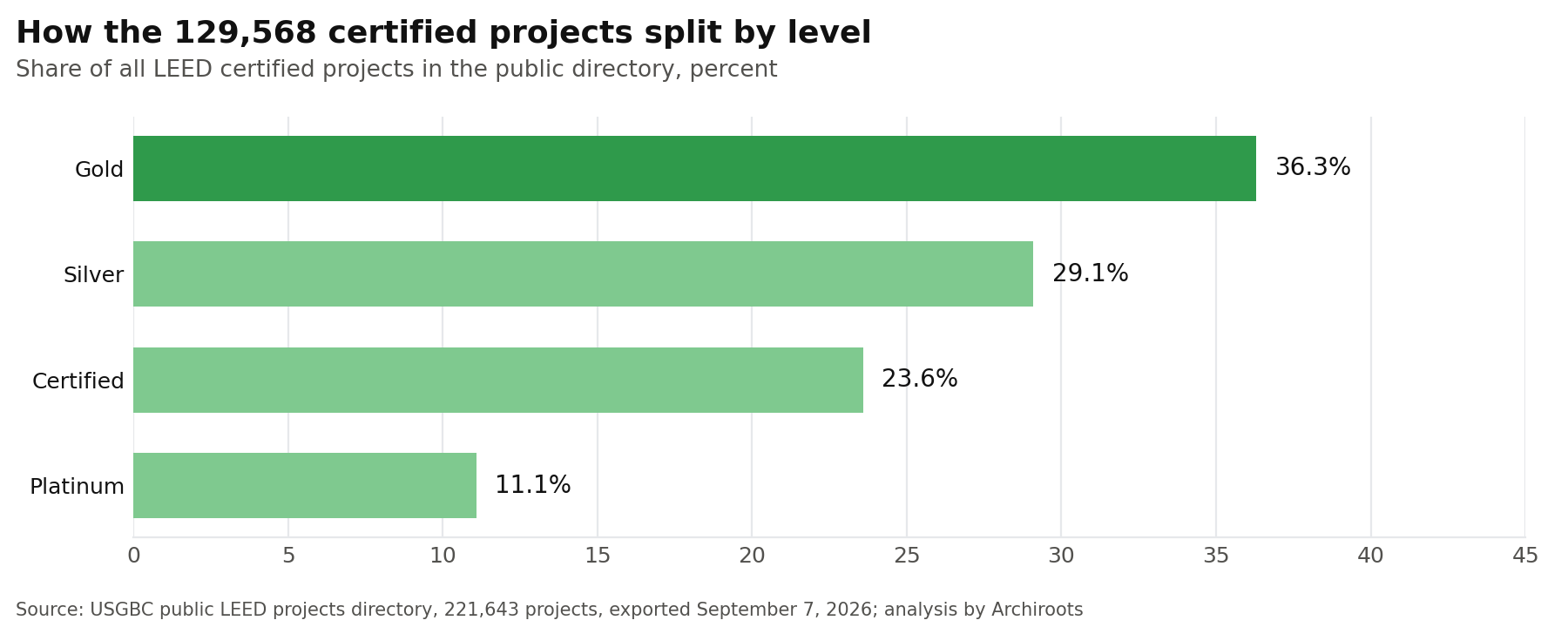
| Level | Points | Share of all certified projects | Average score of projects at this level (110-point systems) |
| Certified | 40 to 49 | 23.6% | 44.3 |
| Silver | 50 to 59 | 29.1% | 52.8 |
| Gold | 60 to 79 | 36.3% | 64.9 |
| Platinum | 80 to 110 | 11.1% | 83.6 |
The level mix depends heavily on the rating system. Existing buildings certified under O+M reach Gold or Platinum 72 percent of the time, because they are scored on measured performance and owners who bother to certify an existing building usually have a good one. New construction under BD+C reaches Gold or Platinum 51 percent of the time. Interiors under ID+C are the most modest, with 42 percent at Gold or above.
| Rating system family | Certified | Silver | Gold | Platinum | Gold or above |
| BD+C (new construction) | 16.6% | 32.7% | 42.4% | 8.3% | 50.7% |
| O+M (existing buildings) | 10.8% | 17.5% | 54.7% | 17.0% | 71.7% |
| ID+C (interiors) | 31.2% | 26.7% | 34.5% | 7.6% | 42.1% |
| Homes and residential | 29.1% | 30.1% | 27.2% | 13.6% | 40.8% |
| Neighborhood Development | 24.9% | 20.2% | 44.0% | 10.8% | 54.8% |
Projects land on the line, not above it
The clearest pattern in the directory is where projects stop. On the 110-point systems (LEED 2009, v4 and v4.1 for BD+C, ID+C and O+M, 63,566 certified projects with a recorded score), the single most common score is exactly 60, the Gold minimum, followed by exactly 50, the Silver minimum. Four projects in ten finish within two points of a threshold, and six in ten within four points. Among Silver projects, more than half sit at 50, 51 or 52.
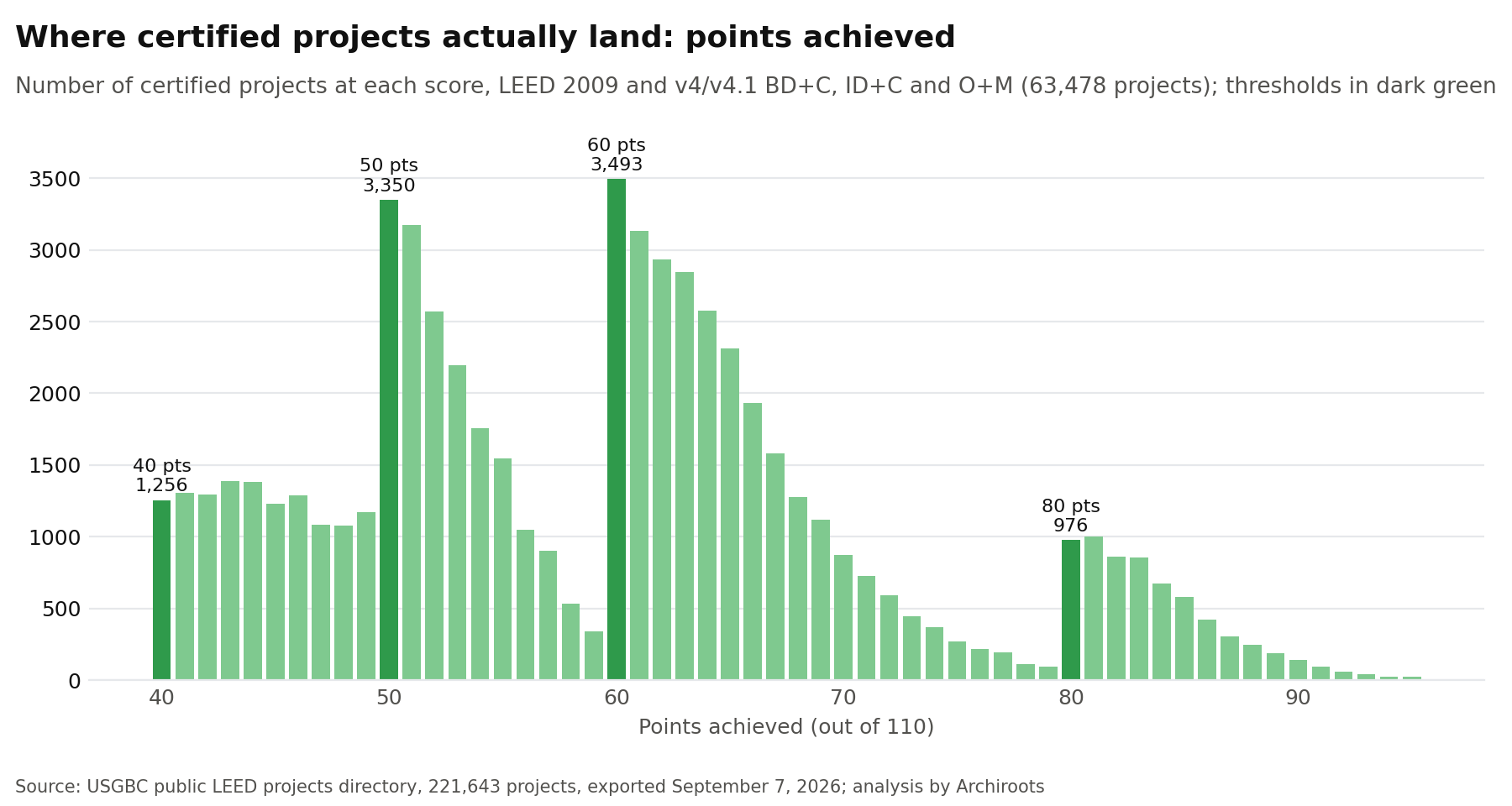
| Level | Share of projects within 2 points of the threshold | Share exactly on the threshold |
| Certified (40) | 30.9% | 10.1% |
| Silver (50) | 52.2% | 19.2% |
| Gold (60) | 35.3% | 12.9% |
| Platinum (80) | 43.7% | 15.0% |
| All four | 39.9% | 14.3% |
This is what a points system does to behaviour. Teams set a target level, pursue credits until the target is reached with a small safety margin, and stop. It is also why the cheapest points on the scorecard, Innovation, Regional Priority and the pilot credits, matter far more than their size suggests: for four projects in ten, those are the points that decided the level. The bicycle shed story below is the rule, not the exception.
What are the LEED credit categories?
Under LEED v4 and v4.1, credits sit in nine categories. The first seven hold the 100 base points; the last two hold the 10 bonus points. The chart and table below use LEED v4 BD+C New Construction, the most used rating system; the other systems shift a few points between categories but keep the same shape.
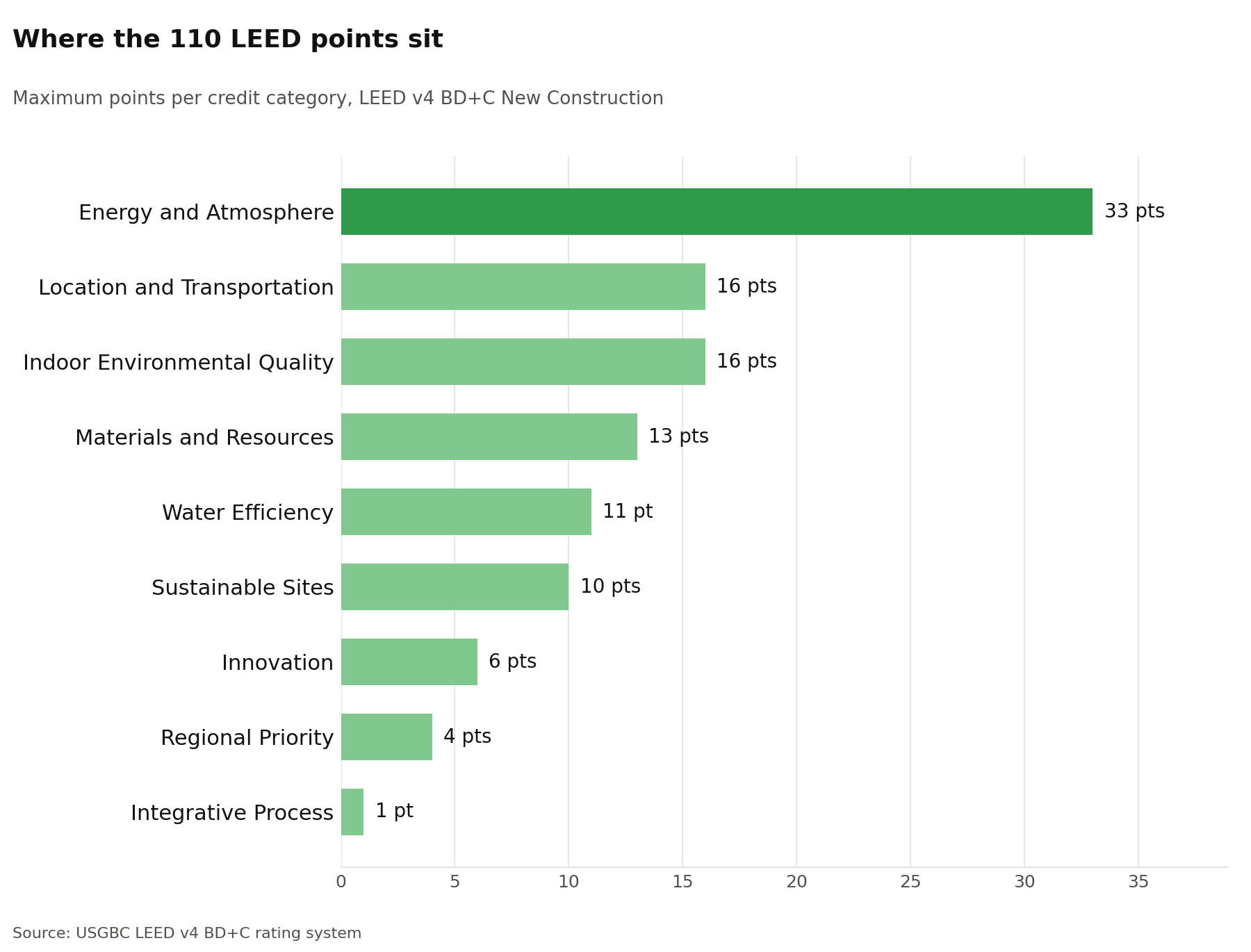
| Category | Maximum points | Share of 110 | Prerequisites |
| Energy and Atmosphere (EA) | 33 | 30% | 4 |
| Location and Transportation (LT) | 16 | 15% | 0 |
| Indoor Environmental Quality (EQ) | 16 | 15% | 2 |
| Materials and Resources (MR) | 13 | 12% | 2 |
| Water Efficiency (WE) | 11 | 10% | 3 |
| Sustainable Sites (SS) | 10 | 9% | 1 |
| Innovation (IN) | 6 | 5% | 0 |
| Regional Priority (RP) | 4 | 4% | 0 |
| Integrative Process (IP) | 1 | 1% | 0 |
| Total | 110 | 100% | 12 |
Two things stand out. Energy and Atmosphere alone is worth more than Silver’s ten-point band three times over, and it also carries a third of the prerequisites. And the two categories that cost the least to pursue, Innovation and Regional Priority, are worth 10 points together, which is the whole distance between the top of Certified and the bottom of Gold.
Integrative Process (IP). One credit that rewards analysing energy and water systems together before design decisions are locked.
Location and Transportation (LT). Where the building is and how people reach it: sensitive land protection, high-priority sites, surrounding density, access to transit, bicycle facilities, reduced parking footprint, green vehicles.
Sustainable Sites (SS). What the project does to the land it occupies: site assessment, habitat protection or restoration, open space, rainwater management, heat island reduction, light pollution reduction.
Water Efficiency (WE). Indoor and outdoor water use, cooling tower water and water metering.
Energy and Atmosphere (EA). The largest category: commissioning, minimum and optimised energy performance, advanced metering, demand response, renewable energy, refrigerant management and green power.
Materials and Resources (MR). Building life-cycle impact, environmental product declarations, sourcing of raw materials, material ingredients and construction and demolition waste management.
Indoor Environmental Quality (EQ). Indoor air quality, low-emitting materials, construction indoor air quality, thermal comfort, interior lighting, daylight, quality views and acoustics.
Innovation (IN). Up to six points for strategies not covered by the credits, exemplary performance, and one point for having a LEED AP on the project team. This is also the door to USGBC’s pilot credit library, a catalogue of credits being tested for future versions of LEED, any of which a registered project can attempt for an Innovation point.
Regional Priority (RP). Up to four points for credits USGBC has identified as priorities for the project’s location. In LEED v5, innovation and regional priority are under the same category called project priority.
How the bonus points work in practice: a Gold closed with a bicycle shed
The Innovation category is where a project a few points short of a level goes looking, and the pilot credits are the part of it most teams never open. An example from a project worked on: a well-known supermarket chain in Italy was pursuing LEED certification and, once the main credits had been documented, was still a few points short of Gold.
Rather than reopen the energy model, the team went through the pilot credit library for something the site could still deliver, and found a pilot credit that fitted. The project built a bicycle maintenance shed stocked with tools, so that staff and customers could fix a flat tire or adjust a chain on site. A shed and a set of tools, against a supermarket, and it closed the gap to Gold.
The Innovation and pilot credits reward things the standard scorecard did not anticipate, and a team that knows they exist has options a team working only from the checklist does not. That is also why the exams test them rather than treating them as a footnote: on a real scorecard, that is often where the last points come from.
The category names matter beyond the scorecard. They are the knowledge domains of the LEED exams, which is why an architect who has never certified a building still learns them: the LEED Green Associate exam prep is organized around them, and the specialty exams go a level deeper into the credits of one rating system.
What are the LEED rating systems?
There is no single LEED checklist. USGBC publishes a family of rating systems, each with its own credits and prerequisites, and a project uses the one that fits what is being built or operated. LEED for Building Design and Construction (BD+C) covers new buildings and major renovations and is where most LEED activity happens. LEED for Interior Design and Construction (ID+C) covers tenant fit-outs. LEED for Building Operations and Maintenance (O+M) covers existing buildings and judges them on measured performance in use.
LEED for Neighborhood Development (ND), LEED for Homes and LEED for Cities and Communities cover developments, residential projects and municipalities. LEED Zero recognizes certified projects that reach net zero carbon, energy, water or waste, and LEED Recertification lets any certified building keep its certification current. The adaptations of each system, for schools, retail, data centers, healthcare and the rest, are listed in the LEED certification requirements guide.
Which systems get used is not what most people expect. By count, homes are the largest family in the directory, because LEED for Homes certifies individual houses and units. Among the commercial systems BD+C leads, but ID+C is growing fastest: interiors were 18 percent of all certifications ever and 30 percent of those awarded in 2025, driven by retail chains certifying every store. The directory holds 6,240 certified fast-food restaurants.
| Rating system family | Share of all certified projects | Share of 2025 certifications | Median project size |
| Homes and residential | 38.6% | 21.8% | 2,200 sq ft |
| BD+C (new construction) | 32.9% | 33.4% | 92,000 sq ft |
| ID+C (interiors) | 18.4% | 30.4% | 6,500 sq ft |
| O+M (existing buildings) | 9.6% | 13.9% | 188,000 sq ft |
| Neighborhood Development, Cities and Communities | 0.4% | 0.5% | not comparable |
What changed in LEED v5, and what happened to the v4 deadline?
LEED v5 is the largest restructuring of the program since LEED v4. USGBC members ratified it on March 28, 2025, GBCI opened v5 project certification on November 3, 2025, and from July 1, 2027, v5 will be the only version open to new registrations for the commercial rating systems.
That last date deserves a correction, because most pages on the internet have it wrong. USGBC originally set June 30, 2026 as the close of LEED v4 and v4.1 registration, and a large number of guides still quote it. In May 2026 USGBC extended the close to June 30, 2027, with the certification sunset, the last date GBCI accepts a first application from a v4 or v4.1 project, moved to June 30, 2033.
LEED v4 Homes, Multifamily, Neighborhood Development and v4.1 Cities and Communities remain open with no close date announced. A project that registers under v4.1 before the close keeps v4.1 for its whole certification; registration locks the version.
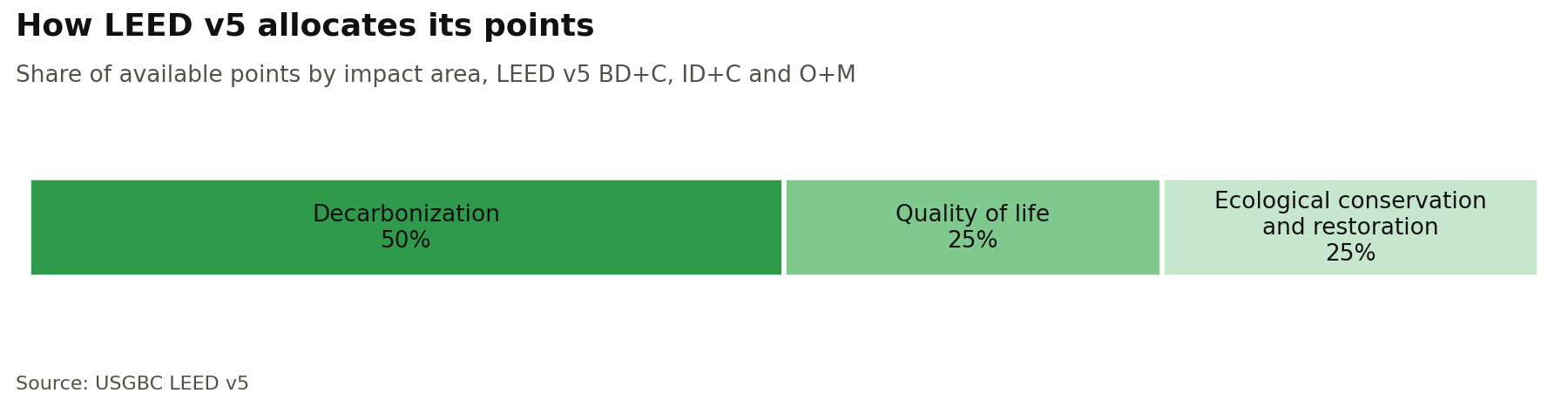
The headline change in v5 is that credits are now organised around three impact areas, with points allocated by how much a credit contributes to each: decarbonization takes half of all available points, quality of life a quarter, and ecological conservation and restoration the remaining quarter. That pushes operational carbon, embodied carbon and refrigerants to the centre of the scorecard, and makes the upper levels hard to reach without a credible decarbonization plan.
The current version is LEED v5, which reorganized the rating system around decarbonization and changed what Platinum requires. What changed in LEED v5 is covered separately.
| LEED v4 and v4.1 | LEED v5 | |
| Organising principle | Nine credit categories | Three impact areas over the same categories |
| Points | 110 (100 base + 10 bonus) | 110 (100 base + 10 Project Priorities) |
| Share of points on carbon and energy | About a third (Energy and Atmosphere) | About half (decarbonization impact area) |
| Assessments required before design | None | Carbon, climate resilience and human impact, all prerequisites |
| Bonus points | Innovation (6) and Regional Priority (4) | Project Priorities (10) from a library by location and context |
| Existing building recertification | Every 3 years under v4.1 O+M | Through Arc on measured data |
| Rating systems available | All | BD+C, ID+C, O+M; ND and Homes stay on v4 |
| New registrations accepted until | June 30, 2027 (commercial) | Current version from July 1, 2027 |
The category structure is recognizable but not identical. Integrative Process becomes Integrative Process, Planning and Assessments, and carries three new prerequisites every v5 project must complete before design is finalized: a carbon assessment, a climate resilience assessment and a human impact assessment. The six main categories continue with revised credits. Innovation and Regional Priority merge into a single Project Priorities category, still worth up to 10 bonus points, drawn from a library of priorities that projects select according to their location and context.
v5 launched for BD+C, ID+C and O+M; Neighborhood Development and Homes remain on LEED v4 for now. For anyone taking a LEED exam, the change already landed: the LEED Green Associate exam moved to v5 content in April 2026 and the LEED AP specialty exams followed in June 2026, so anyone preparing now should study v5 material. The exam side of the transition is covered in the LEED exam guide.
How does a building get LEED certified?
The process is the same across rating systems, and it runs through GBCI.
| Step | Who does it | What happens | Output |
| 1. Register | Owner or consultant | Choose rating system and version, pay the registration fee | Project is “LEED registered”; version locked |
| 2. Set the target | Whole team, ideally before design | Run the scorecard against the site and the budget | Target level and credit list |
| 3. Document | Architect, engineers, contractor, commissioning authority | Upload calculations, drawings, specifications, reports to LEED Online or Arc | Prerequisite and credit submittals |
| 4. Design review (BD+C) | GBCI | Reviews credits that can be verified from drawings | Preliminary findings, one response round |
| 5. Construction review | GBCI | Reviews the rest once the building is complete | Preliminary findings, one response round |
| 6. Award | GBCI | Final review, level awarded | Certificate, plaque, directory listing |
The project team registers the project, choosing the rating system and version, and pays a flat registration fee. The team then documents each prerequisite and credit it is pursuing in LEED Online (or the Arc platform for v5 projects), uploading calculations, drawings, specifications and third-party reports. Most BD+C projects use a split review: a design review of credits that can be verified from drawings, then a construction review of the rest once the building is complete.
GBCI reviewers return preliminary findings, and the team has one opportunity to respond with clarifications before the final review. Where a credit’s language is ambiguous for a project, there are two formal mechanisms: a Credit Interpretation Request, which applies only to that project, and the published LEED Interpretations, which bind all projects. The difference is explained in LEED Interpretation vs CIR. After final review GBCI awards the level, and the project receives its certification and plaque, typically months after the building opens.
How long does LEED certification take?
The directory records both dates, so the answer does not have to be a guess. For new construction the median project is certified 37.5 months after registration, with the middle half of projects taking between 25 and 53 months; that is the design and construction programme plus the review, which is why the number is closer to three years than to the “few months” most guides suggest. Interiors and existing buildings are far quicker, because the review starts on a space that already exists: a median of 11 months for ID+C and just over 10 for O+M.
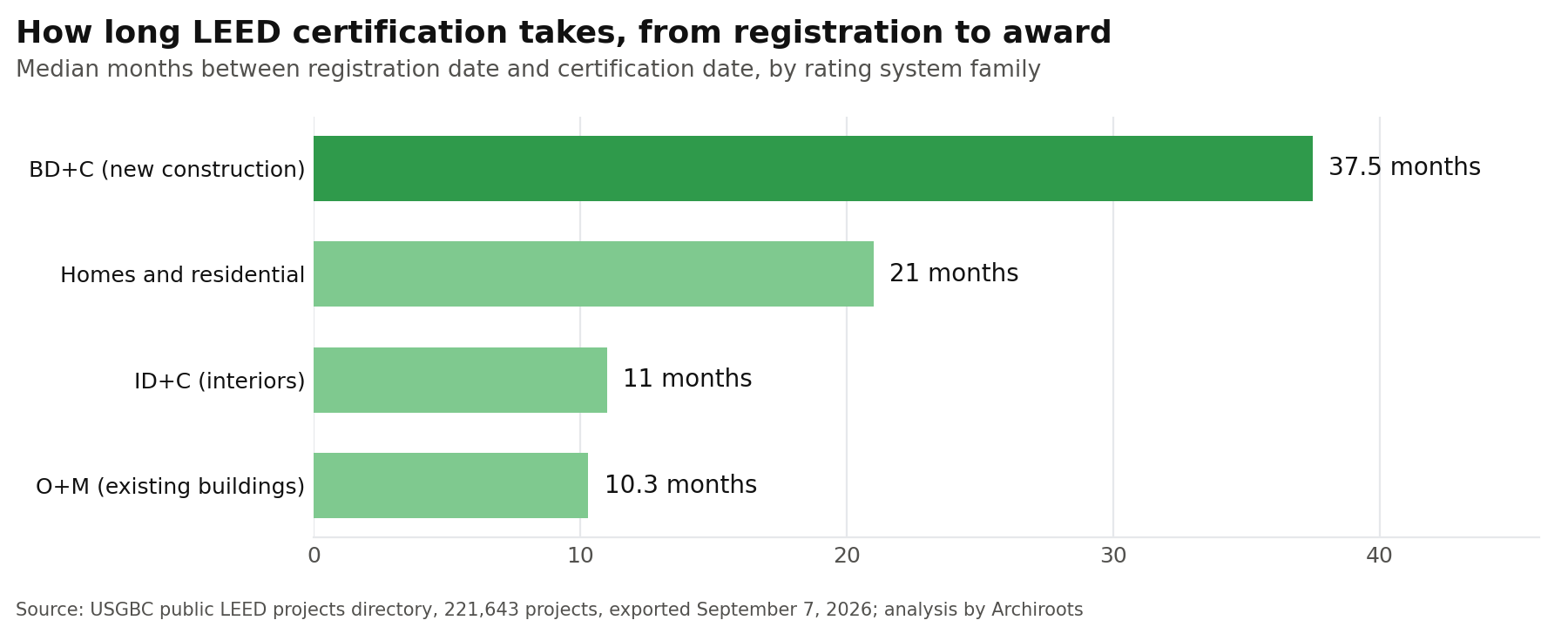
| Rating system family | Median months, registration to certification | Fastest quarter | Slowest quarter | Projects measured |
| BD+C (new construction) | 37.5 | under 25 | over 53 | 42,467 |
| Homes and residential | 21.0 | under 10 | over 36 | 48,913 |
| ID+C (interiors) | 11.0 | under 3 | over 21 | 23,510 |
| O+M (existing buildings) | 10.3 | under 6 | over 19 | 12,358 |
| All certified projects | 22.8 | under 11 | over 40 | 127,248 |
The BD+C figure also moves with the economy. It sat around 37 to 39 months through the 2010s, stretched to 51 months for projects certified in 2021 as construction slowed, and has come back to about 33 to 38 months for projects certified since 2024.
“LEED registered” is not “LEED certified”
Registration is the first step, and it is the cheapest one. A project is “LEED registered” the day the fee is paid, before a single credit has been documented, and it can stay registered for years without ever being reviewed. Developers put “LEED registered” and “designed to LEED Gold” on hoardings and brochures because both are true the moment the project registers.
Neither means the building was certified, and the directory shows how often the process is never completed. Of all projects registered before 2020, which have had at least six years to finish, 35 percent are still not certified. For new construction the figure is 42 percent, and for existing buildings under O+M it is 53 percent: more than half of the existing buildings that registered never earned the plaque.
| Registered before 2020 | Never certified |
| BD+C (new construction) | 42.3% |
| O+M (existing buildings) | 53.1% |
| ID+C (interiors) | 24.6% |
| Homes and residential | 23.7% |
| All projects | 35.0% |
The only reliable check is the USGBC project directory, which lists every certified project with its rating system, version, level and certification date. If a building is not in the directory as certified, it is not certified, whatever the brochure says. The same directory is where a tenant, a lender or a job candidate can verify a claim in under a minute.
| Claim on the brochure | What it actually means | Verified by GBCI? |
| “LEED registered” | The registration fee was paid | No |
| “Designed to LEED Gold” | The team is targeting 60 points | No |
| “LEED compliant” | No official meaning | No |
| “LEED certified” | Reviewed and awarded a level | Yes, listed in the directory |
| “LEED Gold certified, 2024” | Reviewed and awarded Gold, with a date | Yes, listed in the directory |
Project teams certifying for the first time usually put the core team through LEED group training before registration, so that the architect, the engineer and the contractor read the scorecard the same way and the LEED AP on the team is not the only person who understands what is being claimed.
Does LEED certification expire?
It depends on the rating system, and most guides get this wrong. According to USGBC’s maintaining certification page, certifications under BD+C and ID+C do not expire; a building certified LEED Gold in 2012 is still LEED Gold today, even though it was reviewed against a version of LEED that no longer exists. O+M certifications are different because they are based on measured performance: they expire after three or five years depending on the version, and the project has to recertify to keep the status.
| Rating system | Does the certification expire? |
| BD+C (new construction, core and shell, schools, retail, healthcare and the other adaptations) | No |
| ID+C (commercial interiors, retail, hospitality) | No |
| O+M (existing buildings) | Yes, after 3 years (v4.1) or 5 years (older versions); recertification required |
| Any certified building, voluntary | LEED Recertification through Arc, on measured data, available to all |
The practical consequence is that “LEED certified” on its own says nothing about how the building performs now. A BD+C plaque records what the design achieved on paper at handover. A current O+M certification, or a voluntary recertification, records what the building measured last year. Owners who care about the second one recertify; owners who care about the plaque do not. LEED v5 leans on this distinction by moving points toward measured carbon and energy, which is covered below under whether LEED is still relevant.
What does LEED certification cost?
Two kinds of cost, and they are very different sizes. The fees paid to GBCI are the small part.
| Official fee (2026, BD+C) | USGBC member | Non-member |
| Registration, flat | $1,350 | $1,700 |
| Certification review, per square foot, under 250,000 sq ft | $0.064 | $0.076 |
| Certification review, minimum | $3,200 | $3,825 |
| Total official fees for a 50,000 sq ft building | about $4,550 | about $5,525 |
The larger part is the soft cost of documentation, commissioning and energy modelling, plus whatever the design choices themselves add to construction, and that part depends almost entirely on when LEED entered the project. LEED adds no more than about 3 percent to construction cost when the owner, architect, engineers and contractor are in the room from the first meeting with the green strategies set before design, which is what the Integrative Process credit exists to reward. When an owner decides halfway through that the building should be sustainable, and designs and products are changed to fit, the premium goes well past 3 percent, and that late-decision cost is where most of the “LEED is expensive” reputation comes from.
| When LEED enters the project | Typical construction cost premium | Why |
| First meeting, integrative process, target level set before design | Up to about 3 percent | Site, orientation, envelope and systems are chosen once, with the credits in mind |
| After schematic design | Well above 3 percent | Systems resized, materials re-specified, energy model rebuilt |
| During construction | Highest, and credits are lost | Substitutions already installed, documentation missing, prerequisites at risk |
The full 2026 fee tables, by rating system and floor area, and what the cost guides usually leave out, are in the LEED certification requirements guide.
Why do buildings pursue LEED?
Who certifies is the first clue. Of the 71,474 certified projects in the directory whose owner type is stated, six in ten belong to corporations and developers, and investors and REITs account for another one in nine. Government, the group most people associate with LEED, owns 13 percent, and schools and universities 7 percent. LEED is, by a wide margin, a private-sector program.
| Owner of certified projects (where stated) | Share |
| Corporations and developers | 58.7% |
| Government (federal, state, local) | 13.1% |
| Investors and REITs | 10.9% |
| Education (schools, universities) | 7.1% |
| Non-profit and community organisations | 6.7% |
| Individuals | 3.4% |
Owners certify for four reasons, and the mix has shifted over the years. The original argument was operating cost: lower energy and water bills over the life of the building, the easiest case to put in a spreadsheet. The second is policy: federal, state and municipal governments in the United States, and public bodies in many other countries, require LEED or an equivalent for their own buildings and sometimes for private projects above a size threshold. The third is the market: certification is a label that tenants, investors and lenders can read without understanding the engineering behind it, and for institutional owners it feeds directly into ESG reporting, which is what LEED v5’s decarbonization structure was designed around.
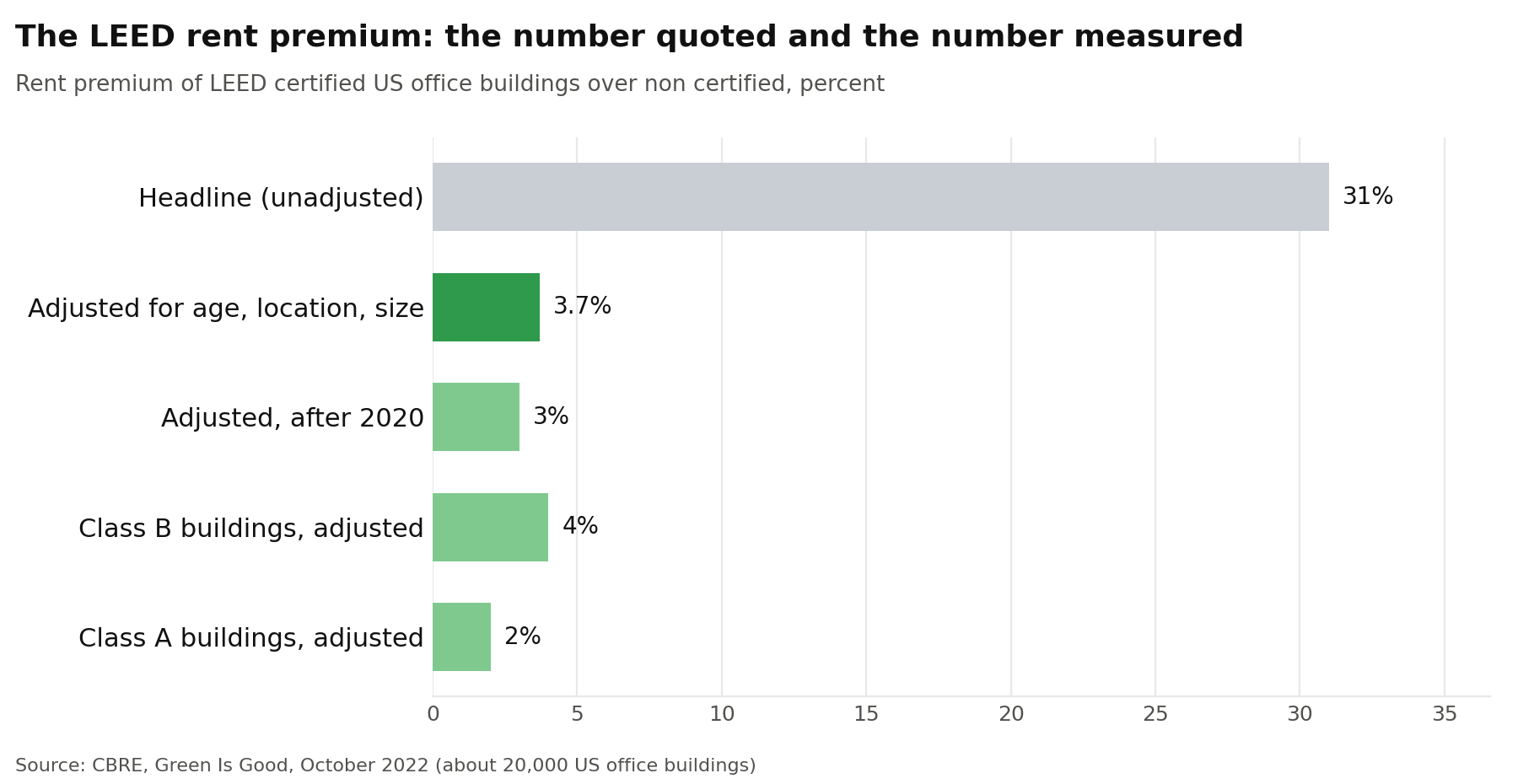
The market argument comes with a number that is quoted everywhere and almost always incompletely. CBRE’s 2022 analysis of roughly 20,000 U.S. office buildings found that LEED certified offices rent for 31 percent more than non-certified ones. That is the figure that ends up in brochures. The same paper reports that once the comparison is adjusted for building age, location, size and renovation, the premium falls to 3.7 percent, and to about 3 percent after 2020.
The honest reading is that LEED buildings are disproportionately newer, better located and better built, and that the certification itself is worth a few percent of rent on top of that, more for Class B buildings than for Class A. A few percent on a large office is still a serious sum, but it is not 31 percent, and anyone making a business case with the headline figure will be corrected by the first analyst who reads the paper.The LEED rent premium: 31 percent unadjusted, 3.7 percent once adjusted for age, location and size, CBRE 2022
| CBRE finding, US office buildings | Rent premium |
| LEED certified vs non certified, unadjusted | 31% |
| Adjusted for age, location, size and renovation | 3.7% |
| Adjusted, 2020 onward | about 3% |
| Class B buildings, adjusted | 4% |
| Class A buildings, adjusted | 2% |
| Sample | about 2,800 LEED certified and 17,700 non certified buildings |
Why a developer with no interest in sustainability chose LEED Gold
One project the Archiroots team consulted on shows how these reasons combine in practice. A developer was applying for a green loan at 2 percent interest, against a standard bank rate of 15 percent in that market, and the amount the lender would advance scaled with the certification level, so the brief was simply the highest level the site could reach. The developer had no particular interest in green building. The loan was the incentive, and the certification was the proof the bank required that the building was in fact green.
The choice came down to LEED or BREEAM, and it was settled on the scorecards before design started. LEED awards points for proximity to public transit, up to five under the LEED v4 credit Access to Quality Transit, which v5 folds into Compact and Connected Development. The site was in a country with no marked bus stops at all. The municipality, however, issued a formal letter confirming that every public road and highway in its jurisdiction was a designated bus stop, and LEED’s documentation path accepted it. BREEAM had no equivalent route. That single difference moved the project’s achievable level, and LEED was chosen.
The building was certified, the loan was drawn at 2 percent, and the finished project sold faster and for more than comparable stock because it was more efficient and healthier than what was on the market beside it. That is the work a sustainability consultant does before the first drawing: read both scorecards against the site, the client’s goal and the three impact areas, and pick the system that delivers the best result on all three bottom lines, profit, efficiency and impact, for a client who may only care about the first.
The fourth reason, increasingly, is the occupants. The Indoor Environmental Quality category, and v5’s quality of life impact area, address air quality, daylight, acoustics and thermal comfort, which is also the overlap with the WELL Building Standard. Where LEED measures a building’s impact on the environment, WELL measures its impact on the people inside it, and a growing number of projects pursue both. The WELL AP exam prep is the credential on that side, and the free WELL AP practice exam is the quickest way to see how different the two systems feel in practice.
What does LEED mean on a construction site?
People search for “LEED in construction” and “LEED for contractors” because most explanations of LEED stop at the design. On site, LEED is a handful of concrete obligations that the general contractor owns, and a project can lose its certification on any of them after the design work is finished.
The first is erosion and sedimentation control, a Sustainable Sites prerequisite that has to be in place from the day ground is broken and documented with dated photographs. The second is the construction and demolition waste management plan, a Materials and Resources prerequisite, with the diversion credits on top of it: the contractor sets up separated waste streams, keeps haul tickets and reports diversion rates by weight or volume. The third is construction indoor air quality management: protecting ductwork and absorptive materials from dust and moisture, sequencing finishes so wet products do not contaminate porous ones, and often a building flush-out or air testing before occupancy.
The fourth is product documentation: the low-emitting materials credit and the Materials and Resources credits require the contractor to collect declarations, certificates and cost data for what was actually installed, not what was specified, and substitutions made on site are where credits quietly disappear. The fifth is commissioning, where the contractor’s subcontractors have to demonstrate that systems perform as designed to a commissioning authority who reports to the owner, not to the contractor.
| What the contractor owns on site | Prerequisite or credit (LEED v4 BD+C) | What has to be documented |
| Erosion and sedimentation control | SS prerequisite, Construction Activity Pollution Prevention | Plan, dated site photographs, inspection log |
| Construction waste | MR prerequisite, Construction and Demolition Waste Management Planning, plus up to 2 credit points | Waste plan, haul tickets, diversion rate by weight or volume |
| Indoor air during construction | EQ credit, Construction Indoor Air Quality Management Plan, 1 point | Duct protection, material storage, sequencing, flush-out or air testing |
| Product documentation | EQ Low-Emitting Materials (up to 3 points), MR Building Product Disclosure credits (up to 6 points) | Declarations, certificates, cost data for installed products |
| Commissioning | EA prerequisite, Fundamental Commissioning; EA credit, Enhanced Commissioning (up to 6 points) | Functional test results reported to the commissioning authority |
This is why the one Innovation point for having a LEED AP on the team is not the reason contractors get their people credentialed. The reason is that a superintendent who understands what a haul ticket has to show, or why a duct has to be sealed the day it is delivered, prevents the loss of credits that the design team already earned on paper. The LEED AP BD+C specialty is the credential for that role.
Is LEED still relevant?
The question has been asked since at least 2016, and it is worth taking seriously, because the criticisms are real. Under LEED 2009 and earlier, most points were awarded for design intent rather than measured results. A 2009 study by the National Research Council of Canada found that LEED buildings used 18 to 39 percent less energy per floor area on average, but that 28 to 35 percent of them used more energy than comparable conventional buildings. Critics called the pattern “point chasing”: teams picking the cheapest credits to reach a level, with the energy model as a prediction that nobody checked afterwards. The gap between designed and measured performance is the strongest argument ever made against LEED.
| The 2009 NRC Canada finding (Newsham, Mancini and Birt) | Result |
| Average energy saving of LEED buildings per unit of floor area | 18 to 39 percent less than conventional counterparts |
| Share of LEED buildings that used more energy than their counterparts | 28 to 35 percent |
| Correlation between certification level and measured energy use | Weak |
Three things have changed since then. LEED v4 added mandatory energy and water metering and a five-year data sharing commitment, so certified buildings report what they actually use. LEED O+M and LEED Recertification moved existing buildings onto measured performance with expiring certifications. And LEED v5 put half the points on decarbonization, made a carbon assessment a prerequisite, and built recertification into Arc on measured data, which is a direct answer to the design-versus-performance critique. Whether the answer is sufficient is a fair debate.
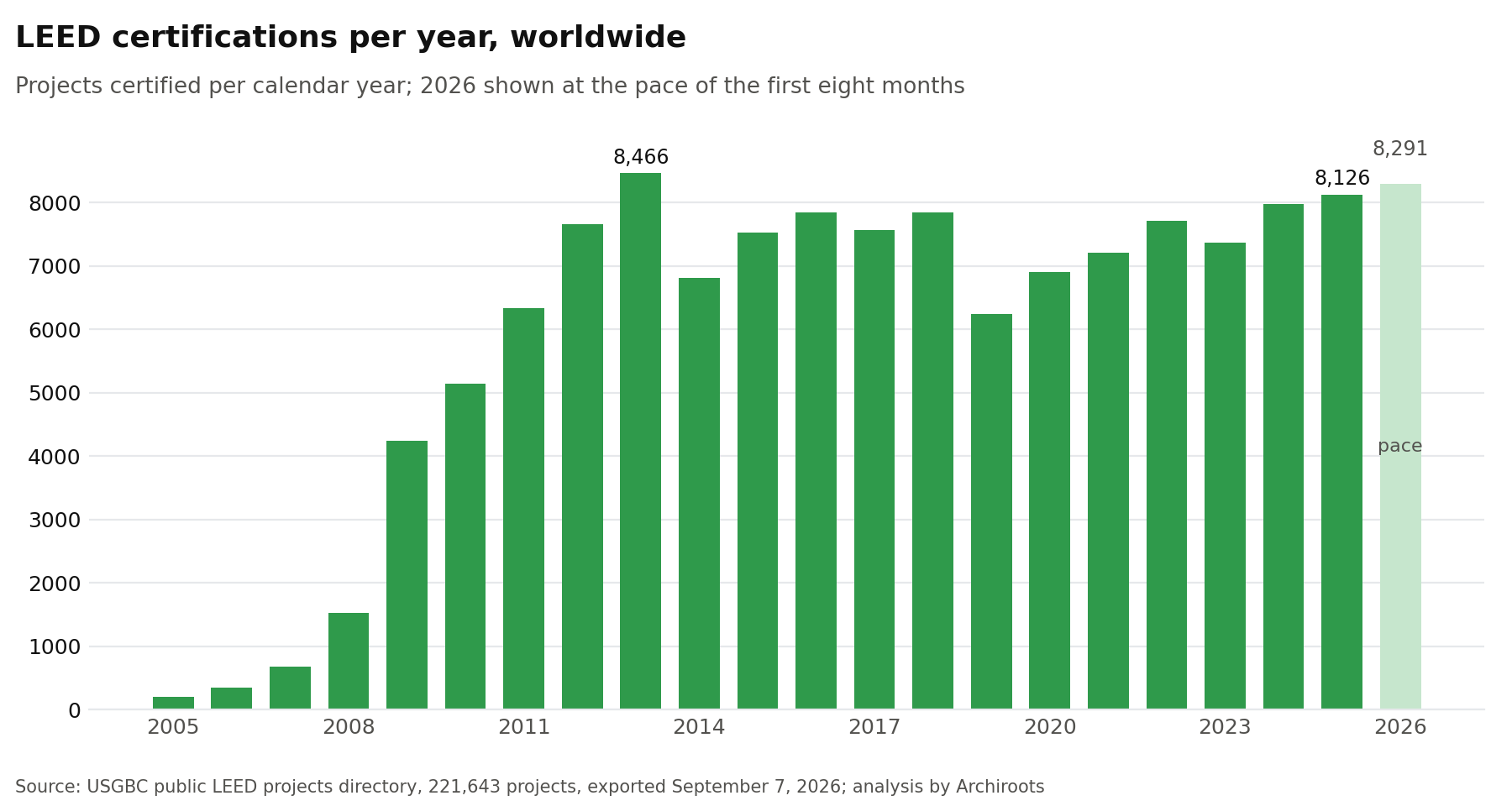
What is not in doubt is the scale, and the direction. Certifications peaked at 8,466 in 2013, dipped to 6,235 in 2019, and have risen every year but one since: 8,126 projects were certified in 2025, the second-highest year on record, and 2026 is running at a pace of about 8,300, which would be a new record. That growth is coming from outside the United States, from interiors and from existing buildings, which is what a program in its third decade looks like when it is still being adopted rather than wound down.
| Year | Projects certified | Share outside the US |
| 2010 | 5,138 | 7% |
| 2013 | 8,466 | 13% |
| 2016 | 7,839 | 17% |
| 2019 | 6,235 | 28% |
| 2022 | 7,706 | 42% |
| 2024 | 7,979 | 55% |
| 2025 | 8,126 | 60% |
| 2026, pace as of September 7 | about 8,300 | 54% so far |
LEED is also written into the procurement rules of the U.S. federal government and most large institutional owners. A rating system can be imperfect and still be the one the market uses, and for anyone working in buildings, “is LEED relevant” is answered by the job postings that require the credential.
LEED for professionals: the credentials
LEED accreditation is the people side of the program. GBCI issues two tiers.
The LEED Green Associate is the entry credential. It certifies a general understanding of green building principles and how the LEED rating systems work, and it has no prerequisites and no minimum age (candidates under 18 need a parent or guardian consent form). It is the correct first step for every profession, including people who will never certify a building themselves, and it is the prerequisite for every specialty.
The LEED AP with specialty certifies applied expertise in one rating system. There are five: BD+C for design and construction, O+M for existing buildings, ID+C for interiors, ND for neighbourhood development and Homes. A candidate must hold an active Green Associate to register. The two specialties most professionals choose are covered in the LEED AP BD+C exam prep and the LEED AP O+M exam prep, and choosing between them is mostly a question of the work you do; LEED GA vs LEED AP vs WELL AP walks through the decision.
Both credentials are maintained with continuing education reported to GBCI: 15 hours every two years for the Green Associate, 3 of them LEED-specific, and 30 hours for a LEED AP, 6 of them specialty-specific. The free LEED CE hours guide covers how to earn them without paying for courses. Exam format, fees, scoring, dates and the v5 exam transition are in the LEED exam guide.
| LEED Green Associate | LEED AP with specialty | |
| Who it is for | Anyone; the entry credential | Professionals working on projects in one rating system |
| Prerequisite | None; no minimum age | Active LEED Green Associate |
| Specialties | None | BD+C, O+M, ID+C, ND, Homes |
| Exam | 100 questions, 2 hours | 100 questions, 2 hours, per specialty |
| Maintenance | 15 CE hours every 2 years, 3 LEED-specific | 30 CE hours every 2 years, 6 specialty-specific |
| Typical preparation | 2 to 3 weeks | 2 to 3 weeks after the Green Associate |
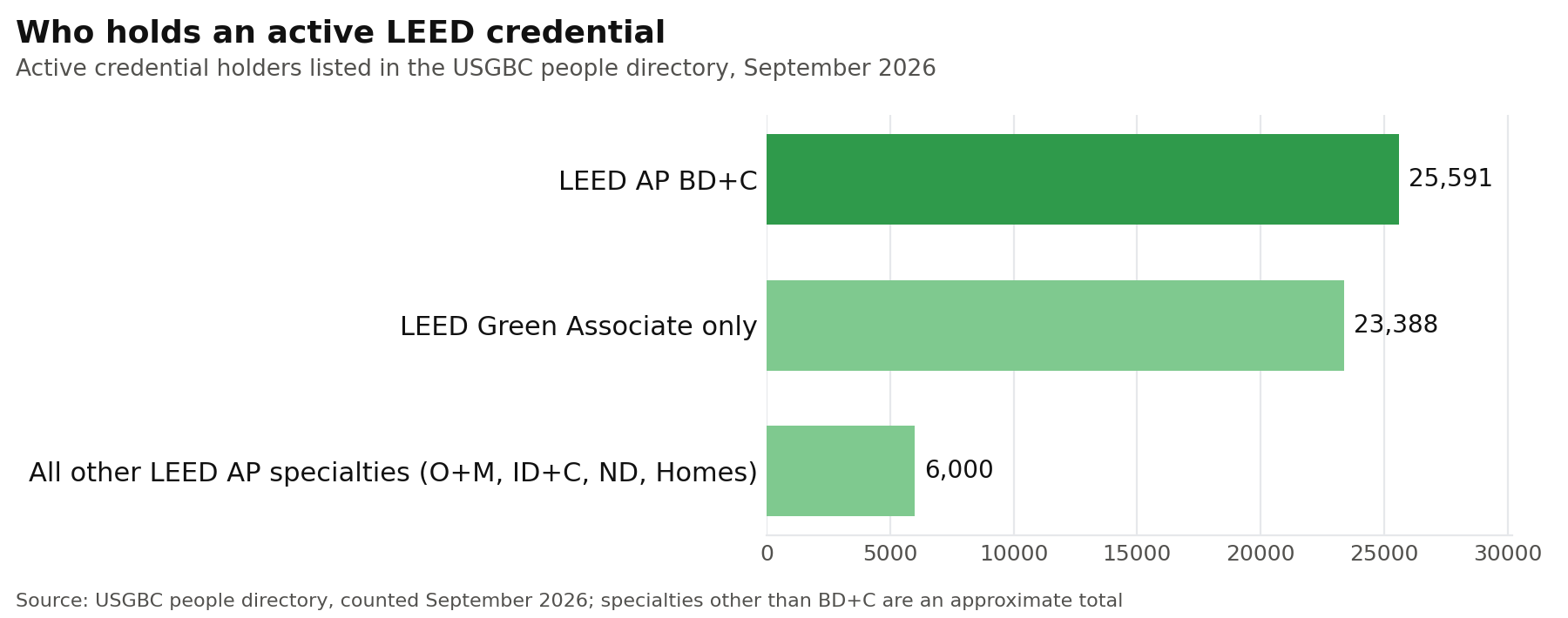
USGBC says more than 203,000 professionals have earned a LEED credential since the program began. The active directory in September 2026 lists 23,388 LEED Green Associates who stopped at that level and 25,591 LEED AP BD+C holders, by far the largest specialty; O+M, ID+C, ND and Homes together account for roughly 6,000 more. Put differently, of roughly 55,000 people with an active credential, about 42 percent stopped at the Green Associate, about 47 percent hold BD+C, and every other specialty combined is about 11 percent.
Who takes the LEED exams: what 7,000 candidates show
Archiroots has prepared more than 7,000 professionals for these exams, and the numbers across them say something about who LEED is for and how people actually approach it. None of the figures below are published by USGBC or GBCI.
Which exam they take. Just over half of candidates, about 55 percent, start with the Green Associate. Around 25 percent go straight to LEED AP BD+C, having earned the Green Associate earlier, 5 percent take LEED AP O+M, and 15 percent sit the WELL AP. Roughly half of the people who pass the Green Associate come back for a specialty, most of them within two years, which lines up with GBCI’s own numbers: the Green Associate is a credential most people pass through rather than stop at.
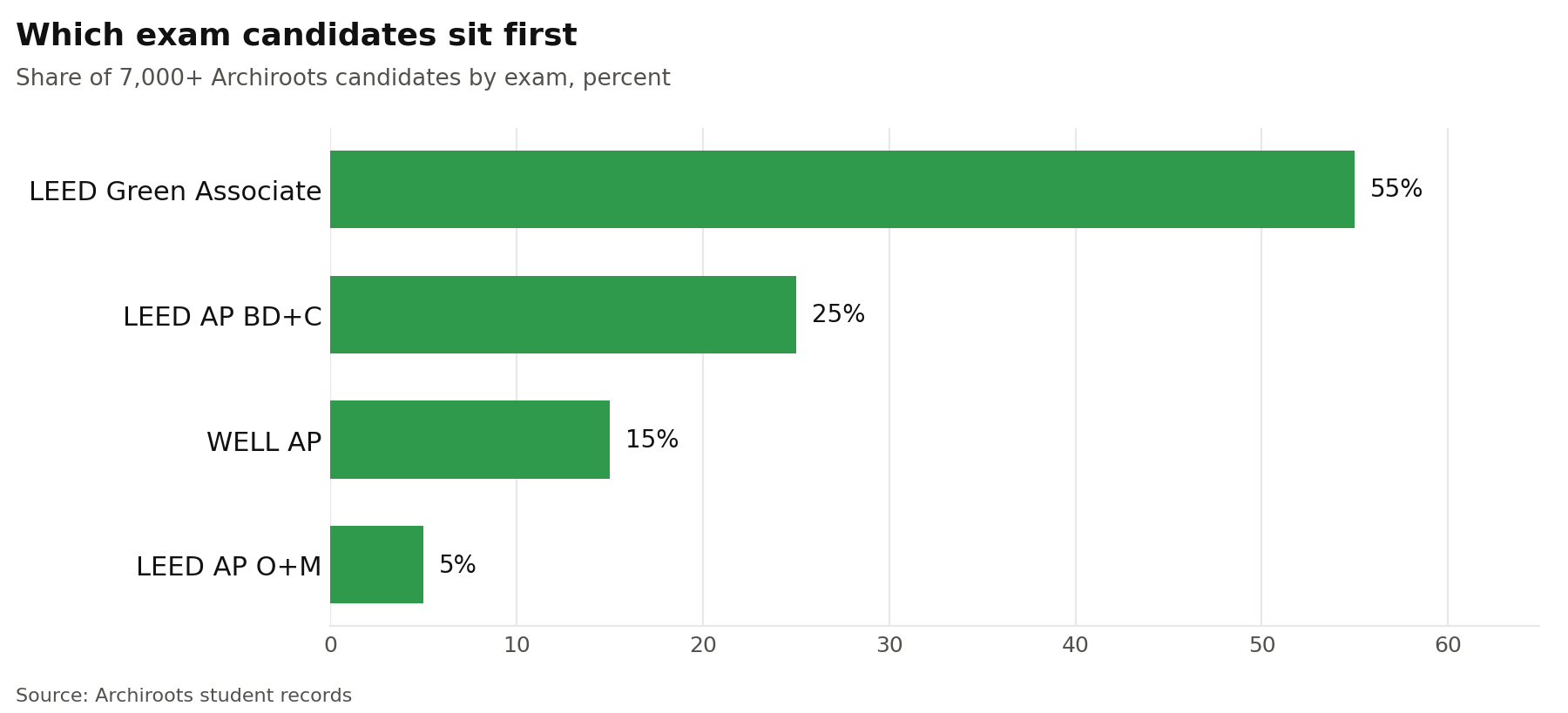
| Exam | Share of Archiroots candidates | Comes back for a specialty later |
| LEED Green Associate | 55% | about half, most within two years |
| LEED AP BD+C | 25% | already hold the Green Associate |
| WELL AP | 15% | often hold a LEED credential as well |
| LEED AP O+M | 5% | already hold the Green Associate |
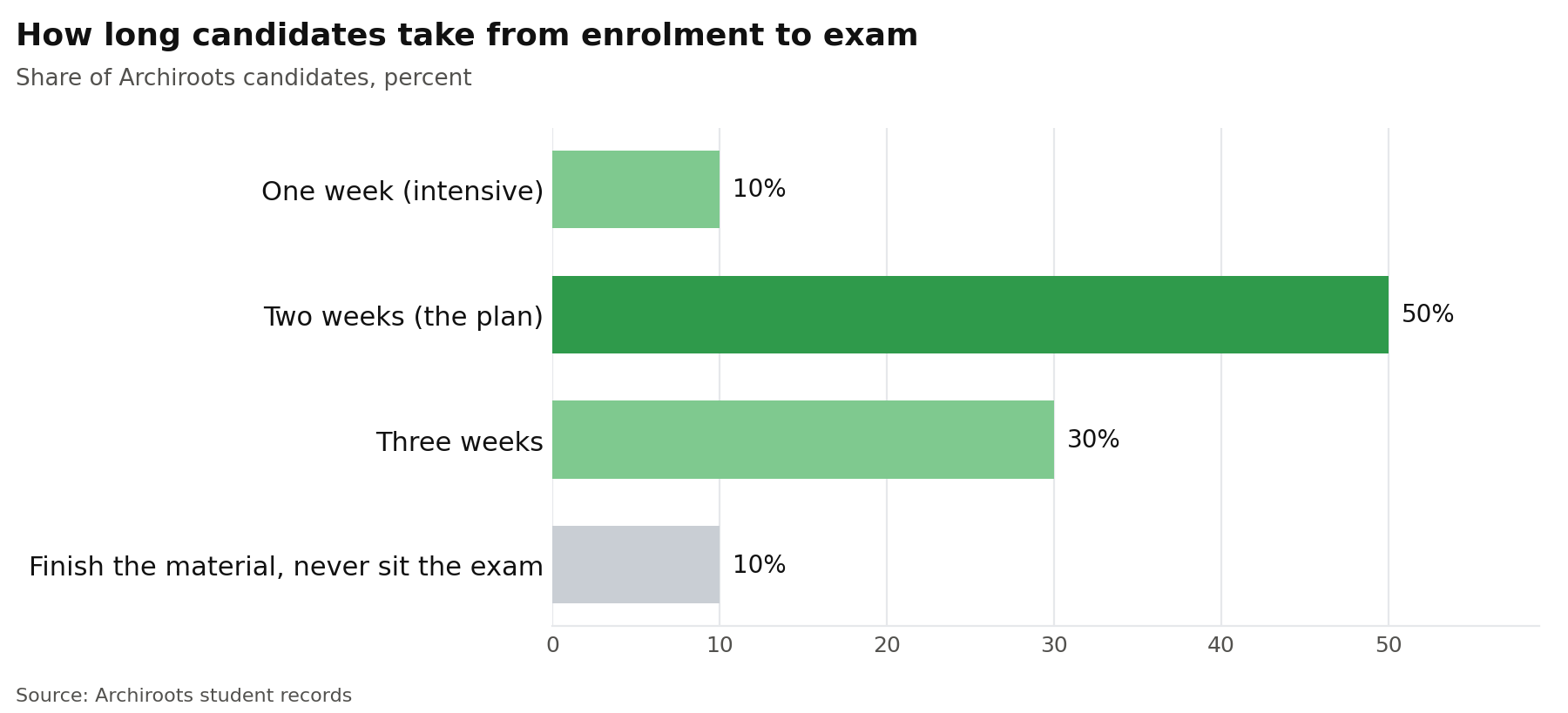
How long it takes. The material is built as a two-week plan: in the first week, 30 minutes a day to finish the training; in the second week, one full practice exam a day with a pass through the flashcards to review what was missed. Measured from enrolment to exam day, about half of candidates follow the plan and sit in two weeks. Three in ten take three weeks, not because they study more but because they skip days.
One in ten goes all in and finishes in a week; they are usually students or people between jobs with the days free. And one in ten finishes the material and never books the exam, because what they wanted was to understand the certification, not to hold the credential, which says something about who reads a page like this one.
| Time from enrolment to exam | Share of candidates | Who they tend to be |
| One week | 10% | Students and people between jobs, studying full time |
| Two weeks | 50% | Candidates who follow the plan every day |
| Three weeks | 30% | Working professionals who skip days |
| Never sit the exam | 10% | People who wanted to understand LEED rather than hold the credential |
| The two-week plan | Daily time | What gets done |
| Week 1 | About 30 minutes | Finish the training, one knowledge domain at a time |
| Week 2 | One practice exam a day, plus flashcards | Seven full-length exams, reviewing every missed question |
| Readiness threshold | 80 percent on full-length practice exams, consistently |
The ones who fail are almost always the 5 to 10 percent who skip the practice exams and book early. Scoring 80 percent on full-length practice exams is the readiness threshold that holds up.
What they find hardest. The hardest domains are consistent.
| Exam | Hardest domains for candidates | Why |
| LEED Green Associate | The LEED process: registration, review, CIRs, interpretations | Administrative material most candidates underestimate |
| LEED AP BD+C | Energy and Atmosphere, Materials and Resources | The most calculation-heavy credits |
| LEED AP O+M | Energy and Atmosphere, Indoor Environmental Quality | Performance metrics and measured data |
Anyone deciding whether to sit an exam can check where they stand in an hour with the free LEED Green Associate practice exam the free LEED AP BD+C practice exam or the free LEED AP O+M practice exam, all written to LEED v5.
Most candidates do not need the reference guide
USGBC sells a reference guide for each rating system, and buying one is the first thing many candidates do. For most of them it is the wrong purchase.
The reference guides are project documents. They are written for teams documenting credits: calculation methods, submittal requirements, referenced standards, worked examples, and they run to several hundred pages each. The exams do not test at that depth. The LEED Green Associate exam tests whether a candidate understands green building principles, the structure of the rating systems, the intent of each credit category and the certification process. The specialty exams go one level deeper, into the credits and prerequisites of a single rating system and how they interact, but still not into the calculation tables that fill the reference guide.
The candidates who pass are the ones who learn the structure, the intents and the process from material built for the exam, then drill practice questions until they hold 80 percent. The reference guide plays no part in that. Where it does earn its price is after the exam, on the first project where a credit has to be documented; buying it then, for the rating system that project uses, makes sense. Buying it as exam preparation mostly does not. The one group who should read it before the exam are candidates already working on a registered project, because for them the exam and the job are the same material.
How does LEED compare with other rating systems?
LEED is the most widely used green building rating system but not the only one. BREEAM, developed in the United Kingdom in 1990, predates it and dominates the UK and much of Europe; Green Star is the reference system in Australia, DGNB in Germany and CASBEE in Japan. Passive House certifies energy performance to a fixed standard rather than a points scale, and the Living Building Challenge sits above all of them in ambition.
ENERGY STAR, which is often confused with LEED in the United States, is a government program that scores a building’s measured energy use against its peers and certifies the top quarter; it covers energy only, and a LEED project typically uses its score inside the Energy and Atmosphere category.WELL and Fitwel certify health outcomes for occupants rather than environmental performance, and are usually pursued alongside LEED rather than instead of it. LEED’s advantage is that a Gold plaque means the same thing in Chicago, Dubai and Singapore, which is why multinational owners standardise on it even where a local system exists.
Choosing between systems is a scorecard exercise done before design rather than a matter of preference: the same site can reach a different level under each one, as the transit example above shows, and a consultant who runs both scorecards against the site before the first drawing is doing the single most valuable piece of LEED work on the project.
| System | Origin | What it measures | How it scores | Usually pursued |
| LEED | USGBC, United States, 1998 | Environmental impact of the building, site and operations | 110 points, four levels | Worldwide; the default for multinational owners |
| BREEAM | BRE, United Kingdom, 1990 | Environmental impact | Weighted percentage, five levels | UK and Europe |
| WELL | IWBI, United States, 2014 | Health and wellbeing of occupants | 110 points, four levels | Alongside LEED |
| ENERGY STAR | US EPA, 1999 | Measured energy use only | 1 to 100 score, certified at 75 or above | Existing US buildings, often inside LEED |
| Passive House | Germany, 1996 | Energy demand of the envelope and systems | Fixed thresholds, pass or fail | Housing and small buildings |
| Green Star | GBCA, Australia, 2003 | Environmental impact | Star rating | Australia and New Zealand |
| Living Building Challenge | ILFI, United States, 2006 | Regenerative performance over a year of occupancy | Petals, all or nothing | Flagship projects |
A comparison of the ten most common systems is in the top green building certifications.
About the data in this guide
Most pages that answer what is LEED rely on USGBC’s headline numbers. The directory figures come from the public LEED projects directory export available from USGBC, downloaded on September 7, 2026: 221,643 projects with their rating system, level, points, registration date, certification date, location, owner type and floor area. Projects marked Denied, Bronze or Pioneer (103 in total) were excluded from level shares. Registration-to-certification times use the two dates in the directory and exclude records with a missing or negative interval.
The score analysis is limited to the 110-point systems (LEED 2009, v4 and v4.1 for BD+C, ID+C and O+M) so that thresholds are comparable. Floor areas recorded in square metres were converted to square feet. Candidate figures come from Archiroots’ own enrolment and exam records. Anyone can repeat the analysis from the same export.
Frequently asked questions
What does LEED stand for?
Leadership in Energy and Environmental Design. It is a green building rating system developed by the U.S. Green Building Council and administered by GBCI.
What are the 7 criteria for LEED?
The seven main credit categories that hold the 100 base points under LEED v4 and v4.1: Integrative Process, Location and Transportation, Sustainable Sites, Water Efficiency, Energy and Atmosphere, Materials and Resources and Indoor Environmental Quality. Innovation and Regional Priority add up to 10 bonus points, which is why some sources count nine categories. LEED v5 keeps the same families of credits but groups them under three impact areas: decarbonization, quality of life, and ecological conservation and restoration.
How does a person get LEED certified?
A person does not get certified; a person gets accredited. The route is to register with GBCI for the LEED Green Associate exam, which has no experience requirement, study the exam content areas for two to four weeks, pass the 100-question exam, then optionally sit a LEED AP specialty exam such as BD+C or O+M. The credential is maintained with continuing education hours every two years.
Is LEED certification worth it?
For an owner, it depends on the market and the policy context: public projects often have no choice, and for private offices CBRE’s adjusted figures put the rent premium at a few percent, more for Class B buildings than Class A. For a professional, the LEED credentials are the most widely requested sustainability credentials in building job postings, and the Green Associate takes most candidates a few weeks.
What are the four levels of LEED certification?
Certified, Silver, Gold and Platinum, in ascending order, decided by the number of points a project earns out of 110 after meeting every prerequisite.
What is the difference between LEED certified and LEED accredited?
Buildings are certified; people are accredited. A LEED certified building has been reviewed by GBCI and awarded a level. A LEED accredited professional has passed the LEED Green Associate exam or a LEED AP specialty exam.
What is the difference between LEED registered and LEED certified?
Registered means the project has paid the registration fee and declared its intent. Certified means GBCI has reviewed the documentation and awarded a level. Only certified projects appear in the USGBC project directory.
Does LEED certification expire?
BD+C and ID+C certifications do not expire. O+M certifications expire after three or five years, depending on the version, and must be renewed through recertification. Any certified building can also recertify voluntarily on measured performance.
How long does LEED certification take?
For a new building, a median of 37.5 months from registration to certification across 42,467 certified BD+C projects, because the clock includes design and construction. Interiors take a median of 11 months and existing buildings about 10. For a person, most candidates go from enrolment to a passed LEED Green Associate exam in two to three weeks.
How many LEED certified buildings are there?
The USGBC public project directory listed 129,568 certified projects in September 2026, including 49,949 homes and residential units, across 158 countries and territories. Another 91,923 projects are registered but not certified.
What share of LEED projects are Platinum?
About 11 percent. Gold is the most common level at 36 percent, followed by Silver at 29 percent and Certified at 24 percent. Existing buildings certified under O+M reach Platinum most often, at 17 percent.
Can a product be LEED certified?
No. USGBC does not certify products, services or companies. A product can contribute to a LEED credit when it meets a requirement of that credit, but the credit is earned by the building, not the product.
Is LEED a law or a code?
No. LEED is a voluntary rating system. Building codes set the legal minimum; LEED sits above code and is adopted by choice, although many public bodies require it for their own buildings.
What is the newest version of LEED?
LEED v5, ratified in March 2025. Project certification under v5 opened in November 2025, and from July 1, 2027, it will be the only version available for new commercial registrations. The LEED v4 and v4.1 registration close was extended from June 30, 2026 to June 30, 2027.
Is LEED only used in the United States?
No. Certified projects exist in 158 countries and territories, and in 2025, 60 percent of the year’s certifications were outside the US, up from 7 percent in 2010. The rating systems are written by a US organisation, but the credits, the review process and the credentials are the same everywhere.
What are examples of LEED certified buildings?
Well-known certified projects include the Empire State Building in New York, which earned LEED Gold under the existing buildings rating system in 2011, and Taipei 101, which earned LEED Platinum the same year. The typical certified project is far less famous: the directory holds 6,240 certified fast-food restaurants and close to 50,000 homes. Every certified project is listed with its level and date in the USGBC project directory.
Is it spelled LEED or lead?
LEED, in capitals, with two Es. It is an acronym and is pronounced “lead” as in “to lead”, which is why it is so often misspelled. “Lead certification” and “lead certified building” in a search or a résumé refer to the metal or to leadership, not to the rating system.